Another surprise from Jobbo. Thank you so much! This one arrived in early January. It's such a lovely view, too, I love the cherry blossoms! It's spring here as well now, although I haven't seen too many blossoming trees yet. There are lots of daffodils, though. :) ...and it's almost Easter, woo! I'm looking forward to hopefully spending a bit more time with Matt (and trying not to eat too much chocolate.... although to be honest, I'm looking forward to my homemade attempt of 'pasha' a lot more :P).
Now, I'm not sure if the name on the card refers to a city or a county in Taiwan. Chiayi is a provincial city located in the plains of southwestern Taiwan. Chiayi County, then, is a county in southwestern Taiwan surrounding but not including Chiayi City. It is the sixth largest county in Taiwan.
Likewise, I'm not sure whether 'Alishan' refers to the Alishan National Scenic Area (a mountain resort and natural preserve located in the mountains of Chiayi County), the Alishan Range (a mountain range in the central-southern region of Taiwan) or the Alishan Forest Railway (which I've written about here before... and actually, these two postcards look like the photos were taken in the exact same spot, hhmmmm...).
Showing posts with label taiwan. Show all posts
Thursday, 24 March 2016
Tuesday, 9 February 2016
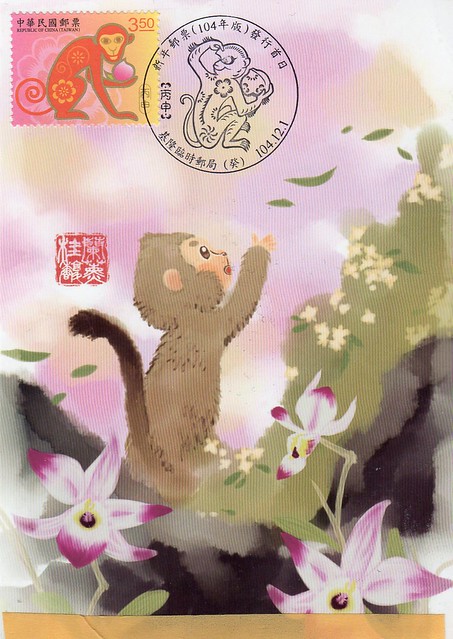
Happy Year of the Monkey!
A super cute Year of the Monkey maxi card I received from Taiwan :)
This is SO cute, and I love the special cancellation as well. Isn't it Chinese New Year this week?? I don't think I'll be celebrating, apart from having some vaguely Chinese food at home...
Labels:
2016,
chinese new year,
maxi cards,
RR,
taiwan,
year of the monkey
Monday, 16 March 2015
Greetings from Taiwan
I had some issues getting this one. I arranged one swap a while back but still haven't received the card (and I don't know if my swap partner received hers as I haven't heard anything from her. Should really message her...). I asked for another swap with a different person later on and this time the card arrived safely.
I love the colours in this one - a lot of the postcards in this series are a tad too light and pastel-coloured for my liking, even if I do still like them, but this is just right. :)
I've only ever tried bubble tea once, in Birmingham a couple of years ago. I quite liked it, although it didn't really taste like tea to me... More like a nice sweet drink with the tapioca pearls somehow reminding me of gummy sweets.
Also, I hadn't realised there were that many Postcrossing members in Taiwan!
I love the colours in this one - a lot of the postcards in this series are a tad too light and pastel-coloured for my liking, even if I do still like them, but this is just right. :)
I've only ever tried bubble tea once, in Birmingham a couple of years ago. I quite liked it, although it didn't really taste like tea to me... More like a nice sweet drink with the tapioca pearls somehow reminding me of gummy sweets.
Also, I hadn't realised there were that many Postcrossing members in Taiwan!
Saturday, 4 October 2014
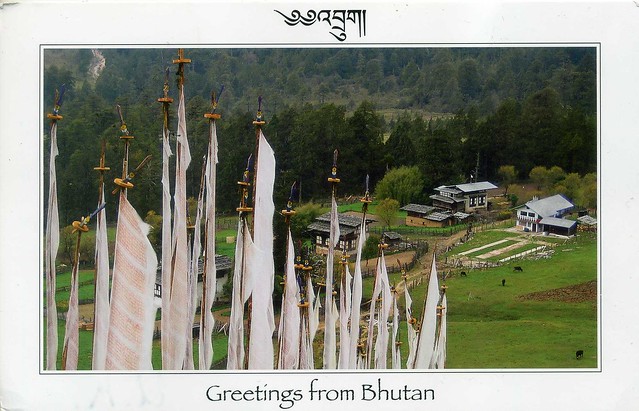
Gogana Village, Bhutan
This is my first ever Bhutan postcard so it's pretty special to me, even if it wasn't mailed directly from Bhutan (but then, I don't really expect to ever receive one). Kim from Taiwan was kind enough to swap with me for this a couple of years ago.
Bhutan, officially the Kingdom of Bhutan, is a landlocked country in South Asia located at the eastern end of the Himalayas. It is bordered to the north by China and to the south, east and west by India. To the west, it is separated from Nepal by the Indian state of Sikkim, while further south it is separated from Bangladesh by the Indian states of Assam and West Bengal. Bhutan's capital and largest city is Thimphu.
Bhutan existed as a patchwork of minor warring fiefdoms until the early 17th century, when the lama and military leader Shabdrung Ngawang Namgyal, fleeing religious persecution in Tibet, unified the area and cultivated a distinct Bhutanese identity. Later, in the early 20th century, Bhutan came into contact with the British Empire and retained strong bilateral relations with India upon its independence. Bhutan is the only country to have officially adopted gross national happiness instead of the gross domestic product as the main development indicator. In 2006, based on a global survey, Business Week rated Bhutan the happiest country in Asia and the eighth-happiest in the world.
Bhutan's landscape ranges from subtropical plains in the south to the sub-alpine Himalayan heights in the north, where some peaks exceed 7,000 metres. Its total area was reported as approximately 46,500 km2 in 1997 and 38,394 square kilometres in 2002. Bhutan's state religion is Vajrayana Buddhism and the population, now (as of 2012/2013) estimated to be nearly three-quarters of a million, is predominantly Buddhist. Hinduism is the second-largest religion.
In 2008, Bhutan made the transition from absolute monarchy to constitutional monarchy and held its first general election. As well as being a member of the United Nations, Bhutan is a member of the South Asian Association for Regional Cooperation (SAARC) and hosted SAARC's sixteenth summit in April 2010.
Kim also told me that Bhutan was the last country in the world without television - the country didn't have a TV until 1999! That's pretty impressive I'd say. Apparently Bhutan also doesn't have any traffic lights. They installed a traffic light once but people didn't like it, they preferred the traditional traffic officer.
Bhutan, officially the Kingdom of Bhutan, is a landlocked country in South Asia located at the eastern end of the Himalayas. It is bordered to the north by China and to the south, east and west by India. To the west, it is separated from Nepal by the Indian state of Sikkim, while further south it is separated from Bangladesh by the Indian states of Assam and West Bengal. Bhutan's capital and largest city is Thimphu.
Bhutan existed as a patchwork of minor warring fiefdoms until the early 17th century, when the lama and military leader Shabdrung Ngawang Namgyal, fleeing religious persecution in Tibet, unified the area and cultivated a distinct Bhutanese identity. Later, in the early 20th century, Bhutan came into contact with the British Empire and retained strong bilateral relations with India upon its independence. Bhutan is the only country to have officially adopted gross national happiness instead of the gross domestic product as the main development indicator. In 2006, based on a global survey, Business Week rated Bhutan the happiest country in Asia and the eighth-happiest in the world.
Bhutan's landscape ranges from subtropical plains in the south to the sub-alpine Himalayan heights in the north, where some peaks exceed 7,000 metres. Its total area was reported as approximately 46,500 km2 in 1997 and 38,394 square kilometres in 2002. Bhutan's state religion is Vajrayana Buddhism and the population, now (as of 2012/2013) estimated to be nearly three-quarters of a million, is predominantly Buddhist. Hinduism is the second-largest religion.
In 2008, Bhutan made the transition from absolute monarchy to constitutional monarchy and held its first general election. As well as being a member of the United Nations, Bhutan is a member of the South Asian Association for Regional Cooperation (SAARC) and hosted SAARC's sixteenth summit in April 2010.
Kim also told me that Bhutan was the last country in the world without television - the country didn't have a TV until 1999! That's pretty impressive I'd say. Apparently Bhutan also doesn't have any traffic lights. They installed a traffic light once but people didn't like it, they preferred the traditional traffic officer.
Monday, 3 September 2012
Palau
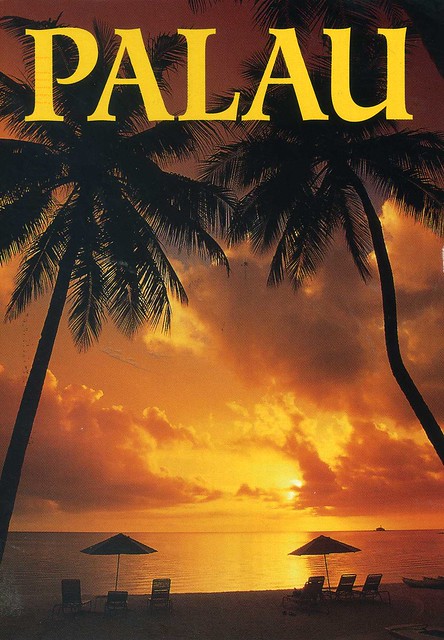
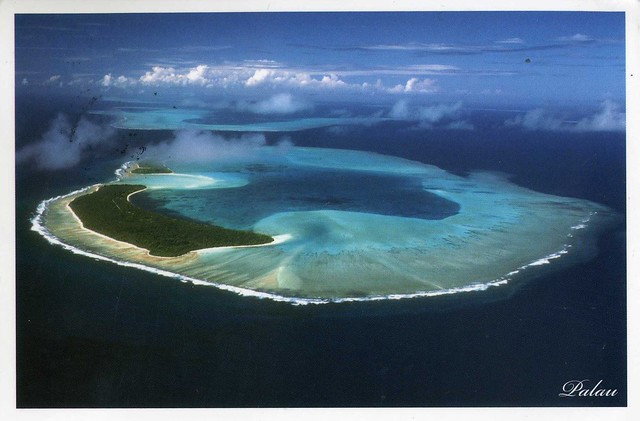
I'll finish off today with a new country to my collection: Palau. Well, actually it's not entirely new as I received a card of the place last year, but that one was mailed from Taiwan. This year I managed to receive a written and stamped postcard directly from Palau :) I'm posting both cards here as I think they complement each other, and the second one shows a better view of one of the islands.
Palau is an island country located in the western Pacific Ocean. Geographically part of the larger island group of Micronesia, with the country's population of around 21,000 people spread out over 250 islands forming the western chain of the Caroline Islands. The islands share maritime boundaries with Indonesia, the Philippines, and the Federated States of Micronesia. The most populous island in the group is Koror, with the capital city, Ngerulmud, located on nearby Babeldaob.
The card above is the one I received this year and which was mailed from Palau. The one underneath is from a swap with the wonderful Kim in Taiwan.
Palau is an island country located in the western Pacific Ocean. Geographically part of the larger island group of Micronesia, with the country's population of around 21,000 people spread out over 250 islands forming the western chain of the Caroline Islands. The islands share maritime boundaries with Indonesia, the Philippines, and the Federated States of Micronesia. The most populous island in the group is Koror, with the capital city, Ngerulmud, located on nearby Babeldaob.
The card above is the one I received this year and which was mailed from Palau. The one underneath is from a swap with the wonderful Kim in Taiwan.
Wednesday, 27 June 2012
Jiufen, Taipei, Taiwan
Last month there was a post in the Postcrossing blog about a special Postcrossing cancellation. I loved the idea but was too late to ask if I could receive a postcard with that cancellation, and I don't have any very close Postcrossing friends in Taiwan so I didn't think I had any changes of receiving this cancellation. ...which is why I was so surprised to find a postcard with the cancellation on in my mailbox earlier this month. I had an official with the cancellation (although the card is only signed by the sender.. maybe Taiwanese meet-ups are different to those elsewhere in that not everyone signs all cards?? Does anyone know?)! What a lovely surprise! :)
On the card you can see a view of Jiufen, a mountain area in Taipei. I've already written about the place here so I won't repeat myself again here. It's such a lovely view, though, and I love the colours and the misty atmosphere. So dreamy!
...and here's the special cancellation alongside with some really pretty stamps. :)
On the card you can see a view of Jiufen, a mountain area in Taipei. I've already written about the place here so I won't repeat myself again here. It's such a lovely view, though, and I love the colours and the misty atmosphere. So dreamy!
...and here's the special cancellation alongside with some really pretty stamps. :)
Labels:
2012,
cancellations,
jiufen,
meet-up cards,
officials,
postcrossing,
taipei,
taiwan
Thursday, 8 March 2012
Taiwan
I had had this postcard in my favourites for quite a while so I was really happy to finally receive it from a tag. It has a mailbox AND a bicycle on it, perfect! ..and the cancellation on this card is pretty amazing as well.

The sender, Sue, tells me this is a vintage mailbox - mailboxes in Taiwan nowadays are square and more convenient for the mailman to take out the letters. There are still some old mailboxes in touristy areas, though.
The design of this mailbox reminds me of some mailboxes over here. I have no idea how convenient they are to the mailman, but they sure are pretty, so much nicer than the ugly modern ones.

The sender, Sue, tells me this is a vintage mailbox - mailboxes in Taiwan nowadays are square and more convenient for the mailman to take out the letters. There are still some old mailboxes in touristy areas, though.
The design of this mailbox reminds me of some mailboxes over here. I have no idea how convenient they are to the mailman, but they sure are pretty, so much nicer than the ugly modern ones.
Saturday, 28 January 2012
Taiwan
My friend Miranda visited her home in Hong Kong again recently, and she also went to Taiwan for a few days. She was kind enough to bring me some postcards from her trip ^_^ I'll probably post one of the postcards from Hong Kong here at some point, meanwhile here's one from Taiwan. I love the colours and the sky in this one.

The National Chiang Kai-shek Memorial Hall is a famous monument, landmark and tourist attractions erected in memory of Generalissimo Chiang Kai-shek, former President of the Republic of China. It is located in Taipei, Republic of China (Taiwan).
The monument, surrounded by a park, stands at the east end of Memorial Hall Square. The structure is framed on the north and south by the National Theater and National Concert Hall. The entire plaza is located within sight of the Presidential Office Building.

The National Chiang Kai-shek Memorial Hall is a famous monument, landmark and tourist attractions erected in memory of Generalissimo Chiang Kai-shek, former President of the Republic of China. It is located in Taipei, Republic of China (Taiwan).
The monument, surrounded by a park, stands at the east end of Memorial Hall Square. The structure is framed on the north and south by the National Theater and National Concert Hall. The entire plaza is located within sight of the Presidential Office Building.
Saturday, 10 December 2011
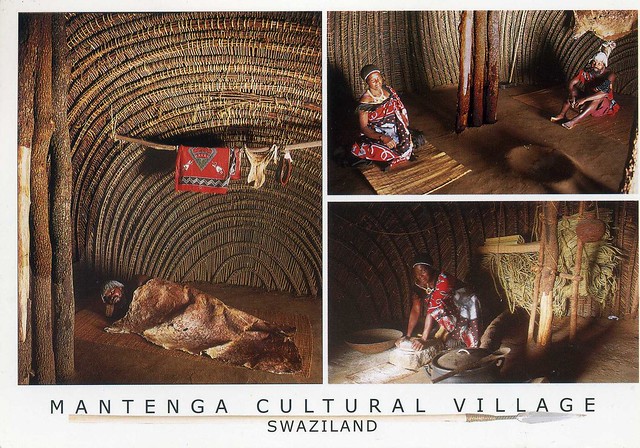
Mantenga Cultural Village, Swaziland
One more card for today... and it's a new country to my collection! Well, it wasn't mailed directly from Swaziland but I think that would be a bit too much to ask. This is another treat from the lovely Kim in Taiwan. Thank you so much!

Swaziland, officially the Kingdom of Swaziland, is a landlocked country in Southern Africa, bordered to the north, south and west by South Africa, and to the east by Mozambique. The nation, as well as its people, are named after the 19th century king Mswati II.
Swaziland is a small country, no more than 200 kilometres north to south and 130 kilometres east to west. The western half is mountainous, descending to a lowveld region to the east. The eastern border with Mozambique and South Africa is dominated by the escarpment of the Lebombo Mountains. The climate is temperate in the west, but may reach 40 °C in summer in the lowveld. Rainfall occurs mainly in the summer and may reach 2 metres in the west.
The area that Swaziland now covers has been continuously inhabited since prehistory. Today, the population is primarily ethnic Swazis whose language is siSwati, though English is spoken as a second language. The Swazi people descend from the southern Bantu who migrated from Central Africa in the 15th and 16th centuries. The Anglo Boer war saw the United Kingdom make Swaziland a protectorate under its direct control. Swaziland gained independence in 1968. Swaziland is a member of the Southern African Development Community, the African Union, and the Commonwealth of Nations. The head of state is the king, who appoints the prime minister and a small number of representatives for both chambers of parliament. Elections are held every five years to determine the majority of the representatives. A new constitution was adopted in 2005.
Some 75% of the population are employed in subsistence farming, and 60% of the population live on less than the equivalent of US$1.25 per day. Swaziland's main trading partner is South Africa, and its currency is pegged to the South African rand.

Kim mailed the postcard from Taiwan so the stamps are obviously from Taiwan as well.

Swaziland, officially the Kingdom of Swaziland, is a landlocked country in Southern Africa, bordered to the north, south and west by South Africa, and to the east by Mozambique. The nation, as well as its people, are named after the 19th century king Mswati II.
Swaziland is a small country, no more than 200 kilometres north to south and 130 kilometres east to west. The western half is mountainous, descending to a lowveld region to the east. The eastern border with Mozambique and South Africa is dominated by the escarpment of the Lebombo Mountains. The climate is temperate in the west, but may reach 40 °C in summer in the lowveld. Rainfall occurs mainly in the summer and may reach 2 metres in the west.
The area that Swaziland now covers has been continuously inhabited since prehistory. Today, the population is primarily ethnic Swazis whose language is siSwati, though English is spoken as a second language. The Swazi people descend from the southern Bantu who migrated from Central Africa in the 15th and 16th centuries. The Anglo Boer war saw the United Kingdom make Swaziland a protectorate under its direct control. Swaziland gained independence in 1968. Swaziland is a member of the Southern African Development Community, the African Union, and the Commonwealth of Nations. The head of state is the king, who appoints the prime minister and a small number of representatives for both chambers of parliament. Elections are held every five years to determine the majority of the representatives. A new constitution was adopted in 2005.
Some 75% of the population are employed in subsistence farming, and 60% of the population live on less than the equivalent of US$1.25 per day. Swaziland's main trading partner is South Africa, and its currency is pegged to the South African rand.

Kim mailed the postcard from Taiwan so the stamps are obviously from Taiwan as well.
Sunday, 25 September 2011
Pitcairn Island
..and now something quite different: Pitcairn Island! Unfortunately the card was not sent directly from Pitcairn Island, but that would just be too much luck as receiving a written and stamped postcard directly from there is extremely difficult. I'm not surprised when there are so few people living there, and travelling there is really difficult and it's not easy to get a permission to travel there (you need an approval of perfect health, amongst other requirements). Thanks a million for the swap, Kim!

The Pitcairn Islands form a group of four volcanic islands in the southern Pacific Ocean. The islands are a British Overseas Territory and overseas territory of the European Union in the Pacific. The four islands – named Pitcairn, Henderson, Ducie, and Oeno – are spread over several hundred miles of ocean and have a total land area of about 47 km2. Only Pitcairn, the second largest and measuring about 3.2 km across, is inhabited.
The islands are best known as home of the descendants of the Bounty mutineers and the Tahitians (or Polynesians) who accompanied them, an event retold in numerous books and films. This history is still apparent in the surnames of many of the islanders. With only about 50 inhabitants (from four families as of 2010: Christian, Warren, Young, and Brown), Pitcairn is the least populous jurisdiction in the world (although it is not a sovereign nation). The United Nations Committee on Decolonisation includes the Pitcairn Islands on the United Nations list of Non-Self-Governing Territories.

The card was mailed from Taiwan, and the stamp is from a miniature sheet issued in 2008 to commemorate the Year of the Ox.

The Pitcairn Islands form a group of four volcanic islands in the southern Pacific Ocean. The islands are a British Overseas Territory and overseas territory of the European Union in the Pacific. The four islands – named Pitcairn, Henderson, Ducie, and Oeno – are spread over several hundred miles of ocean and have a total land area of about 47 km2. Only Pitcairn, the second largest and measuring about 3.2 km across, is inhabited.
The islands are best known as home of the descendants of the Bounty mutineers and the Tahitians (or Polynesians) who accompanied them, an event retold in numerous books and films. This history is still apparent in the surnames of many of the islanders. With only about 50 inhabitants (from four families as of 2010: Christian, Warren, Young, and Brown), Pitcairn is the least populous jurisdiction in the world (although it is not a sovereign nation). The United Nations Committee on Decolonisation includes the Pitcairn Islands on the United Nations list of Non-Self-Governing Territories.

The card was mailed from Taiwan, and the stamp is from a miniature sheet issued in 2008 to commemorate the Year of the Ox.
Saturday, 16 July 2011
Map of Taiwan
Let's stay in Asia for a moment.. This card from Taiwan is one of the coolest map cards I've ever received - I love the cute illustrations and the huge number of tiny little details.

You can see all the major cities of Taiwan here, as well as all famous spots and landmarks. The Black Bear, DiDi, is in reality a native animal in Taiwan, "Formosan Black Bear". 'DiDi' means younger brother in Chinese, which is the official language of Taiwan.

You can see all the major cities of Taiwan here, as well as all famous spots and landmarks. The Black Bear, DiDi, is in reality a native animal in Taiwan, "Formosan Black Bear". 'DiDi' means younger brother in Chinese, which is the official language of Taiwan.
Wednesday, 29 December 2010
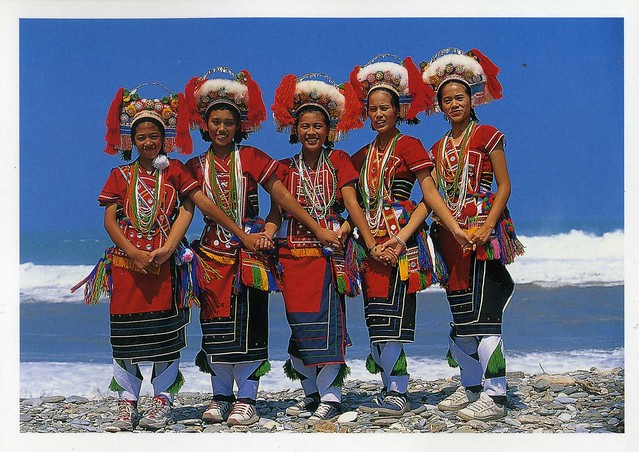
Amis people, Taiwan
This is one of my favourite received official cards in the last few months. Not only because it's a very nice card, but also because the sender, Tina, really put effort into it. She sent the card in an envelope because she had written SO much on the card, and even included an extra note. It's all super cute and decorated with pretty stickers, AND she used several gorgeous stamps on the envelope, as well as a pretty rubber stamped tea pot. It's all very, very sweet - such a treat! :)

TW-220038
The Amis are an indigenous people of Taiwan. They speak Amis, an Austronesian language and are one of the thirteen officially recognized peoples of Taiwanese aborigines. The traditional territory of the Amis include the long, narrow valley between the Central Mountains and the Coastal Mountains, the Pacific coastal plain eastern to the Coastal Mountains, and the Hengchun Peninsula.
In the year 2000 the Ami numbered 148,992. This was approximately 37.5% of Taiwan's total indigenous population, making them the largest tribal group. The Amis are primarily fishermen due to their coastal location. They are traditionally matrilineal. Traditional Amis villages were relatively large for indigenous groups, typically between 500 and 1,000. In today's Taiwan, the Amis also comprise the majority of "urban aboriginals" and have developed many "urban tribes" all around the island.

..and here are the stamps. So many and so pretty! I wish I could create envelopes like this, too.. *sigh* Anyway. The stamp on top left is from a set of 4 stamps issued in 2009, with the theme Kinmen panorama. The stamp underneath it is from a set of 3 definitives issued in 1999, showing Fruits. The bird stamp in the middle is from a set of 4 stamps issued in 2008, representing birds. This one is the Bronzed Drongo. The two stamps next to it are from a set of 4 stamps issued in 2009 with the theme 'Children', and the stamp underneath those is from a set of 4 flower stamps issued earlier this year.

The Amis are an indigenous people of Taiwan. They speak Amis, an Austronesian language and are one of the thirteen officially recognized peoples of Taiwanese aborigines. The traditional territory of the Amis include the long, narrow valley between the Central Mountains and the Coastal Mountains, the Pacific coastal plain eastern to the Coastal Mountains, and the Hengchun Peninsula.
In the year 2000 the Ami numbered 148,992. This was approximately 37.5% of Taiwan's total indigenous population, making them the largest tribal group. The Amis are primarily fishermen due to their coastal location. They are traditionally matrilineal. Traditional Amis villages were relatively large for indigenous groups, typically between 500 and 1,000. In today's Taiwan, the Amis also comprise the majority of "urban aboriginals" and have developed many "urban tribes" all around the island.

..and here are the stamps. So many and so pretty! I wish I could create envelopes like this, too.. *sigh* Anyway. The stamp on top left is from a set of 4 stamps issued in 2009, with the theme Kinmen panorama. The stamp underneath it is from a set of 3 definitives issued in 1999, showing Fruits. The bird stamp in the middle is from a set of 4 stamps issued in 2008, representing birds. This one is the Bronzed Drongo. The two stamps next to it are from a set of 4 stamps issued in 2009 with the theme 'Children', and the stamp underneath those is from a set of 4 flower stamps issued earlier this year.
Labels:
2010,
aboriginals,
officials,
people,
taiwan,
traditional clothes
Wednesday, 22 December 2010
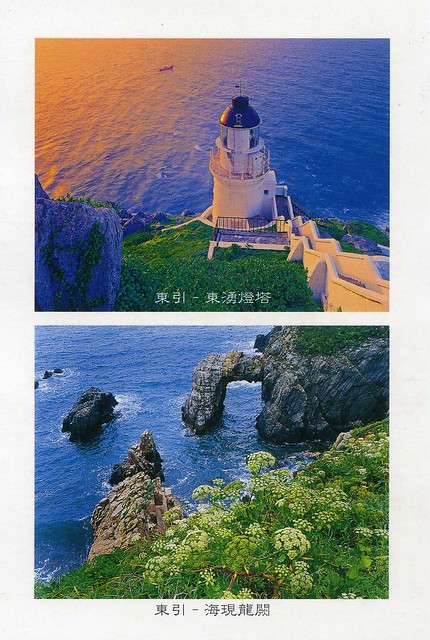
Taiwanese Lighthouse
Another lighthouse postcard, this time from Taiwan.

I can't read Chinese so I don't know if the name of this lighthouse is actually written on the card, it probably is.. Maybe I should ask Miranda for help... I usually prefer single view cards but this one is REALLY nice, both pictures are very beautiful and I love the colours. The pink of the sunset in the top picture, and the wild sea and flowers in the bottom one. I think there's something quite dreamy about this card, I really like the atmosphere here, particularly in the lighthouse picture.

The card came in an envelope with a few other cards, here's the stamp from the envelope. It's from a set of two Winnie the Pooh miniature sheets issued in 2006. Both miniature sheets have two stamps, this is one of the four stamps.

I can't read Chinese so I don't know if the name of this lighthouse is actually written on the card, it probably is.. Maybe I should ask Miranda for help... I usually prefer single view cards but this one is REALLY nice, both pictures are very beautiful and I love the colours. The pink of the sunset in the top picture, and the wild sea and flowers in the bottom one. I think there's something quite dreamy about this card, I really like the atmosphere here, particularly in the lighthouse picture.

The card came in an envelope with a few other cards, here's the stamp from the envelope. It's from a set of two Winnie the Pooh miniature sheets issued in 2006. Both miniature sheets have two stamps, this is one of the four stamps.
Saturday, 18 December 2010
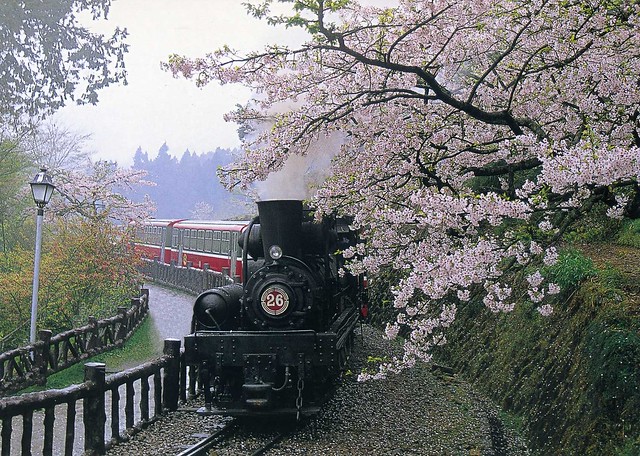
Alishan Forest Railway, Taiwan
There are some truly gorgeous sceneries in Taiwan and this one is no exception. Just look at the blossiming trees and a pretty old train running by a tiny river (?).

TW-212072
The Alishan Forest Railway is an 86 km network of 762 mm (narrow gauge) railways running up to and throughout the popular mountain resort of Alishan in Chiayi County, Taiwan.
The narrow gauge lines were originally constructed by the Japanese Colonial Government in 1912 to facilitate the logging of cypress and Taiwania wood, however today the line caters mostly to tourists. Passenger carriages were first added to the trains in 1918. The first motive power was a Shay locomotive purchased second hand from the Kiso Forest Railway in Japan. Eventually the railway acquired 20 Shay locomotives.
Unlike the national rail system administered by the Taiwan Railway Administration, the Alishan railway is managed by the Forestry Bureau. The system is currently operated using diesel locomotives, although there are occasional special public runs using the old steam powered Shay locomotives.

Such a nice, clear cancellation on the card! The stamp is from a set of 4 flower stamps issued in 2009.

The Alishan Forest Railway is an 86 km network of 762 mm (narrow gauge) railways running up to and throughout the popular mountain resort of Alishan in Chiayi County, Taiwan.
The narrow gauge lines were originally constructed by the Japanese Colonial Government in 1912 to facilitate the logging of cypress and Taiwania wood, however today the line caters mostly to tourists. Passenger carriages were first added to the trains in 1918. The first motive power was a Shay locomotive purchased second hand from the Kiso Forest Railway in Japan. Eventually the railway acquired 20 Shay locomotives.
Unlike the national rail system administered by the Taiwan Railway Administration, the Alishan railway is managed by the Forestry Bureau. The system is currently operated using diesel locomotives, although there are occasional special public runs using the old steam powered Shay locomotives.

Such a nice, clear cancellation on the card! The stamp is from a set of 4 flower stamps issued in 2009.
Friday, 8 October 2010
99.9.9-9
It's been a very busy week. Several training days, aikido, aikido club meeting... and I'm not sure how much I'll be able to relax this weekend, either :( Tomorrow I'm going to a friend's birthday party, though, that should be fun!
I've received lots of very nice postcards in the past two weeks and there are so many I want to post about here. I thought I'd start with this very cool card from Taiwan, I won it in a lottery on the postcrossing forum (and yes, I'll organise my own lottery when I have more time).

This is what the sender, Shu-i, explained about the card and the cancellations:
2010 is the 99th year of the Republic of China Era. As it is September, 9th today, we will get a postmark dated as 99.9.9-9. The last 9 refers to postmark made around 9:00 a.m. In Chinese, 9 pronounced the same as (jiou) which means "lasting for a long time." In this way, people here think it's quite a good number to express their love (some people choose to get married today !) or see it as a lucky number for healthy, friendship, happiness..etc.
The words on the front side mean "Happy Teacher's Day!" The Teacher's Day is on September 28th in Taiwan, which is also Confucius' (a Chinese thinker and social philosopher of the Spring and Autumn Period) birthday.

..and here's the special cancellation. :)
I've received lots of very nice postcards in the past two weeks and there are so many I want to post about here. I thought I'd start with this very cool card from Taiwan, I won it in a lottery on the postcrossing forum (and yes, I'll organise my own lottery when I have more time).

This is what the sender, Shu-i, explained about the card and the cancellations:
2010 is the 99th year of the Republic of China Era. As it is September, 9th today, we will get a postmark dated as 99.9.9-9. The last 9 refers to postmark made around 9:00 a.m. In Chinese, 9 pronounced the same as (jiou) which means "lasting for a long time." In this way, people here think it's quite a good number to express their love (some people choose to get married today !) or see it as a lucky number for healthy, friendship, happiness..etc.
The words on the front side mean "Happy Teacher's Day!" The Teacher's Day is on September 28th in Taiwan, which is also Confucius' (a Chinese thinker and social philosopher of the Spring and Autumn Period) birthday.

..and here's the special cancellation. :)
Friday, 6 August 2010
Jiufen, Taipei, Taiwan
I'll finish off today with Taiwan.. This lovely card arrived from a swap with Moonie in Taiwan. She actually visited Indonesia recently and I asked if she could send me a postcard from there instead (as I don't have many cards from Indonesia) but she didn't have chance to pick a postcard from there so sent me this instead. I have to say I'm more than happy with this one, too, there are some truly amazing sceneries in Taiwan!

This is a view from Jiufen, a mountain town in the Rueifang Township of Taipei County near Keelung, Taiwan. Jiufen was only an isolated village until 1893, when gold was discovered in the area. The resulting gold rush hastened the village's development into a town, and reached its peak during the Japanese rule. Many present features of Jiufen reflect the era under Japanese colonization, with many Japanese inns surviving to this day. During World War II, a POW camp named Kinkaseki was set up in the village, holding Allied soldiers captured in Singapore (including many British) who worked in the nearby gold mines. Gold mining activities declined after World War II, and the mine was shut off in 1971. Jiufen quickly went into decline, and for a while the town was mostly forgotten.
In 1989, Hou Hsiao-hsien's A City of Sadness, the first film to touch on the 228 Incident, a taboo subject in Taiwan, became a big hit in the theatres. As a result Jiufen, where the film was set, revived due to the film's popularity. The nostalgic scenery of Jiufen as seen in the film, as well as appearances in other media, charmed many people into visiting Jioufen. For the beginning of the 90s, Jiufen experienced a tourist boom that has shaped the town as a tourist attraction. Soon retro-Chinese style cafés, tea houses, and souvenir stores bearing the name "City of Sadness" were built.
Jiufen also became popular in 2001, when its downtown was used as a model in the anime movie Spirited Away.
I'm pretty sure I have postcards of Jiufen already - I googled it and the narrow lanes with red lanterns look familiar. It's nice to see the place from a different angle for a change. :)

The stamp on the left would seem to be from a set of 11 definitive stamps issued in 2005, showing fruit. I'm not sure what this one here is called, it looks like some citrus fruit. I couldn't find any info on the stamp in the middle, and I'd assume the stamp on the right was issued earlier this year as it's the Year of the Tiger at the moment.

This is a view from Jiufen, a mountain town in the Rueifang Township of Taipei County near Keelung, Taiwan. Jiufen was only an isolated village until 1893, when gold was discovered in the area. The resulting gold rush hastened the village's development into a town, and reached its peak during the Japanese rule. Many present features of Jiufen reflect the era under Japanese colonization, with many Japanese inns surviving to this day. During World War II, a POW camp named Kinkaseki was set up in the village, holding Allied soldiers captured in Singapore (including many British) who worked in the nearby gold mines. Gold mining activities declined after World War II, and the mine was shut off in 1971. Jiufen quickly went into decline, and for a while the town was mostly forgotten.
In 1989, Hou Hsiao-hsien's A City of Sadness, the first film to touch on the 228 Incident, a taboo subject in Taiwan, became a big hit in the theatres. As a result Jiufen, where the film was set, revived due to the film's popularity. The nostalgic scenery of Jiufen as seen in the film, as well as appearances in other media, charmed many people into visiting Jioufen. For the beginning of the 90s, Jiufen experienced a tourist boom that has shaped the town as a tourist attraction. Soon retro-Chinese style cafés, tea houses, and souvenir stores bearing the name "City of Sadness" were built.
Jiufen also became popular in 2001, when its downtown was used as a model in the anime movie Spirited Away.
I'm pretty sure I have postcards of Jiufen already - I googled it and the narrow lanes with red lanterns look familiar. It's nice to see the place from a different angle for a change. :)

The stamp on the left would seem to be from a set of 11 definitive stamps issued in 2005, showing fruit. I'm not sure what this one here is called, it looks like some citrus fruit. I couldn't find any info on the stamp in the middle, and I'd assume the stamp on the right was issued earlier this year as it's the Year of the Tiger at the moment.
Wednesday, 14 July 2010
Sun Moon Lake, Taiwan
All the official cards I've received in the past few days have been *really* nice so I plan to post about quite a few of them. This one is truly wonderful - such amazing sceneries!

TW-164471
Sun Moon Lake is the largest body of water in Taiwan as well as a tourist attraction. Situated in Yuchih, Nantou, the area around the Sun Moon Lake is home to the Thao tribe, one of aboriginal tribes in Taiwan. Sun Moon Lake surrounds a tiny island called Lalu. The east side of the lake looks like a sun and the west side looks like a moon, hence the name.
Sun Moon Lake is located 748 metres above sea level. It is 27 metres deep and has a surface area of approximately 7.93 square kilometres.
In older English literature it was commonly referred to as Lake Candidius, after the 17th century Dutch missionary Georgius Candidius. In the middle of the lake is the Lalu Island, which is the holy ground for the Thao tribe. Originally, the Lalu was where the Thao people inhabited. Under the Japanese occupation of Taiwan, the Japanese named it the "Jade Island". After Chiang Kai-shek's Nationalist Government moved to Taiwan, the island was renamed Kuang Hua ("Glorious China") and in 1978 the local government built a pavilion where annual weddings took place. The 921 Earthquake destroyed the pavilion and sunk most of the island. In recent years, due to increasing social and political awareness, more deference and recognition are being given to Taiwanese aborigines. As a result, after 921 earthquake, the island was renamed in the Thao language as "Lalu".
The lake and its surrounding countryside have been designated one of thirteen National scenic areas in Taiwan.

The stamp is from a set of 4 stamps issued in 2007, depicting birds in Taiwan. This one here is the Siberian Rubythroat.

Sun Moon Lake is the largest body of water in Taiwan as well as a tourist attraction. Situated in Yuchih, Nantou, the area around the Sun Moon Lake is home to the Thao tribe, one of aboriginal tribes in Taiwan. Sun Moon Lake surrounds a tiny island called Lalu. The east side of the lake looks like a sun and the west side looks like a moon, hence the name.
Sun Moon Lake is located 748 metres above sea level. It is 27 metres deep and has a surface area of approximately 7.93 square kilometres.
In older English literature it was commonly referred to as Lake Candidius, after the 17th century Dutch missionary Georgius Candidius. In the middle of the lake is the Lalu Island, which is the holy ground for the Thao tribe. Originally, the Lalu was where the Thao people inhabited. Under the Japanese occupation of Taiwan, the Japanese named it the "Jade Island". After Chiang Kai-shek's Nationalist Government moved to Taiwan, the island was renamed Kuang Hua ("Glorious China") and in 1978 the local government built a pavilion where annual weddings took place. The 921 Earthquake destroyed the pavilion and sunk most of the island. In recent years, due to increasing social and political awareness, more deference and recognition are being given to Taiwanese aborigines. As a result, after 921 earthquake, the island was renamed in the Thao language as "Lalu".
The lake and its surrounding countryside have been designated one of thirteen National scenic areas in Taiwan.

The stamp is from a set of 4 stamps issued in 2007, depicting birds in Taiwan. This one here is the Siberian Rubythroat.
Saturday, 26 June 2010
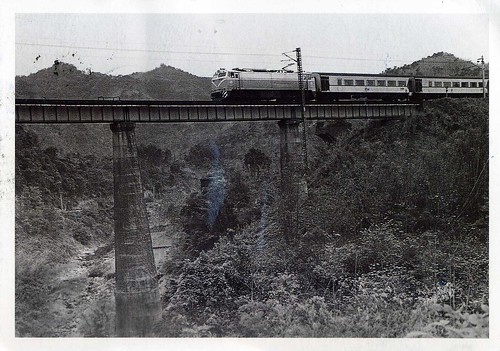
Back to the Old-Time Taiwan
This lovely black & white train postcard arrived today as an official from Taiwan.

TW-161811
There wasn't any further info about the picture on the card, except that it seems to be from a series of postcards depicting Taiwan in the past. I like seeing trains around the world. :)

Not much info about the stamps, either... I'd assume the middle one was issued this year as it's the Year of the Tiger at the moment. The picture in the stamp on the right looks like the Chinese lucky knots I've seen before (and we've got one at home, a gift from Miranda).
There wasn't any further info about the picture on the card, except that it seems to be from a series of postcards depicting Taiwan in the past. I like seeing trains around the world. :)

Not much info about the stamps, either... I'd assume the middle one was issued this year as it's the Year of the Tiger at the moment. The picture in the stamp on the right looks like the Chinese lucky knots I've seen before (and we've got one at home, a gift from Miranda).
Saturday, 12 June 2010
bananas in Taiwan
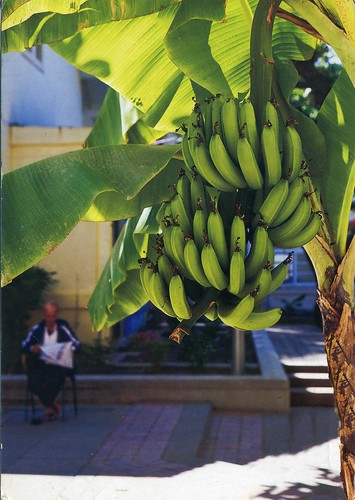
I seem to be receiving official postcrossing cards from Taiwan fairly regularly, and they are usually quite nice, too (don't really like some of the ad cards I've received from there, though). This one is probably one of my favourites, and I love it how it's so different from the other cards I've got from there.

TW-157693
I don't know if it's just me, but when I think of Taiwan, bananas are not the first thing that comes into mind. Chun-Ying, who sent me this card, told me that bananas are the most representative of Taiwan fruits, however. On the back of the card it says this is "Banana heaven" in Cishan Kaohsiung (Kaohsiung is a county in southern Taiwan).

Stamps from Taiwan always seem to be very beautiful. Unfortunately it also seems to be very difficult to find any information about them. Anyway, from what I could find, the bird stamp is from a set of 4 stamps issued in 2008, representing birds. This one is the Bronzed Drongo. The bridge stamp is also from a set of 4 stamps, issued in 2010, themed Bridges of Taiwan. This one shows Jinde Bridge in Donggang. The other two stamps I could find no info of.

I don't know if it's just me, but when I think of Taiwan, bananas are not the first thing that comes into mind. Chun-Ying, who sent me this card, told me that bananas are the most representative of Taiwan fruits, however. On the back of the card it says this is "Banana heaven" in Cishan Kaohsiung (Kaohsiung is a county in southern Taiwan).

Stamps from Taiwan always seem to be very beautiful. Unfortunately it also seems to be very difficult to find any information about them. Anyway, from what I could find, the bird stamp is from a set of 4 stamps issued in 2008, representing birds. This one is the Bronzed Drongo. The bridge stamp is also from a set of 4 stamps, issued in 2010, themed Bridges of Taiwan. This one shows Jinde Bridge in Donggang. The other two stamps I could find no info of.
Subscribe to:
Posts (Atom)


Maroon