Showing posts with label romania. Show all posts

Sunday, 6 September 2015

Sighișoara, Romania

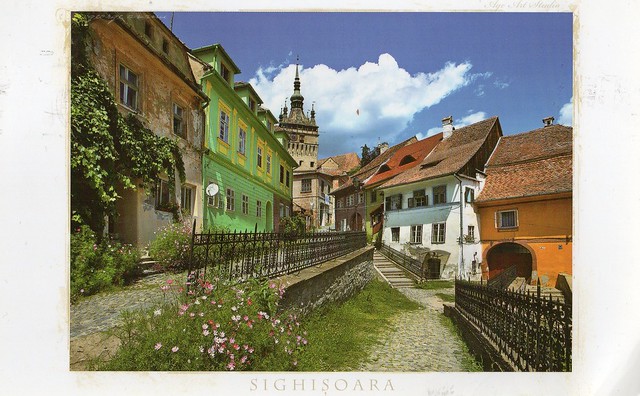
Today's last card was a surprise from my friend Astrid, who attended a Postcrossing meet-up in Romania. I had no idea she was planning on going there! It must have been a pretty interesting place to visit as well, and looks very beautiful.


Sighișoara is a city on the Târnava Mare River in Mureș County, Romania. Located in the historic region of Transylvania, Sighișoara has a population of 28,102 according to the 2011 census.

Historic Centre of Sighişoara is a Unesco site. Founded by German craftsmen and merchants known as the Saxons of Transylvania, Sighişoara is a fine example of a small, fortified medieval town which played an important strategic and commercial role on the fringes of central Europe for several centuries.

Transylvania is a historical region in the central part of Romania. Bounded on the east and south by its natural borders, the Carpathian mountain range, historical Transylvania extended in the west to the Apuseni Mountains; however, the term sometimes encompasses not only Transylvania proper, but also the historical regions of Crișana, Maramureș, and Romanian part of Banat. The region of Transylvania is known for the scenic beauty of its Carpathian landscape and its rich history. In the English-speaking world it has been commonly associated with vampires, chiefly due to the influence of Bram Stoker's famous novel Dracula as well as the many later film adaptations.

Wednesday, 4 March 2015

Kyrenia, North Cyprus

This postcard wasn't actually mailed from North Cyprus but since it's pretty difficult to get postcards from there, I didn't mind receiving this one from Romania at all.


Kyrenia is a city on the northern coast of Cyprus, noted for its historic harbour and castle. It is under the de facto control of Northern Cyprus.

While there is evidence showing that Kyrenia has been populated since ca. 5800–3000 BC, it is traditionally accepted that the city was founded by Achaeans from the Peloponnese after the Trojan War. As the town grew prosperous, the Romans established the foundations of its castle in the 1st century AD. Kyrenia grew in importance after the 9th century due to the safety offered by the castle, and played a pivotal role under the Lusignan rule as the city never capitulated. The castle has been most recently modified by the Venetians in the 15th century, but the city surrendered to the Ottoman Empire in 1571.

The city's population was almost equally divided between Muslims and Christians in 1831, with a slight Muslim majority. However, with the advent of British rule, many Turkish Cypriots fled to Anatolia, and the town came to be predominantly inhabited by Greek Cypriots. While the city suffered little intercommunal violence, its Greek Cypriot inhabitants, numbering around 2,650, fled or were forcefully displaced in the wake of the Turkish invasion in 1974. Currently, the city is populated by Turkish Cypriots, Turks and Britons with a municipal population of 33,207.

Kyrenia is a major cultural and economical centre, considered to be the touristic capital of Northern Cyprus. It is home to numerous hotels, a vibrant nightlife and a busy port. It hosts an annual culture and arts festival with hundreds of participating artists and performers and is home to two universities and a student population around 14,000.

Monday, 16 February 2015

Merry Cemetery, Săpânța, Romania

Another random selection of postcards for today... I wonder if I should actually try to come up with themes or something at some point? :P

Anyway, this card arrived last year. I had had it in my favourites for a while so I was really happy to finally receive it.


The Merry Cemetery is a cemetery in the village of Săpânța, Maramureş county, Romania. It is famous for its colourful tombstones with naïve paintings describing, in an original and poetic manner, the persons that are buried there as well as scenes from their lives. The Merry Cemetery became an open-air museum and a national tourist attraction.

The unusual feature of this cemetery is that it diverges from the prevalent belief, culturally shared within European societies – a belief that views death as something indelibly solemn. Connections with the local Dacian culture have been made, a culture whose philosophical tenets presumably vouched for the immortality of the soul and the belief that death was a moment filled with joy and anticipation for a better life.

Sunday, 11 March 2012

Bran Castle, Romania

A very nice postcard of Bran Castle in Romania I received last summer. I had swapped with Oana through the main Postcrossing site before and soon after she hosted a RR on the forum. I like coincidences like that! :)


Bran Castle, situated near Bran and in the immediate vicinity of Braşov, is a national monument and landmark in Romania. The fortress is situated on the border between Transylvania and Wallachia, on DN73. Commonly known as "Dracula's Castle" (although it is one among several locations linked to the Dracula legend, including Poenari Castle and Hunyad Castle), it is marketed as the home of the titular character in Bram Stoker's Dracula. There is, however, no evidence that Stoker knew anything about this castle, which has only tangential associations with Vlad III, voivode of Wallachia, the putative inspiration for Dracula.

The castle is now a museum open to tourists, displaying art and furniture collected by Queen Marie. Tourists can see the interior individually or by a guided tour. At the bottom of the hill is a small open air museum park exhibiting traditional Romanian peasant structures (cottages, barns, etc.) from across the country.

Thursday, 6 October 2011

Transylvania, Romania

One more card for today, a very nice official I received from Romania this summer.


RO-28622


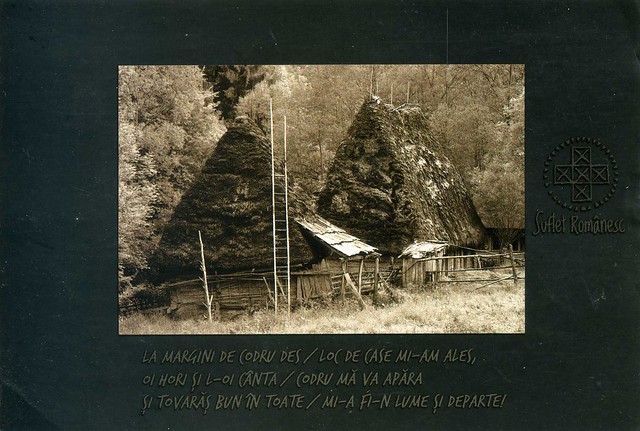
Transylvania is a historical region in the central part of Romania. Bounded on the east and south by the Carpathian mountain range, historical Transylvania extended in the west to the Apuseni Mountains; however, the term sometimes encompasses not only Transylvania proper, but also the historical regions of Crişana, Maramureş, and Romanian part of Banat.

Transylvania is often associated with Dracula (Bram Stoker's novel and its film adaptations, and Vlad the Impaler), and the horror genre in general, while the region is also known for the scenic beauty of its Carpathian landscape and its rich history.

The houses on this card are traditional houses that can be found in Carpathian Mountains. The poem, then, is called 'Soapte Din Transilvania' ('Whispers of Transylvania'). There was a helpful English translation on the back of the card:

At the edge of that dark forest
I chose my house to build
I dance and sing to praise the best
of my companions, my truthful shield
here and far away.


The stamp on the left is from a set of 7 stamps issued in 2005, depicting Romanian Pottery. The stamp on the right is from a set of 4 stamps issued in 2007, showing Romanian Ceramics.

Saturday, 21 May 2011

Romania

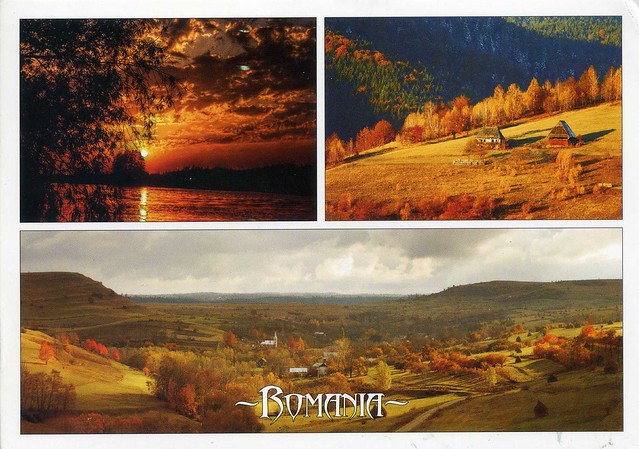
Moving on to more rural settings... This card came from a swap with Oana in Romania. I don't have too many postcards from Romania so it's always nice to see new views from there. :)


The bottom picture shows a village near to Cluj in nortwestern Romania, while the top right picture shows Valea Stanciului, a small commune in southern Romania. There's a bit more to say about the top left picture - it shows Danube Delta, which is also a Unesco World Heritage Site.

Danube Delta is the second largest river delta in Europe, after the Volga Delta, and is the best preserved on the continent. The greater part of the Danube Delta lies in Romania (Tulcea county), while its northern part, on the left bank of the Chilia arm, is situated in Ukraine (Odessa Oblast). The approximate surface is 4152 km², of which 3446 km² are in Romania. If the lagoons of Razim-Sinoe (1015 km² of which 865 km² water surface; situated in the south, but attached to the Danube Delta from geological and ecological perspectives, as well as being the combined territory of the World Heritage Site) are to be added, the considered area of the Danube Delta grows to 5165 km².

The modern Danube Delta began forming after 4,000 B.C. in a gulf of the Black Sea, when the sea rose to its present level. A sandy barrier blocked the Danube gulf where the river initially built its delta. Upon filling the gulf with sediments, the delta advanced outside the barrier-blocked estuary after 3,500 B.C. building several successive lobes: the St. George I (3,500-1,600 B.C.), the Sulina (1,600-0 B.C.), the St. George II (0 B.C.-Present) and the Chilia or Kilia (1600 A.D.-Present).

The Danube Delta is a low alluvial plain, mostly covered by wetlands and water. It consists of an intricate pattern of marshes, channels, streamlets and lakes. The average altitude is 0.52 m, with 20% of the territory below sea level, and more than half not exceeding one meter in altitude. Dunes on the most extensive strandplains of the delta (Letea and Caraorman strandplains) stand higher (12.4 m and 7 m respectively). The largest lakes are Dranov (21.7 km²), Roşu (14.5 km²), Gorgova (13.8 km²).


The stamp is from a set of 2 issued in 2010, with the theme 'Carpates'.