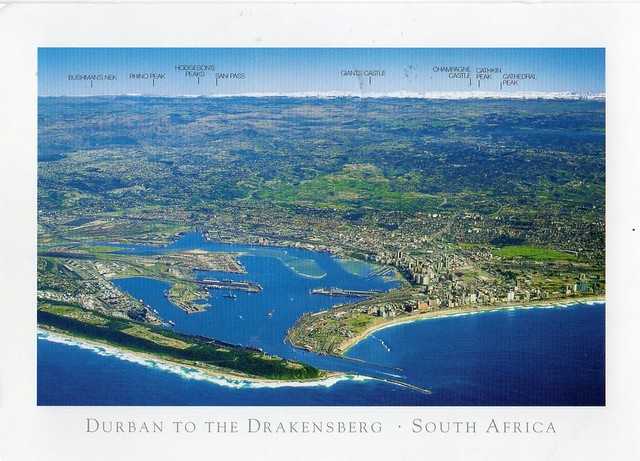
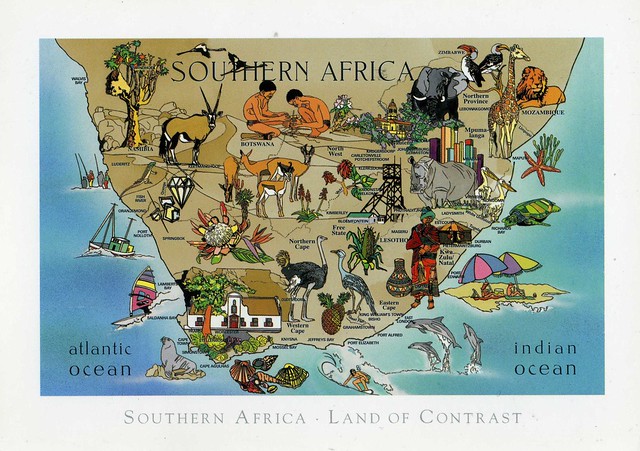
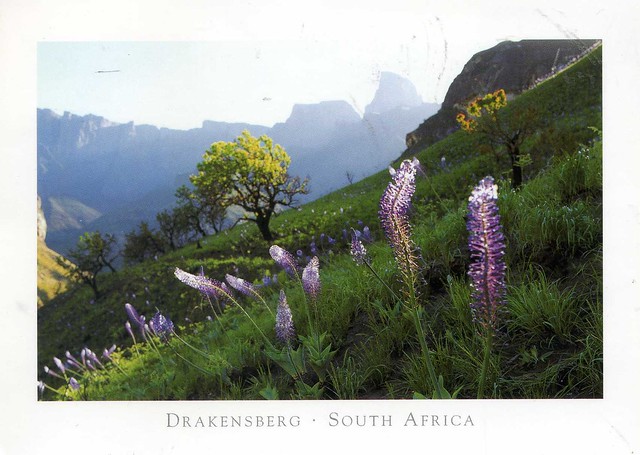
A lovely South Africa map card I received some years ago. I still don't have too many postcards from South Africa...
South Africa, officially the Republic of South Africa (RSA), is a country located in Southern Africa. It has 2,798 kilometres of coastline that stretches along the South Atlantic and Indian oceans. To the north lie the neighbouring countries of Namibia, Botswana and Zimbabwe; to the east are Mozambique and Swaziland; and within it lies Lesotho, an enclave surrounded by South African territory. South Africa is the 25th-largest country in the world by land area, and with close to 53 million people, is the world's 25th-most populous nation.
South Africa is a multiethnic society encompassing a wide variety of cultures, languages, and religions. Its pluralistic makeup is reflected in the constitution's recognition of 11 official languages, which is among the highest number of any country in the world. Two of these languages are of European origin: Afrikaans developed from Dutch and serves as the first language of most white and coloured South Africans, based on history. Though English is commonly used in public and commercial life, it is fourth-ranked as a spoken first language.
About 80 percent of South Africans are of black sub-Saharan African ancestry, divided among a variety of ethnic groups speaking different Bantu languages, nine of which have official status. The remaining population consists of Africa's largest communities of European (white), Asian (Indian), and multiracial (coloured) ancestry. Since 1994, all ethnic and linguistic groups have had political representation in the country's constitutional democracy, which comprises a parliamentary republic and nine provinces. South Africa is often referred to as the "Rainbow Nation," a term coined by Archbishop Desmond Tutu and later adopted by then-President Nelson Mandela as a metaphor to describe the country's newly developing multicultural diversity in the wake of segregationist apartheid ideology.
The country is one of the few in Africa never to have had a coup d'état, and regular elections have been held for almost a century. But the vast majority of black South Africans were not enfranchised until 1994. During the 20th century, the black majority sought to recover its rights from the dominant white minority, with this struggle playing a large role in the country's recent history and politics. The National Party imposed apartheid in 1948, institutionalizing previous racial segregation. After a long and sometimes violent struggle by the African National Congress and other anti-apartheid activists, Discriminatory laws began to be repealed or abolished from 1990 onwards.
South Africa is ranked as an upper-middle income economy by the World Bank, and is considered to be a newly industrialised country. Its economy is the second-largest in Africa, and the 34th-largest in the world. In terms of purchasing power parity, South Africa has the seventh-highest per capita income in Africa. But poverty and inequality remain widespread, with about a quarter of the population unemployed and living on less than US$1.25 a day. Nevertheless, South Africa has been identified as a middle power in international affairs, and maintains significant regional influence.




 Maroon


