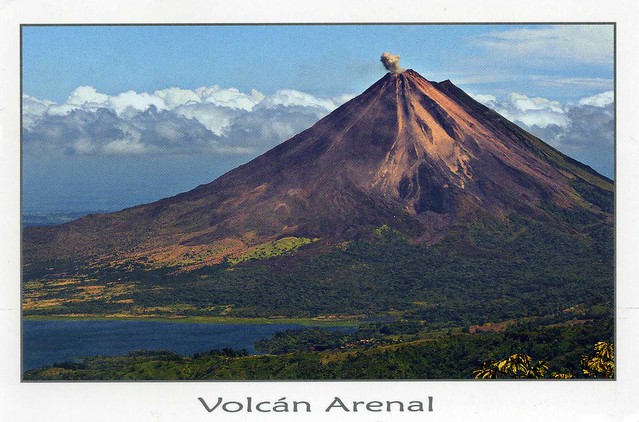
I don't have too many postcards from Costa Rica so I'm really happy about this one, even if it wasn't mailed directly from Costa Rica in the end.
Arenal Volcano is an active andesitic stratovolcano in north-western Costa Rica around 90 km northwest of San José, in the province of Alajuela, canton of San Carlos, and district of La Fortuna. The Arenal volcano measures at least 1,633 metres. It is conically shaped with a crater spanning 140 metres. Arenal is geologically considered a young volcano and the age is estimated to be less than 7,000 years. It is also known as "Pan de Azúcar", "Canaste", "Volcan Costa Rica", "Volcan Río Frío" or "Guatusos Peak".
The volcano was dormant for hundreds of years and exhibited a single crater at its summit, with minor fumaroles activity, covered by dense vegetation. In 1968 it erupted unexpectedly, destroying the small town of Tabacón. Due to the eruption three more craters were created on the western flanks but only one of them still exists today. Since October 2010, Arenal's volcanic activity appears to be decreasing and explosions have become rare.
Showing posts with label volcanoes. Show all posts
Thursday, 23 August 2012
Thursday, 28 April 2011
Volcan de Izalco, El Salvador
One more card for today.. and it's from a new country so it's even more special to me! :)

The sender, Fernando, tells me that this volcano can be seen from his window. Wow! That's a pretty impressive view to have, although I'd imagine it might be a bit unnerving to live so close to a volcano that might still erupt one day... For comparison, if I look straight out of my bedroom window I just see the next door house. To the right the views are nicer, and sometimes we get really nice sunsets. This is from October 2009. To the left, I can see the big road and houses across the road, and the hill behind those houses. I couldn't find any recent photos (although I'm sure I've taken some not too long ago) so here's one from December last year, when it snowed. Obviously it doesn't look like that at the moment. :P
Anyway, back to the postcard... Izalco is a parasitic stratovolcano of the Santa Ana Volcano, which is located in western El Salvador. It is situated on the southern flank of the Santa Ana volcano. Izalco erupted almost continuously from 1770 (when it formed) to 1958 earning it the nickname of "Lighthouse of the Pacific", and experienced a flank eruption in 1966. During an eruption in 1926, the village of Matazano was buried and 56 people were killed. The formation of the volcano actually occupied highly arable land on the southern slope of the Santa Ana volcano which was used for the production of coffee, cacao and sugar cane.
A hotel was built on the nearby Cerro Verde to provide accommodation with a view of the erupting volcano, but the volcano ceased to erupt shortly before the hotel was completed.
Today, Izalco experiences only fumarolic activity in the form of rainwater seeping into the volcano and contacting hot rocks, rather than steam emissions from underground gases. The volcano is visited and climbed regularly by tourists to El Salvador via the Cerro Verde National Park and is a national icon of the country, even featured on the 10 colón bank note (US dollars replaced the colon in 2001, so the bank note is no longer in circulation). The volcano is currently quiescent but may erupt again.

The stamp is from a set of 2 stamps issued in 2008 under the theme "82 years of radio communication".
The sender, Fernando, tells me that this volcano can be seen from his window. Wow! That's a pretty impressive view to have, although I'd imagine it might be a bit unnerving to live so close to a volcano that might still erupt one day... For comparison, if I look straight out of my bedroom window I just see the next door house. To the right the views are nicer, and sometimes we get really nice sunsets. This is from October 2009. To the left, I can see the big road and houses across the road, and the hill behind those houses. I couldn't find any recent photos (although I'm sure I've taken some not too long ago) so here's one from December last year, when it snowed. Obviously it doesn't look like that at the moment. :P
Anyway, back to the postcard... Izalco is a parasitic stratovolcano of the Santa Ana Volcano, which is located in western El Salvador. It is situated on the southern flank of the Santa Ana volcano. Izalco erupted almost continuously from 1770 (when it formed) to 1958 earning it the nickname of "Lighthouse of the Pacific", and experienced a flank eruption in 1966. During an eruption in 1926, the village of Matazano was buried and 56 people were killed. The formation of the volcano actually occupied highly arable land on the southern slope of the Santa Ana volcano which was used for the production of coffee, cacao and sugar cane.
A hotel was built on the nearby Cerro Verde to provide accommodation with a view of the erupting volcano, but the volcano ceased to erupt shortly before the hotel was completed.
Today, Izalco experiences only fumarolic activity in the form of rainwater seeping into the volcano and contacting hot rocks, rather than steam emissions from underground gases. The volcano is visited and climbed regularly by tourists to El Salvador via the Cerro Verde National Park and is a national icon of the country, even featured on the 10 colón bank note (US dollars replaced the colon in 2001, so the bank note is no longer in circulation). The volcano is currently quiescent but may erupt again.

The stamp is from a set of 2 stamps issued in 2008 under the theme "82 years of radio communication".
Subscribe to:
Posts (Atom)

Maroon