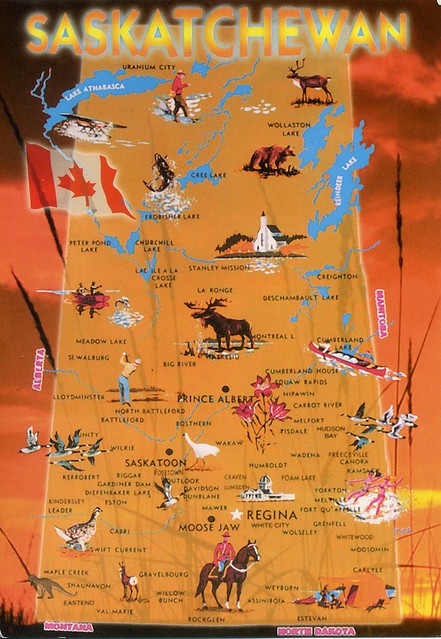
Saskatchewan is a prairie province in Canada, which has a total area of 651,900 square kilometres and a land area of 592,534 square kilometres, the remainder being water area (covered by lakes/ponds, reservoirs and rivers). Saskatchewan is bordered on the west by the Province of Alberta, on the north by the Northwest Territories, on the east by Manitoba, and on the south by the U.S. states of Montana and North Dakota. As of December 2013, the population of Saskatchewan was estimated at 1,114,170. Residents primarily live in the southern half of the province. Of the total population, 257,300 live in the province's largest city, Saskatoon, while 210,000 live in the provincial capital, Regina. Other major cities include Prince Albert, Moose Jaw, Yorkton, Swift Current, and North Battleford.
Saskatchewan has been inhabited for thousands of years by various indigenous groups, and first explored by Europeans in 1690 and settled in 1774. It became a province in 1905, its name derived from the Saskatchewan River. The river was known as kisiskāciwani-sīpiy ("swift flowing river") in the Cree language. In the early 20th century the province became known as a stronghold for Canadian democratic socialism. Tommy Douglas, who was premier from 1944 to 1961, became the first social-democratic politician to be elected in North America. The province's economy is based on agriculture, mining, and energy. Saskatchewan's current premier is Brad Wall and its lieutenant-governor is Vaughn Solomon Schofield.
In 1992, the federal and provincial governments signed a historic land claim agreement with Saskatchewan First Nations. The First Nations received compensation and were permitted to buy land on the open market for the tribes; they have acquired about 761,000 acres, now reserve lands. Some First Nations have used their settlement to invest in urban areas, including Saskatoon.




 Maroon


