Showing posts with label poland. Show all posts

Tuesday, 2 February 2016

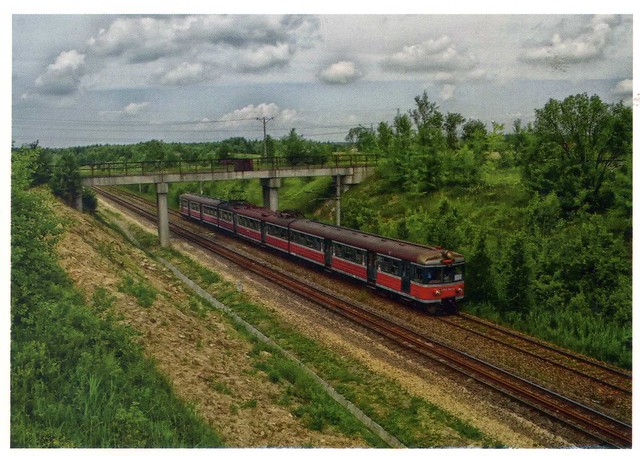
Polish train

A random card from last year, received through Postcard United.


There is no information about the picture on the card so I have no idea what place this is or whether this train has any significance. I do think it's a nice picture, though. I haven't looked at the Postcard United website for months and months now. I thought they were really suspicious (how could they not be if you can't even delete your account or at least remove your contact details off the site?!) so haven't bothered since. I did receive some nice postcards through the site but I can do the same with Postcrossing.

Wednesday, 16 September 2015

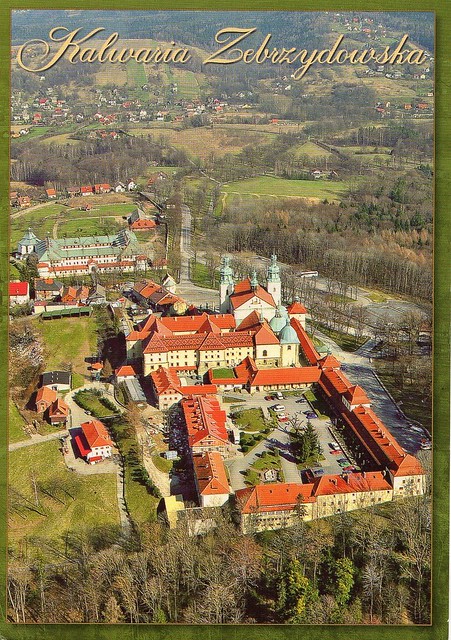
Kalwaria Zebrzydowska, Poland

Another Unesco card, this time from Poland.


Kalwaria Zebrzydowska: the Mannerist Architectural and Park Landscape Complex and Pilgrimage Park

Kalwaria Zebrzydowska is a breathtaking cultural landscape of great spiritual significance. Its natural setting – in which a series of symbolic places of worship relating to the Passion of Jesus Christ and the life of the Virgin Mary was laid out at the beginning of the 17th century – has remained virtually unchanged. It is still today a place of pilgrimage.

Wednesday, 22 July 2015

Wooden Churches of Southern Małopolska, Poland

My Unesco collection has been growing slowly. This is one of the cards I've received this year.


The wooden churches of southern Little Poland represent outstanding examples of the different aspects of medieval church-building traditions in Roman Catholic culture. Built using the horizontal log technique, common in eastern and northern Europe since the Middle Ages, these churches were sponsored by noble families and became status symbols. They offered an alternative to the stone structures erected in urban centres. The churches are located in Gorlice, Nowy Targ, Bochnia counties (Lesser Poland Voivodeship or Małopolskie), and Brzozów County (Subcarpathian Voivodeship) and are in Binarowa, Blizne, Dębno, Haczów, Lipnica Dolna, and Sękowa.

The wooden church style of the region originated in the late Medieval, the late sixteenth century, and began with Gothic ornament and polychrome detail, but because they were timber construction, the structure, general form, and feeling is entirely different from the gothic architecture or Polish Gothic (in stone or brick). Later construction show Rococo and Baroque ornamental influence. The form of these Roman Catholic churches is deeply influenced by the Greco-Catholic and Orthodox presence in the region. Some display Greek cross plans and onion domes, but the most interesting of the churches combine these features with the Roman forms with elongated naves and steeples. Other collections of wooden churches of the region are in the open-air museums in Sanok and Nowy Sącz.

Wednesday, 22 April 2015

Greetings from Poland

This is the third Polish 'Greetings from' postcard. I wonder if there's going to be a fourth one one day... :D


The Tatra Mountains are a mountain range that form a natural border between Slovakia and Poland. They are the highest mountain range in the Carpathian Mountains. The Tatras should be distinguished from the Low Tatras which are located south of the Tatra Mountains in Slovakia.

The Tatra Mountains occupy an area of 785 square kilometres, of which about 610 square kilometres (77.7%) lie within Slovakia and about 175 square kilometres (22.3%) on the territory of Poland. The highest peak called Gerlach, at 2,655 m is located north of Poprad. The highest point in Poland, Rysy, at 2,499 m is located south of Zakopane.

Sunday, 5 April 2015

Greetings from Poland

Unless I'm very much mistaken, this was the very first 'Greetings from' postcard from Postallove..?? Or could it have been one of the first batch of countries? I ordered a bunch of the latest countries when they came out but am still waiting for my order. I'm a bit annoyed as so many other people seem to have received their orders already. Me, impatient?! :P


I hadn't realised there were so many lakes in Poland! I did know there are a LOT in Finland, but never thought there'd be that many in Poland. Hmmm.

Wednesday, 18 March 2015

Auschwitz Birkenau, Poland

A rather creepy card for now... I don't think I'd ever be able to stomach visiting this place, I think it would just be way too much. On a slightly different note, I don't want to get too much into politics here as this isn't the place, but I find it odd how there doesn't seem to be nearly the same level of outrage at the fact that concentration camps still exist in North Korea. I've read a couple of really, really grim books on the topic recently and was pretty horrified. I mean there's Holocaust Memorial Day and everything (and for a good reason, too), but why isn't there more campaigning against the ones that still exist - how can you have a slogan like 'Never Again' in these circumstances?? Unless I've missed something...


Auschwitz Birkenau
German Nazi Concentration and Extermination Camp (1940-1945)

The fortified walls, barbed wire, platforms, barracks, gallows, gas chambers and cremation ovens show the conditions within which the Nazi genocide took place in the former concentration and extermination camp of Auschwitz-Birkenau, the largest in the Third Reich. According to historical investigations, 1.5 million people, among them a great number of Jews, were systematically starved, tortured and murdered in this camp, the symbol of humanity's cruelty to its fellow human beings in the 20th century.

Monday, 16 February 2015

Greetings from Poland

My 'Greetings from...' postcard collection is growing! :) This one arrived last week from a Facebook swap with Gosia in Poland. Thank you ever so much!


I kind of hope that the only reason there are three different 'Greetings from...' Poland postcards is because that's where the designer lives. The series is starting to get rather large... I don't think I'll be able to keep up, particularly as there are supposed to be new countries out later this month (and some of them are not so common, either...).

Saturday, 30 March 2013

Polish foods

I ended up receiving two copies of this card last year, and both through swaps as well. I don't mind, though, I really like it. ...although it does make me hungry :P


 There's a fairly big Polish community in the area where I live so it's pretty easy to find Polish foods in supermarkets and other shops. I haven't tried many for some reason, though, and only tried some pierogi a few weeks ago when Matt's mum bought some that had been in the 'reduced' section in Tesco. Mmmmm, so tasty! ...and those pickled cucumbers look really yummy as well, I wonder if they're more sweet or sour? I prefer the kind that's not too sweet, but sadly those aren't too easy to find (I think they're more of a Russian thing??). The things in the middle in this postcard are some sort of smoked cheeses, made of salted sheep milk.


Sunday, 16 September 2012

Kraków, Poland

A wonderful official I received from Poland earlier this year. This card was in my favourites, too! It's always nice when people look at the favourites wall. I always do that, too, but don't always have anything from some people's favourites :(

 
PL-379104

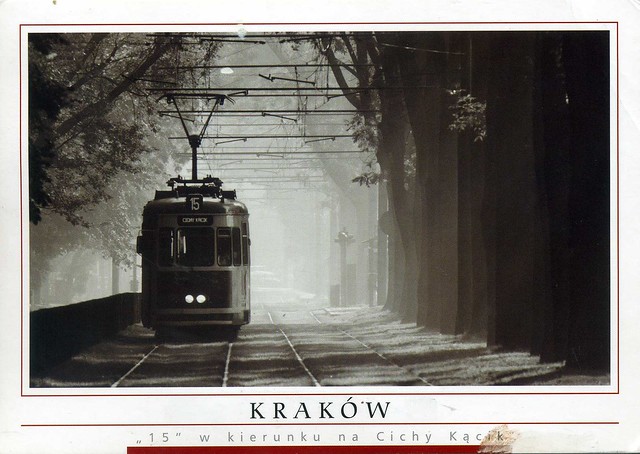
On this card you can see Tram No. 15 on its way to the Cichy Kącik estate in Kraków. I just love the atmosphere here, so mysterious! ...and I love trams, they have so much more character than buses or trains I think.

Thursday, 23 August 2012

Zamość, Poland

I received this beautiful postcard from one of my favourite RR's on the Postcrossing forum, the 'Choose a Country' RR hosted by the lovely Peggy. This RR is on holiday mode at the moment but even before that, I haven't been lucky enough to join any groups for a while and I miss it!


Zamość is a town in southeastern Poland with 66,633 inhabitants (2004), situated in the south-western part of Lublin Voivodeship (since 1999). The historical city centre was added to the UNESCO World Heritage List in 1992. In the view of UNESCO, "Zamość is a unique example of a Renaissance town in Central Europe, consistently designed and built in accordance with the Italian theories of the "ideal town," on the basis of a plan which was the result of perfect cooperation between the open-minded founder, Jan Zamoyski, and the outstanding architect, Bernardo Morando.

Wednesday, 11 April 2012

Wrocław, Poland

I've said before that I'm not generally too fond of multiviews. A lot of them just seem to be too crowded and you can't see anything properly on them. However, I really like this official I received earlier this year. ...maybe because it's a panoramic card and larger than a normal card so you can still see what's in the pictures? ...and it does help that it has a bicycle on it ;)


PL-366628


Wrocław is situated on the River Oder in Lower Silesia. It is the largest city in southwestern Poland.

Wrocław was the historical capital of Silesia, and today is the capital of the Lower Silesian Voivodeship. Over the centuries, the city has been part of either Poland, Bohemia, Austria, Prussia, or Germany, but since 1945 it has been part of Poland as a result of border changes after World War II. According to official figures for 2010, its population is 632,996, making it the fourth largest city in Poland.

Wroclaw is one of the hosts of UEFA Euro 2012. Wrocław has been selected as a European Capital of Culture for 2016. It will share the title with San Sebastián (aka Donostia), Spain. In 2017, Wrocław will host the World Games, a competition in 37 non-olympic sport disciplines.

Saturday, 31 March 2012

Kraków, Poland

Earlier this week it was really warm and sunny here in England - above +20 C and you could go out in a t-shirt! It was lovely, I wish these sunny days weren't over yet. Something else earlier this week made me a LOT less happy.. the Royal Mail announced their annual price increases, and it's the biggest increase in 37 years, about 30% in average but some prices are going up even more (like parcels and packets). Needless to say I'm NOT happy. I'm going to have to cut back on the number of postcards I send. I still want to keep sending postcards to my postcard pals, friends and regular swappers, but I'll have to cut back on the number of officials I send, and limit my forum activities. I can sort of see why they need to increase the prices if they are making losses, but increases on this kind of scale just seem totally ridiculous and over the top, surely it's going to mean that people will send even less mail than before?! Seems to me like they're just trying to fatten up the Royal Mail for privatisation (and if/when that happens, I suspect even bigger price increases and worse service :(). Grrrrr!!

Anyway. I thought I'd post some nice cards here to cheer myself up a bit. This first beauty had been in my favourites for a while and then earlier this year I received it through one of my favourite RR's (Choose a Country RR). :)


I've already written about Kraków here so I'm not going to repeat myself. I wanted to post about this card anyway, though, because I simply adore it, the atmosphere in it is so beautiful. I love the tones here, it looks like such a surreal scene!

Saturday, 17 March 2012

Poznań, Poland

I do love it when people pick me a postcard from my favourites on the official Postcrossing site. It's so thoughtful of them, and then usually these same people also write lots on the card :) This treat arrived last year from Poland.


PL-288718


Poznań is a city on the Warta river in west-central Poland, with a population of 556,022 in June 2009. It is among the oldest cities in Poland, and was one of the most important centres in the early Polish state, whose first rulers were buried at Poznań's cathedral. It is sometimes claimed to be the first capital of the kingdom of Poland.

Poznań is now Poland's fifth largest city. It is the historical capital of the Wielkopolska ("Greater Poland") region, and is currently the administrative capital of the province called Greater Poland Voivodeship.

Poznań is an important centre of trade, industry, and education, and hosts regular international trade fairs. It was the host city for the United Nations Climate Change Conference in December 2008, a key stage in the creation of a successor to the Kyoto Protocol. Poznań was a candidate city for European Capital of Culture in 2016. Poznań is currently bidding to host the 2018 Summer Youth Olympics.

Saturday, 28 January 2012

Kraków, Poland

Just a small update for today. I'm getting behind with everything again :( I received this postcard from dear Ana earlier this month. Thank you so much for the lovely surprise! Ahhh, I wish I could travel a bit more, too. I certainly wouldn't mind visiting Kraków, it looks really pretty ^_^


Kraków is the second largest and one of the oldest cities in Poland. Situated on the Vistula River in the Lesser Poland region, the city dates back to the 7th century. Kraków has traditionally been one of the leading centres of Polish academic, cultural, and artistic life and is one of Poland's most important economic hubs. It was the capital of Poland from 1038 to 1596; the capital of the Grand Duchy of Kraków from 1846 to 1918; and the capital of Kraków Voivodeship from the 14th century to 1999. It is now the capital of the Lesser Poland Voivodeship.

The city has grown from a Stone Age settlement to Poland's second most important city. It began as a hamlet on Wawel Hill and was already being reported as a busy trading centre of Slavonic Europe in 965. With the establishment of new universities and cultural venues at the emergence of the Second Polish Republic and throughout the 20th century, Kraków reaffirmed its role as a major national academic and artistic centre. The city has a population of approximately 760,000 whereas about 8 million people live within a 100 km radius of its main square.

After the invasion of Poland by Nazi Germany at the start of World War II, Kraków was turned into the capital of Germany's General Government. The Jewish population of the city was moved into a walled zone known as the Kraków Ghetto, from which they were sent to extermination camps such as Auschwitz and the concentration camp at Płaszów.

In 1978, Karol Wojtyła, archbishop of Kraków, was elevated to the papacy as Pope John Paul II – the first Slavic pope ever, and the first non-Italian pope in 455 years. Also that year, UNESCO approved the first ever sites for its new World Heritage List, including the entire Old Town in inscribing Cracow's Historic Centre.

Saturday, 26 November 2011

Gdańsk, Poland

Another official, I received this one around the same time as the card from Latvia. This one is from my favourites as well. I really appreciate it when people take the time to select a card they think the receiver is going to like, and go through the galleries. Not that I don't like surprises as well, though!


PL-271187


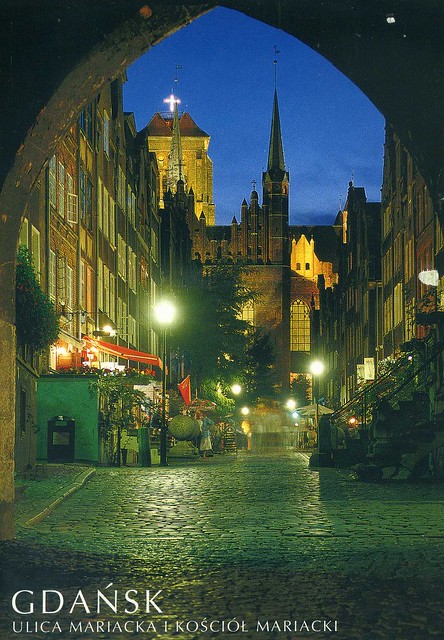
Gdańsk is a Polish city on the Baltic coast, at the centre of the country's fourth-largest metropolitan area. It's an old city, dating back to 997.

Gdańsk is Poland's principal seaport as well as the capital of the Pomeranian Voivodeship. It is also historically the largest city of the Kashubian region. The city is close to the former late medieval/modern boundary between West Slavic and Germanic lands and it has a complex political history with periods of Polish rule, periods of German rule, and extensive self-rule, with two spells as a free city. It has been part of modern Poland since 1945.

Gdańsk is situated at the mouth of the Motława River, connected to the Leniwka, a branch in the delta of the nearby Vistula River, whose waterway system supplies 60% of the area of Poland and connects Gdańsk to the national capital in Warsaw. This gives the city a unique advantage as the centre of Poland's sea trade. Together with the nearby port of Gdynia, Gdańsk is also an important industrial centre. Historically an important seaport and shipbuilding centre, Gdańsk was a member of the Hanseatic League.

The city was the birthplace of the Solidarity movement which, under the leadership of political activist Lech Wałęsa, played a major role in bringing an end to Communist rule across Central Europe.

Saturday, 29 January 2011

Warsaw, Poland

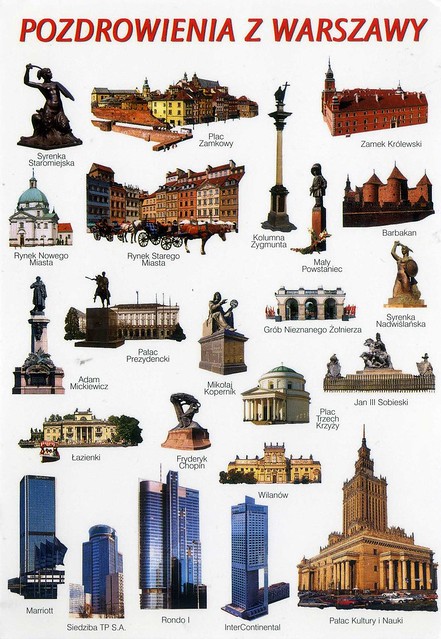
And now, a slightly different postcard from Warsaw, Poland...


The title on the card translates as "Greetings from Warsaw". This card shows monuments and buildings all over the city. Most of them are in Old Town and near it. Mermaid is a symbol of the city. The legend says she promised to protect the city, which is why she has a sword and shield.


The stamp is from 2001, representing Farms.

Saturday, 31 July 2010

Warsaw, Poland

Another gorgeous official, this time from Poland.


PL-108703


I've already written about the Warsaw Old Town in this blog so I'm not going to repeat myself. I just HAD to post this card as I absolutely adore it. The atmosphere is great - I love the blue tones and the lights from the buildings. And there's a full moon! The picture looks like it could be from decades ago, very timeless.

It's such a fun card on the back, too, with lots of writing and a nice message, and some super cute drawings (including one of a squirrel! ^_^). I wish I could draw that well, too...


The stamp is from 2001, representing Farms.

Wednesday, 21 July 2010

Dawna Street, Warsaw, Poland

I can't really understand why they seem to publish so many rather boring viewcards in Poland, when there are lots of beautiful places and little details to use in cards instead. ..although I have to say they do that in a lot of other countries as well, in England too. Do the majority of people really want ugly postcards instead of nice ones? Or do they just not care? Anyway... A while ago I received two truly gorgeous postcards from Poland, makes me wonder why there aren't more like them available.


This is one of the cards, showing Dawna Street (Ulica Dawna) in the capital of Poland, Warsaw. It's so cute and colourful! It seems like this place is located in the Warsaw Old Town, which is also a Unesco site. Dawna Street seems to be the shortest street in Warsaw. This terrace is called Gnojna Mount (gnoj in Polish means dung) as till the 1774 gigantic dumping functioned here. (info)

Warsaw's Old Town is the oldest historic district of the city. It is bounded by Wybrzeże Gdańskie, along the bank of the Vistula, and by Grodzka, Mostowa and Podwale Streets. It is one of Warsaw's most prominent tourist attractions. The heart of the area is the Old Town Market Place, with its restaurants, cafés and shops. Surrounding streets feature medieval architecture such as the city walls, the Barbican and St. John's Cathedral.

Warsaw's Old Town was established in the 13th century. Initially surrounded by an earthwork rampart, prior to 1339 it was fortified with brick city walls. The town originally grew up around the castle of the Dukes of Mazovia that later became the Royal Castle. The Market Square (Rynek Starego Miasta) was laid out sometime in the late 13th or early 14th century, along the main road linking the castle with the New Town to the north.

During the Invasion of Poland (1939), much of the district was badly damaged by the German Luftwaffe, which targeted the city's residential areas and historic landmarks in a campaign of terror bombing. Following the Siege of Warsaw, parts of the Old Town were rebuilt, but immediately after the Warsaw Uprising (August-October 1944) what had been left standing was systematically blown up by the German Army. A statue commemorating the Uprising, "the Little Insurgent," now stands on the Old Town's medieval city wall.

After World War II, the Old Town was meticulously rebuilt. As many of the original bricks were reused as possible. The rubble was sifted for reusable decorative elements, which were reinserted into their original places. Bernardo Bellotto's 18th-century vedute, as well as pre-World-War II architecture students' drawings, were used as essential sources in the reconstruction effort.


The stamps on the envelope were wonderful. They are from a set of 4 stamps issued in 2003, depicting Birds of Prey, more specifically ospreys.
Sunday, 18 July 2010

Grodzisk Mazowiecki, Poland

..and I continue with the train theme. :) This one came as an official, too. The train looks so cute - so colourful!

PL-106379


This postcard shows the last station of Warsaw Suburban Railway, which is in Grodzisk Mazowiecki. Grodzisk Mazowiecki is a town in central Poland with 26,881 inhabitants (in 2006). It is located 30 km southwest of Warsaw.

Warsaw Suburban Railway (WKD; Warszawska Kolej Dojazdowa) is a suburban light rail line in Poland's capital city of Warsaw. The line, together with its two branches, links Warsaw with the municipalities of Michałowice, Pruszków, Brwinów, Podkowa Leśna, Milanówek and Grodzisk Mazowiecki to the south-west of Warsaw.

The line was opened on 11 January 1927 as Elektryczna Kolej Dojazdowa (Electrical Suburban Railway), and received its current name in 1951. It was the first electric railway in Poland and the first one with automatic colour light signalling, supplied by the Swedish firm Signalbolaget.


The stamp on the left is from a set of 3 stamps issued in 2002, representing Polish cities, this one here being the Cathedral of Gniezno, showing the coffin with relics of St Adalberg. I couldn't find any info about the second stamp but it was issued in 1999.