I'm normally at volunteering on Fridays but I'm not feeling too well - I've had a cold for a few days now, although it does seem to be getting better. It better had, too, because I'm supposed to go to the cinema with Matt and some friends on Sunday. I'd hate to have to miss that.
Anyway.. I've had enough of lying in bed so I thought I'd update here. Today's first card is from my dear friend Wanda. She lives in England now but frequently goes back to Santiago de Compostela where she's from. It looks like such a beautiful city, I'd love to visit one day. Wanda has already invited me and Matt over a few times... :P
This is Plaza de las Platerías which, unless I'm very much mistaken, is located in the Old Town of Santiago de Compostela. I've already posted about Santiago de Compostela here so I won't repeat myself now.
Wanda always seems to decorate the backs of the postcards she sends and this one is not an exception. This is just a glimpse of her drawing as I don't want to show the message here, but the rest of it is pretty amazing as well. I wish I was that talented, too...!
Showing posts with label santiago de compostela. Show all posts
Friday, 20 February 2015
Wednesday, 2 June 2010
Santiago de Compostela, Spain
This postcard is from a very close friend, too. I met Wanda in our aikido club in Wolverhampton and she's still one of my closest friends. She's from Santiago de Compostela in Galicia, Spain, and sent me this postcard once when she went to visit her family there.
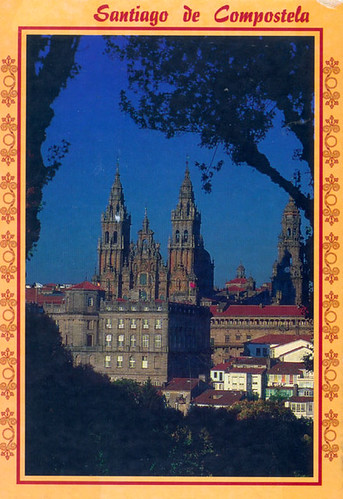
Santiago de Compostela is the capital of the autonomous community of Galicia, Spain. The city's Cathedral is the destination today, as it has been throughout history, of the important 9th century medieval pilgrimage route, the Way of St. James (Galician: Camiño de Santiago, Spanish: Camino de Santiago). In 1985 the city's Old Town was designated a UNESCO World Heritage Site.
I'd like to say a word about Galicia here, since it's rather important (at least if you ask Wanda!). Galicia is an autonomous community and historic region in northwest Spain, with the status of a historic nationality, and descends from one of the first kingdoms of Europe, the Kingdom of Galicia. It is constituted under the Galician Statute of Autonomy of 1981. Its component provinces are A Coruña, Lugo, Ourense and Pontevedra. It is bordered by Portugal to the south, the Spanish regions of Castile and León and Asturias to the east, the Atlantic Ocean to the west, and the Bay of Biscay to the north.
Besides its continental territory, Galicia includes the archipelagos of Cíes, Ons, Sálvora, as well as Cortegada Island, the Malveiras Islands, Sisargas Islands, and Arousa Island.
Galicia has roughly 2.78 million inhabitants as of 2008, with the largest concentration in two coastal areas, from Ferrol to A Coruña in the northwest from Vilagarcía to Vigo on the southwest. The capital is Santiago de Compostela, in the province of A Coruña. Vigo, in the province of Pontevedra, is the most populous city, with 297,332 inhabitants.
Galicia has its own historic language, Galician, more closely related to Portuguese than Spanish, and sharing a common Galician-Portuguese root language with the former in the Middle Ages. Some authors even consider present-day Galician and Portuguese to be dialects of a single language, but the prevailing view, endorsed by the Galician Language Institute is that differences, especially in phonology and vocabulary, are large enough to make them two separate languages. Inevitably, the distinction is reinforced by the political border.
Wanda has also told me that Galicia is one of the Celtic nations together with Scotland, Wales, Ireland, Isle of Man, Cornwall and Brittany. I couldn't find anything about Galicia on the Celtic League website, so I'm a bit confused. Maybe I should ask Wanda again...
Anyway... I want to show the stamp, too, since it's one of the nicer printed sticker postage labels I've seen.

It's so lovely and colourful! I don't know if it's still in use, probably not. This was mailed in August 2006...
..and here's one of my favourite parts of this postcard:

I love the way Wanda wrote my address. :D This is so typical of her, being so random, and one of the many things I love so much about her.
Subscribe to:
Posts (Atom)


Maroon