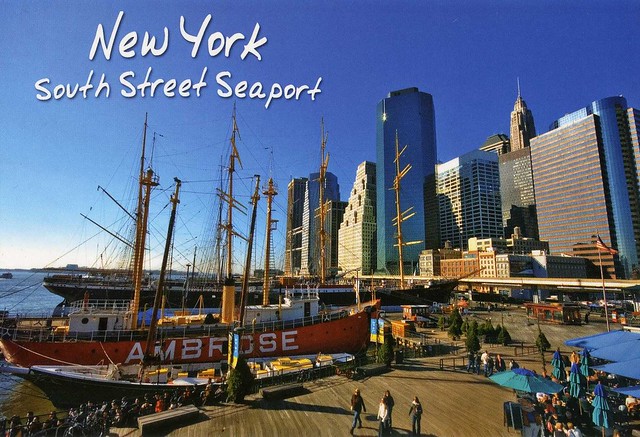
I got this postcard from my friend Wanda a few years ago. I really like this postcard, and it's nice to see a slightly different view of New York.
The South Street Seaport is a historic area in the New York City borough of Manhattan, centered where Fulton Street meets the East River, and adjacent to the Financial District. The Seaport is a designated historic district, and is distinct from the neighboring Financial District. It is part of Manhattan Community Board 1 in Lower Manhattan, and is bounded by the Financial District to the west, southwest, and north; the East River to the southeast; and Two Bridges to the northeast.
It features some of the oldest architecture in downtown Manhattan, and includes the largest concentration of restored early 19th-century commercial buildings in the city. This includes renovated original mercantile buildings, renovated sailing ships, the former Fulton Fish Market, and modern tourist malls featuring food, shopping, and nightlife, with a view of the Brooklyn Bridge.
Showing posts with label wanda. Show all posts
Saturday, 12 September 2015
Monday, 13 April 2015
New York's Little Italy, USA
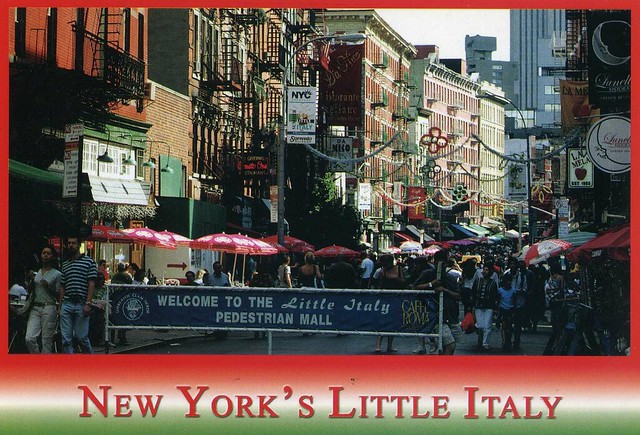
I got some New York postcards from Wanda a few years ago. This is one of them. I really like street views like this!
Little Italy is a neighborhood in lower Manhattan, New York City, once known for its large population of Italians. Today the neighborhood consists of only a few Italian stores and restaurants. It is bounded on the west by Tribeca and Soho, on the south by Chinatown, on the east by the Bowery and Lower East Side, and on the north by Nolita.
Little Italy on Mulberry Street used to extend as far south as Worth Street, as far north as Kenmare Street, as far west as Lafayette Street, and as far east as Bowery. It is now only three blocks on Mulberry Street.
As of the 2000 U.S. Census, 1,211 residents claiming Italian ancestry lived in three census tracts that make up Little Italy. Those residents comprise 8.25% of the population in the community, which is similar to the proportion of those of Italian ancestry throughout New York City.
Little Italy is a neighborhood in lower Manhattan, New York City, once known for its large population of Italians. Today the neighborhood consists of only a few Italian stores and restaurants. It is bounded on the west by Tribeca and Soho, on the south by Chinatown, on the east by the Bowery and Lower East Side, and on the north by Nolita.
Little Italy on Mulberry Street used to extend as far south as Worth Street, as far north as Kenmare Street, as far west as Lafayette Street, and as far east as Bowery. It is now only three blocks on Mulberry Street.
As of the 2000 U.S. Census, 1,211 residents claiming Italian ancestry lived in three census tracts that make up Little Italy. Those residents comprise 8.25% of the population in the community, which is similar to the proportion of those of Italian ancestry throughout New York City.
Wednesday, 18 March 2015
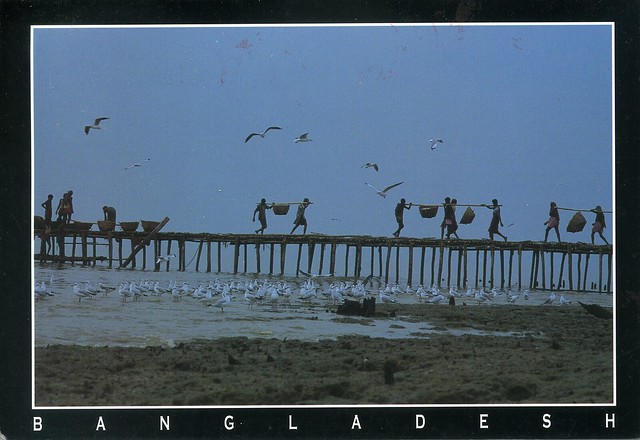
Dubla Island, the Sundarbans, Bangladesh
My dear friend Wanda visited Bangladesh a little over a year ago. I was cheeky and asked if she could send me some postcards, and she did. :) I've already posted one here before, but here's another. This one is actually a Unesco site as well!
The Sundarbans is a natural region in Bengal. It is the largest single block of tidal halophytic mangrove forest in the world. The Sundarbans covers approximately 10,000 square kilometres of which 60 percent is in Bangladesh with the remainder in India. The Sundarbans is a UNESCO World Heritage Site.
The Sundarbans National Park is a National Park, Tiger Reserve, and a Biosphere Reserve located in the Sundarbans delta in the Indian state of West Bengal. Sundarbans South, East and West are three protected forests in Bangladesh. This region is densely covered by mangrove forests, and is one of the largest reserves for the Bengal tiger.
The Sundarbans is a natural region in Bengal. It is the largest single block of tidal halophytic mangrove forest in the world. The Sundarbans covers approximately 10,000 square kilometres of which 60 percent is in Bangladesh with the remainder in India. The Sundarbans is a UNESCO World Heritage Site.
The Sundarbans National Park is a National Park, Tiger Reserve, and a Biosphere Reserve located in the Sundarbans delta in the Indian state of West Bengal. Sundarbans South, East and West are three protected forests in Bangladesh. This region is densely covered by mangrove forests, and is one of the largest reserves for the Bengal tiger.
Friday, 20 February 2015
Santiago de Compostela, Spain
I'm normally at volunteering on Fridays but I'm not feeling too well - I've had a cold for a few days now, although it does seem to be getting better. It better had, too, because I'm supposed to go to the cinema with Matt and some friends on Sunday. I'd hate to have to miss that.
Anyway.. I've had enough of lying in bed so I thought I'd update here. Today's first card is from my dear friend Wanda. She lives in England now but frequently goes back to Santiago de Compostela where she's from. It looks like such a beautiful city, I'd love to visit one day. Wanda has already invited me and Matt over a few times... :P
This is Plaza de las Platerías which, unless I'm very much mistaken, is located in the Old Town of Santiago de Compostela. I've already posted about Santiago de Compostela here so I won't repeat myself now.
Wanda always seems to decorate the backs of the postcards she sends and this one is not an exception. This is just a glimpse of her drawing as I don't want to show the message here, but the rest of it is pretty amazing as well. I wish I was that talented, too...!
Anyway.. I've had enough of lying in bed so I thought I'd update here. Today's first card is from my dear friend Wanda. She lives in England now but frequently goes back to Santiago de Compostela where she's from. It looks like such a beautiful city, I'd love to visit one day. Wanda has already invited me and Matt over a few times... :P
This is Plaza de las Platerías which, unless I'm very much mistaken, is located in the Old Town of Santiago de Compostela. I've already posted about Santiago de Compostela here so I won't repeat myself now.
Wanda always seems to decorate the backs of the postcards she sends and this one is not an exception. This is just a glimpse of her drawing as I don't want to show the message here, but the rest of it is pretty amazing as well. I wish I was that talented, too...!
Sunday, 17 August 2014
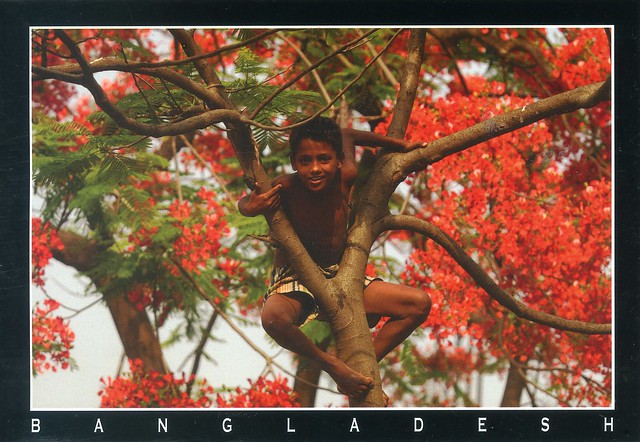
Bangladesh
Just one more card for today. My friend Wanda visited Bangladesh earlier this year and was sweet enough to send me some postcards from there. :) This is probably my favourite.
According to the description on the back of the card, this view is from Dhaka, and shows flame trees in bloom during spring. Wanda said that in villages, many people (mainly boys) climb coconut trees and would put a monkey to shame :D
Thursday, 17 February 2011
Cathedral–Mosque of Córdoba, Spain
..and here's another card from Wanda. It's actually a Unesco one, too!

The Cathedral and former Great Mosque of Córdoba is today a World Heritage Site and the Cathedral of the diocese of Córdoba. The site was originally a pagan temple, then a Visigothic Christian church, before the Umayyad Moors at first converted the building into a mosque, and then built a new mosque on the site. It is located in the Andalusian city of Córdoba, Spain. The Mezquita is regarded as perhaps the most accomplished monument of the Umayyad Caliphate of Córdoba. After the Spanish Reconquista, it once again became a Roman Catholic church, with a plateresque cathedral later inserted into the centre of the large Moorish building.

The Cathedral and former Great Mosque of Córdoba is today a World Heritage Site and the Cathedral of the diocese of Córdoba. The site was originally a pagan temple, then a Visigothic Christian church, before the Umayyad Moors at first converted the building into a mosque, and then built a new mosque on the site. It is located in the Andalusian city of Córdoba, Spain. The Mezquita is regarded as perhaps the most accomplished monument of the Umayyad Caliphate of Córdoba. After the Spanish Reconquista, it once again became a Roman Catholic church, with a plateresque cathedral later inserted into the centre of the large Moorish building.
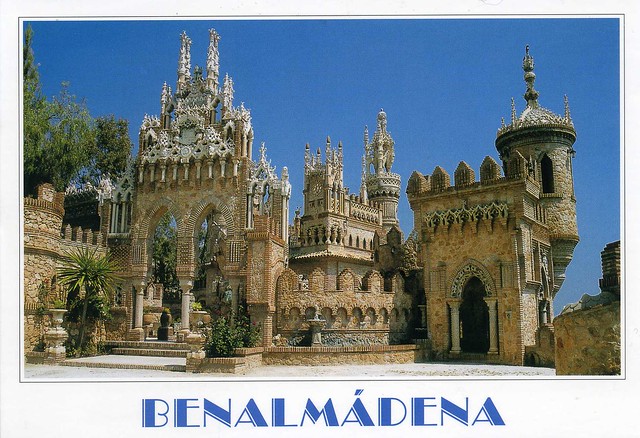
Colomares Castle, Spain
I got some more postcards from Wanda not long ago. Lots of gorgeous views from Spain, and I wanted to show a couple of them here.

The first cards shows the Colomares Castle in Benalmádena, Málaga, Spain. Built by Esteban Martin and local bricklayers from nearby Mijas, between 1987 and 1994, this castle pays homage to Christopher Colombus and the discovery of America. This castle offers the visitor different architectural styles: Byzantine, Roman, Gothic and Mudejar. In the interior is what is believed to be the smallest church in the world, dedicated to St Elizabeth of Hungary, and which features in the Guinness Book of Records. source
Benalmádena, then, is a town and municipality in the province of Málaga, part of the autonomous community of Andalusia in southern Spain. The municipality is situated approximately 12 km to the west of the city of Málaga, on the southern coast between Torremolinos and Fuengirola, in the heart of the Costa del Sol. It has a population of approximately 53,000 residents, but also caters for a large number of tourists.

The first cards shows the Colomares Castle in Benalmádena, Málaga, Spain. Built by Esteban Martin and local bricklayers from nearby Mijas, between 1987 and 1994, this castle pays homage to Christopher Colombus and the discovery of America. This castle offers the visitor different architectural styles: Byzantine, Roman, Gothic and Mudejar. In the interior is what is believed to be the smallest church in the world, dedicated to St Elizabeth of Hungary, and which features in the Guinness Book of Records. source
Benalmádena, then, is a town and municipality in the province of Málaga, part of the autonomous community of Andalusia in southern Spain. The municipality is situated approximately 12 km to the west of the city of Málaga, on the southern coast between Torremolinos and Fuengirola, in the heart of the Costa del Sol. It has a population of approximately 53,000 residents, but also caters for a large number of tourists.
Sunday, 2 January 2011
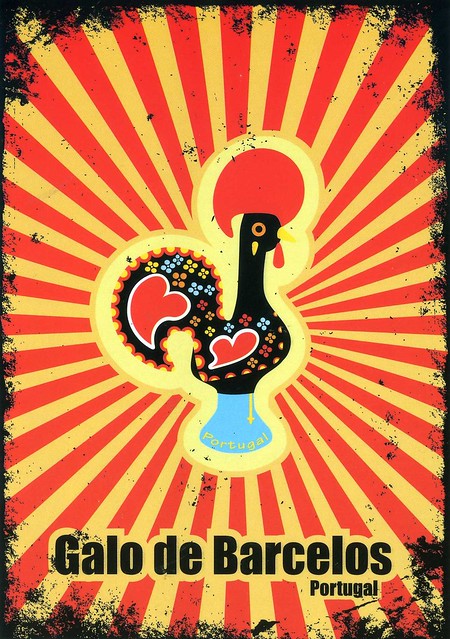
Galo de Barcelos, Portugal
Most of the cards I got from Wanda for Christmas were from Spain, but there were a few Portuguese ones there as well. This one is probably my favourite.

There is some info at the back of the card:
In the town of Barcelos there is a very famous symbol called o Galo de Barcelos in Portuguese. The legend says that a rich man made a big party. When the party was over, the rich man noticed that his sterling cutlery was stolen by a guest. He accused a pilgrim and let him go to court. He protested his innocence, but the judge didn't believe him. The judge was about to eat a roasted cock and the pilgrim said: If I am innocent, this cock will crow. When the pilgrim was about to be hanged, the cock crowed. The judge released the pilgrim. The story ends and a few years later when the pilgrim returned and made a statue over the event. This legend became famous all over Portugal.

There is some info at the back of the card:
In the town of Barcelos there is a very famous symbol called o Galo de Barcelos in Portuguese. The legend says that a rich man made a big party. When the party was over, the rich man noticed that his sterling cutlery was stolen by a guest. He accused a pilgrim and let him go to court. He protested his innocence, but the judge didn't believe him. The judge was about to eat a roasted cock and the pilgrim said: If I am innocent, this cock will crow. When the pilgrim was about to be hanged, the cock crowed. The judge released the pilgrim. The story ends and a few years later when the pilgrim returned and made a statue over the event. This legend became famous all over Portugal.
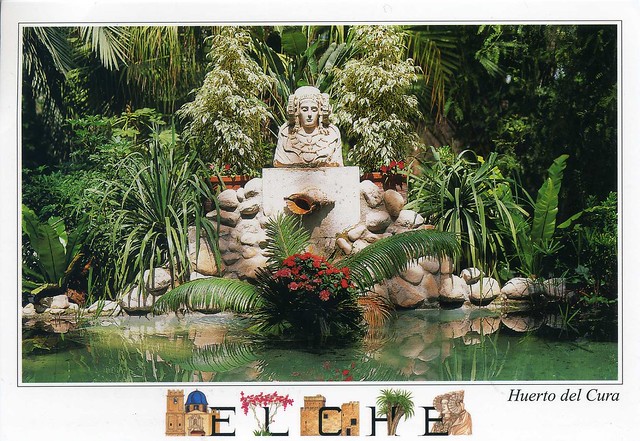
Elche, Spain
One more card from Spain for today. This one's from Elche, in Costa Blanca in Valencia.

Elche is a city located in the comarca of Baix Vinalopó, in the Alicante province which, in turn, is a part of the Valencian Community, Spain. According to the 2008 census, Elche has a population of some 228,300 inhabitants, ranking as the third most populated city in the Valencian Community (after Valencia and Alicante) and the 20th largest Spanish city.
Part of the municipality is coastal but the main city is some 11 km from the Mediterranean Sea. A small creek called Vinalopó flows through the city splitting it in two parts.
El Huerto del Cura ('the Curate's orchard') is part of El Palmeral - an ancient grove of palm trees (Phoenix dactylifera) said to have been planted by the Phoenecians. The orchard grows both fruiting species and ornamental species. The garden has two ponds. [source]

Elche is a city located in the comarca of Baix Vinalopó, in the Alicante province which, in turn, is a part of the Valencian Community, Spain. According to the 2008 census, Elche has a population of some 228,300 inhabitants, ranking as the third most populated city in the Valencian Community (after Valencia and Alicante) and the 20th largest Spanish city.
Part of the municipality is coastal but the main city is some 11 km from the Mediterranean Sea. A small creek called Vinalopó flows through the city splitting it in two parts.
El Huerto del Cura ('the Curate's orchard') is part of El Palmeral - an ancient grove of palm trees (Phoenix dactylifera) said to have been planted by the Phoenecians. The orchard grows both fruiting species and ornamental species. The garden has two ponds. [source]
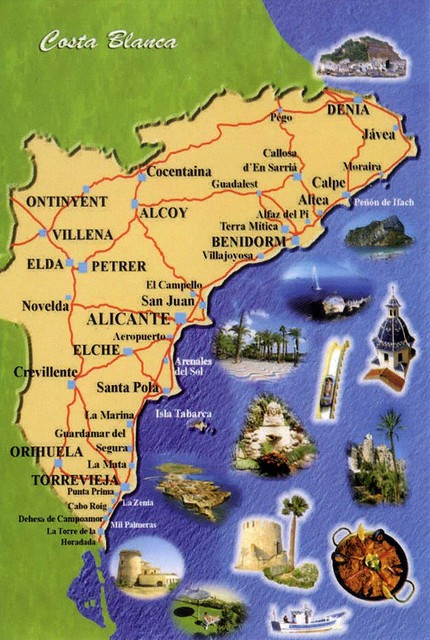
Costa Blanca, Spain
Let's move on, to the west coast of Spain. This is another card I got from Wanda. I'm so excited she got me a map card as well!

Costa Blanca refers to the over 200 kilometres of coastline belonging to the Province of Alicante in Spain. The name "Costa Blanca" was devised as a promotional name used by British European Airways when they launched their air service between London and Valencia in 1957. It has a well developed tourism industry and is a popular destination for British and German tourists. It extends from the towns of Denia in the north, beyond which lies the Costa dels Tarongers, to Pilar de la Horadada in the south, beyond which lies the Costa Calida. It includes the major tourist destinations of Benidorm, Alicante, Denia and Xàbia.

Costa Blanca refers to the over 200 kilometres of coastline belonging to the Province of Alicante in Spain. The name "Costa Blanca" was devised as a promotional name used by British European Airways when they launched their air service between London and Valencia in 1957. It has a well developed tourism industry and is a popular destination for British and German tourists. It extends from the towns of Denia in the north, beyond which lies the Costa dels Tarongers, to Pilar de la Horadada in the south, beyond which lies the Costa Calida. It includes the major tourist destinations of Benidorm, Alicante, Denia and Xàbia.
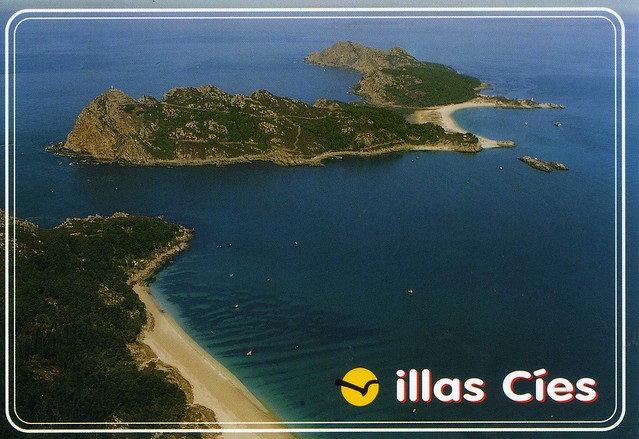
Cíes Islands, Spain
One more Galician card...

The Cíes Islands are an archipelago off the coast of Pontevedra in Galicia, in the mouth of the Ría de Vigo. They belong to the parish of San Francisco de Afora, in the municipality of Vigo. They were declared a Nature Reserve in 1980 and are included in the Atlantic Islands of Galicia National Park (Parque Nacional Marítimo-Terrestre das Illas Atlánticas de Galicia) created in 2002. In the year 2007, the British newspaper The Guardian chose the beach of Rodas, in the island of Monteagudo, as the "most beautiful beach of the world".
The Cíes consist of three islands, Monteagudo ("Sharp Mount" or North Island), do Faro ("Lighthouse Island", or Isla do Medio, "Middle Island") and San Martiño ("Saint Martin" or South Island).
Due to the high natural value of this area and to the deterioration it was suffering by human activity, it was declared a Nature Reserve in 1980. The level of legal protection varied until November 21, 2000, when the Galician Parliament unanimously agreed to apply for the status of National Park to the central Government. The Spanish Congress of Deputies signed a definite agreement in June 2002, creating the National Land-Marine Park of the Atlantic Islands of Galicia, formed by a number of archipelagos, islands and cays, namely the Cíes, Ons, Sálvora, Noro, Vionta, Cortegada and the Malveiras.

The Cíes Islands are an archipelago off the coast of Pontevedra in Galicia, in the mouth of the Ría de Vigo. They belong to the parish of San Francisco de Afora, in the municipality of Vigo. They were declared a Nature Reserve in 1980 and are included in the Atlantic Islands of Galicia National Park (Parque Nacional Marítimo-Terrestre das Illas Atlánticas de Galicia) created in 2002. In the year 2007, the British newspaper The Guardian chose the beach of Rodas, in the island of Monteagudo, as the "most beautiful beach of the world".
The Cíes consist of three islands, Monteagudo ("Sharp Mount" or North Island), do Faro ("Lighthouse Island", or Isla do Medio, "Middle Island") and San Martiño ("Saint Martin" or South Island).
Due to the high natural value of this area and to the deterioration it was suffering by human activity, it was declared a Nature Reserve in 1980. The level of legal protection varied until November 21, 2000, when the Galician Parliament unanimously agreed to apply for the status of National Park to the central Government. The Spanish Congress of Deputies signed a definite agreement in June 2002, creating the National Land-Marine Park of the Atlantic Islands of Galicia, formed by a number of archipelagos, islands and cays, namely the Cíes, Ons, Sálvora, Noro, Vionta, Cortegada and the Malveiras.
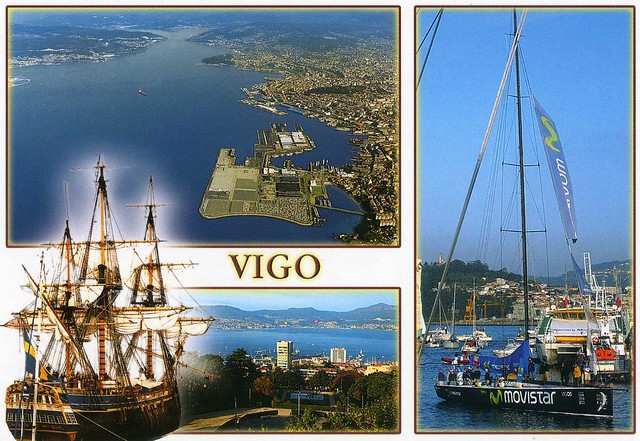
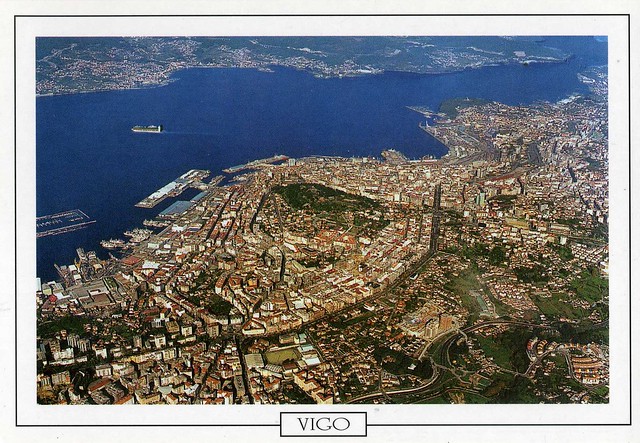
Vigo, Spain
More cards from Wanda...

Vigo is a city and municipality in Galicia, Spain. The city is located on the ria of the same name on the Atlantic Ocean.
It is the largest city in Galicia with a population of 297,332, with an extended metropolitan population of 468,654, making it the 14th-largest metropolitan area of Spain. Vigo is the largest city in Spain which is not a provincial capital.
The urban area of Vigo is built over both a hill-fort (Castro) and a Roman settlement. It is generally accepted that the name Vigo is derived from the Latin word Vicus.
Vigo is one of the leading industrial areas in Galicia, with car factories, shipyards, and auxiliary industry. Vigo has the largest fishing port in Europe as well, and the home port of the world's largest fishing company, Pescanova. The headquarters of the European Fisheries Agency are placed in here.

Vigo is a city and municipality in Galicia, Spain. The city is located on the ria of the same name on the Atlantic Ocean.
It is the largest city in Galicia with a population of 297,332, with an extended metropolitan population of 468,654, making it the 14th-largest metropolitan area of Spain. Vigo is the largest city in Spain which is not a provincial capital.
The urban area of Vigo is built over both a hill-fort (Castro) and a Roman settlement. It is generally accepted that the name Vigo is derived from the Latin word Vicus.
Vigo is one of the leading industrial areas in Galicia, with car factories, shipyards, and auxiliary industry. Vigo has the largest fishing port in Europe as well, and the home port of the world's largest fishing company, Pescanova. The headquarters of the European Fisheries Agency are placed in here.
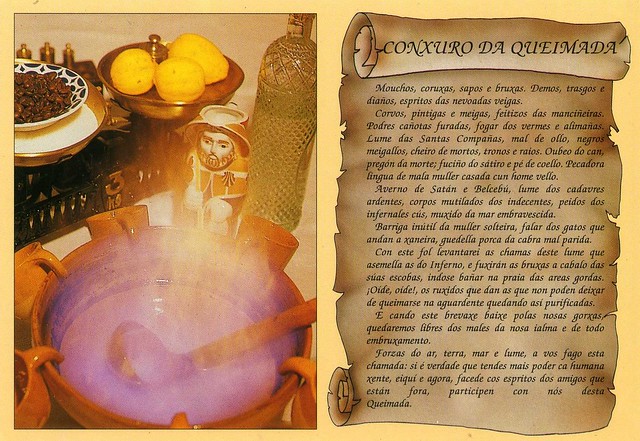
Conxuro da Queimada
Happy New Year 2011! I hope you all will have a lovely year with lots of great postcards. :) 2010 was pretty good for me postcard-wise, I'm hoping 2011 will be the same. I got some Spanish and Portuguese postcards for Christmas from my friend Wanda. Yeah, my friends know I like postcards :D There were some really nice ones amongst those cards so I wanted to post about a few of them here. The first one is a very cool recipe card. :)

'Conxuro da Queimada' translates as 'Queimada's Spell'. It is an alcoholic beverage of Galician tradition. Queimada is a punch made from Galician aguardente (Orujo Gallego) - a spirit distilled from wine and flavoured with special herbs or coffee, plus sugar, lemon peel, coffee beans and cinnamon.
Typically, while preparing the punch a spell or incantation is recited, so that special powers are conferred to the queimada and those drinking it. Then the queimada is set alight, and slowly burns as more brandy is added. Wanda very helpfully included an English translation on the back of the card:
Owls, barn owls, toads and witches. Demons, goblins and devils, spirits of the misty vales.
Crows, salamanders and mages, charms of the folk healer(ess). Rotten pierced canes, home of worms and vermin. Wisps of the Holy Company, evil eye, black witchcraft, scent of the dead, thunder and lightning. Howl of the dog, omen of death, maws of the satyr and foot of the rabbit. Sinful tongue of the bad woman married to an old man.
Satan and Beelzebub's Inferno, fire of the burning corpses, mutilated bodies of the indecent ones, farts of the arses of doom, bellow of the enraged sea.
Useless belly of the unmarried woman, speech of the cats in heat, dirty turf of the wicked born goat.
With this bellows I will pump the flames of this fire which looks like that from Hell, and witches will flee, straddling their brooms, going to bathe in the beach of the thick sands. Hear! Hear the roars of those that cannot stop burning in the firewater, becoming so purified.
And when this beverage goes down our throats, we will get free of the evil of our soul and of any charm. Forces of air, earth, sea and fire, to you I make this call: if it's true that you have more power than people, here and now, make the spirits of the friends who are outside, take part with us in this Queimada.

'Conxuro da Queimada' translates as 'Queimada's Spell'. It is an alcoholic beverage of Galician tradition. Queimada is a punch made from Galician aguardente (Orujo Gallego) - a spirit distilled from wine and flavoured with special herbs or coffee, plus sugar, lemon peel, coffee beans and cinnamon.
Typically, while preparing the punch a spell or incantation is recited, so that special powers are conferred to the queimada and those drinking it. Then the queimada is set alight, and slowly burns as more brandy is added. Wanda very helpfully included an English translation on the back of the card:
Owls, barn owls, toads and witches. Demons, goblins and devils, spirits of the misty vales.
Crows, salamanders and mages, charms of the folk healer(ess). Rotten pierced canes, home of worms and vermin. Wisps of the Holy Company, evil eye, black witchcraft, scent of the dead, thunder and lightning. Howl of the dog, omen of death, maws of the satyr and foot of the rabbit. Sinful tongue of the bad woman married to an old man.
Satan and Beelzebub's Inferno, fire of the burning corpses, mutilated bodies of the indecent ones, farts of the arses of doom, bellow of the enraged sea.
Useless belly of the unmarried woman, speech of the cats in heat, dirty turf of the wicked born goat.
With this bellows I will pump the flames of this fire which looks like that from Hell, and witches will flee, straddling their brooms, going to bathe in the beach of the thick sands. Hear! Hear the roars of those that cannot stop burning in the firewater, becoming so purified.
And when this beverage goes down our throats, we will get free of the evil of our soul and of any charm. Forces of air, earth, sea and fire, to you I make this call: if it's true that you have more power than people, here and now, make the spirits of the friends who are outside, take part with us in this Queimada.
Wednesday, 2 June 2010
Santiago de Compostela, Spain
This postcard is from a very close friend, too. I met Wanda in our aikido club in Wolverhampton and she's still one of my closest friends. She's from Santiago de Compostela in Galicia, Spain, and sent me this postcard once when she went to visit her family there.
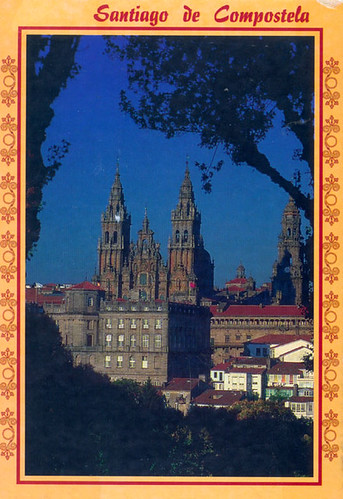
Santiago de Compostela is the capital of the autonomous community of Galicia, Spain. The city's Cathedral is the destination today, as it has been throughout history, of the important 9th century medieval pilgrimage route, the Way of St. James (Galician: Camiño de Santiago, Spanish: Camino de Santiago). In 1985 the city's Old Town was designated a UNESCO World Heritage Site.
I'd like to say a word about Galicia here, since it's rather important (at least if you ask Wanda!). Galicia is an autonomous community and historic region in northwest Spain, with the status of a historic nationality, and descends from one of the first kingdoms of Europe, the Kingdom of Galicia. It is constituted under the Galician Statute of Autonomy of 1981. Its component provinces are A Coruña, Lugo, Ourense and Pontevedra. It is bordered by Portugal to the south, the Spanish regions of Castile and León and Asturias to the east, the Atlantic Ocean to the west, and the Bay of Biscay to the north.
Besides its continental territory, Galicia includes the archipelagos of Cíes, Ons, Sálvora, as well as Cortegada Island, the Malveiras Islands, Sisargas Islands, and Arousa Island.
Galicia has roughly 2.78 million inhabitants as of 2008, with the largest concentration in two coastal areas, from Ferrol to A Coruña in the northwest from Vilagarcía to Vigo on the southwest. The capital is Santiago de Compostela, in the province of A Coruña. Vigo, in the province of Pontevedra, is the most populous city, with 297,332 inhabitants.
Galicia has its own historic language, Galician, more closely related to Portuguese than Spanish, and sharing a common Galician-Portuguese root language with the former in the Middle Ages. Some authors even consider present-day Galician and Portuguese to be dialects of a single language, but the prevailing view, endorsed by the Galician Language Institute is that differences, especially in phonology and vocabulary, are large enough to make them two separate languages. Inevitably, the distinction is reinforced by the political border.
Wanda has also told me that Galicia is one of the Celtic nations together with Scotland, Wales, Ireland, Isle of Man, Cornwall and Brittany. I couldn't find anything about Galicia on the Celtic League website, so I'm a bit confused. Maybe I should ask Wanda again...
Anyway... I want to show the stamp, too, since it's one of the nicer printed sticker postage labels I've seen.

It's so lovely and colourful! I don't know if it's still in use, probably not. This was mailed in August 2006...
..and here's one of my favourite parts of this postcard:

I love the way Wanda wrote my address. :D This is so typical of her, being so random, and one of the many things I love so much about her.
Santiago de Compostela is the capital of the autonomous community of Galicia, Spain. The city's Cathedral is the destination today, as it has been throughout history, of the important 9th century medieval pilgrimage route, the Way of St. James (Galician: Camiño de Santiago, Spanish: Camino de Santiago). In 1985 the city's Old Town was designated a UNESCO World Heritage Site.
I'd like to say a word about Galicia here, since it's rather important (at least if you ask Wanda!). Galicia is an autonomous community and historic region in northwest Spain, with the status of a historic nationality, and descends from one of the first kingdoms of Europe, the Kingdom of Galicia. It is constituted under the Galician Statute of Autonomy of 1981. Its component provinces are A Coruña, Lugo, Ourense and Pontevedra. It is bordered by Portugal to the south, the Spanish regions of Castile and León and Asturias to the east, the Atlantic Ocean to the west, and the Bay of Biscay to the north.
Besides its continental territory, Galicia includes the archipelagos of Cíes, Ons, Sálvora, as well as Cortegada Island, the Malveiras Islands, Sisargas Islands, and Arousa Island.
Galicia has roughly 2.78 million inhabitants as of 2008, with the largest concentration in two coastal areas, from Ferrol to A Coruña in the northwest from Vilagarcía to Vigo on the southwest. The capital is Santiago de Compostela, in the province of A Coruña. Vigo, in the province of Pontevedra, is the most populous city, with 297,332 inhabitants.
Galicia has its own historic language, Galician, more closely related to Portuguese than Spanish, and sharing a common Galician-Portuguese root language with the former in the Middle Ages. Some authors even consider present-day Galician and Portuguese to be dialects of a single language, but the prevailing view, endorsed by the Galician Language Institute is that differences, especially in phonology and vocabulary, are large enough to make them two separate languages. Inevitably, the distinction is reinforced by the political border.
Wanda has also told me that Galicia is one of the Celtic nations together with Scotland, Wales, Ireland, Isle of Man, Cornwall and Brittany. I couldn't find anything about Galicia on the Celtic League website, so I'm a bit confused. Maybe I should ask Wanda again...
Anyway... I want to show the stamp, too, since it's one of the nicer printed sticker postage labels I've seen.

It's so lovely and colourful! I don't know if it's still in use, probably not. This was mailed in August 2006...
..and here's one of my favourite parts of this postcard:

I love the way Wanda wrote my address. :D This is so typical of her, being so random, and one of the many things I love so much about her.
Subscribe to:
Comments (Atom)


Maroon