Showing posts with label 2005. Show all posts

Wednesday, 20 June 2012

Hiiumaa, Estonia

Speaking of holidays... My parents are going to Prague next week for a few days. I'm so jealous, Prague is one of those cities I'd really love to visit as well. It's quite funny though, my parents are going because my sister had told them they need to go on a holiday somewhere else than to their caravan where they always spend their holidays :D I do agree with my sister, though, I think my parents need this. ...although it's not like they spend ALL their holidays at their caravan - they've been to Estonia a few times as well. One of those visits was in 2005 when they visited Hiiumaa. ..and sent me this postcard from there :) I like it how my family have always been into sending postcards from holidays, even way before I had heard of Postcrossing.


The lighthouse is the Kõpu Lighthouse, I think. I've already written about it here so I won't repeat myself again here. The other pictures I'm not sure of, it doesn't say anything on the card (which seems quite unusual for an Estonian postcard; most of the ones I have seem to have some kind of description of the pictures at the back of the card).

Hiiumaa is the second largest island (989 km²) belonging to Estonia. It is located in the Baltic Sea, north of the island of Saaremaa, a part of the West Estonian archipelago. Its largest town is Kärdla.

Archaeological evidence of the first human settlement in Hiiumaa dates to as early as the 4th century BC. The first documented record of the island of Dageida was made by contemporary chroniclers in 1228, at the time when Hiiumaa, along with the rest of Estonia, had been conquered by Germanic crusaders. In 1254, Hiiumaa was divided between the Bishopric of Ösel-Wiek and the Livonian branch of the Teutonic Order, who were also partly acting on behalf of the Hanseatic League.

 The island was part of Swedish Estonia from 1563 to 1721, after which it passed to the Russian Empire as part of the Governorate of Estonia, although Dagö's Swedish population kept most of their privileges. Most of the island's previously numerous Swedish-speaking population emigrated or were "Estonianised" during the period of Imperial Russian rule, although a small minority remains to this day. Estonian Swedes are also known as "aibofolke" (meaning island people in Swedish) or "rannarootslased" (meaning coastal Swedes in Estonian).

Hiiumaa was occupied during World War I by the Imperial German Army, in Operation Albion. After the war, it became a part of independent Estonia. It was annexed by the Soviet Union in 1940, by Nazi Germany in 1941, and by the Soviets again in 1944. It was then a part of the Estonian Soviet Socialist Republic until the Soviet Union's collapse in 1991. During the Soviet era Hiiumaa was declared a restricted zone, closed to foreigners and to most mainland Estonians. Since 1991, the island has been a part of independent Estonia.


Friday, 4 June 2010

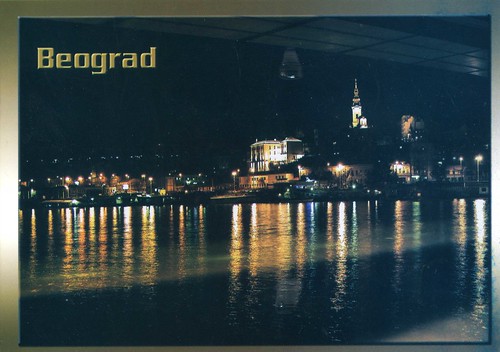
Belgrade, Serbia

Continuing with older cards from friends... This one is from Shana, we were penpals for years but sadly aren't in touch anymore. I miss her and her letters. :( Shana lived in the USA but was quite fascinated with Serbia and got to visit there in 2005. She sent me this lovely card from there.


Belgrade (Beograd in Serbian) is the capital and largest city of Serbia. With a population of 1,630,000 (official estimate 2007), Belgrade is the third largest city in Southeastern Europe, after Istanbul and Athens. Its name in Serbian translates to "White city".

Belgrade's wider city area was the birthplace of the largest prehistoric culture of Europe, the Vinča culture, as early as the 6th millennium BC. In antiquity, the area of Belgrade was inhabited by the Thraco-Dacian tribe of Singi who would give the name to the city after a fortress was founded in the 3rd century BC by the Celts, who named it Singidun (dun, fortress). It was awarded city rights by the Romans before it was permanently settled by Serbs from the 7th century onwards. As a strategic location, the city was battled over in 115 wars and razed to the ground 44 times since the ancient period by countless armies of the East and West. In medieval times, it was in the possession of Byzantine, Frankish, Bulgarian, Hungarian and Serbian rulers. In 1521 Belgrade was conquered by the Ottomans and became the seat of the Pashaluk of Belgrade, as the principal city of Ottoman Europ and among the largest European cities. Frequently passing from Ottoman to Austrian rule which saw destruction of most of the city, the status of Serbian capital would be regained only in 1841, after the Serbian revolution. Northern Belgrade, though, remained a Habsburg outpost until the breakup of Austria-Hungary in 1918. The united city then became the capital of several incarnations of Yugoslavia, up to 2006, when Serbia became an independent state again. [from Wikipedia]