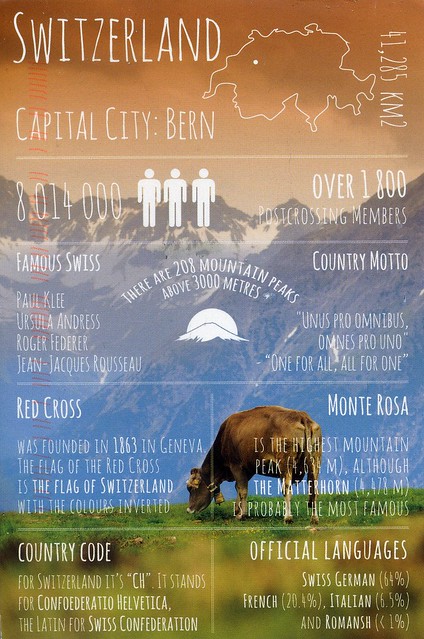
A surprise from dear Sara (zasa)! :) I really like the postcards in this series but only have a couple so far. I ordered some postcards from postallove a couple of days ago and was tempted to get the whole series but I'd prefer the cards written and stamped from their respective countries of origin so I decided against it. Oh well...
I think this series is a brilliant idea, I wonder how many more countries will be added in the future...?!
Showing posts with label switzerland. Show all posts
Sunday, 21 December 2014
Wednesday, 9 May 2012
map of Switzerland
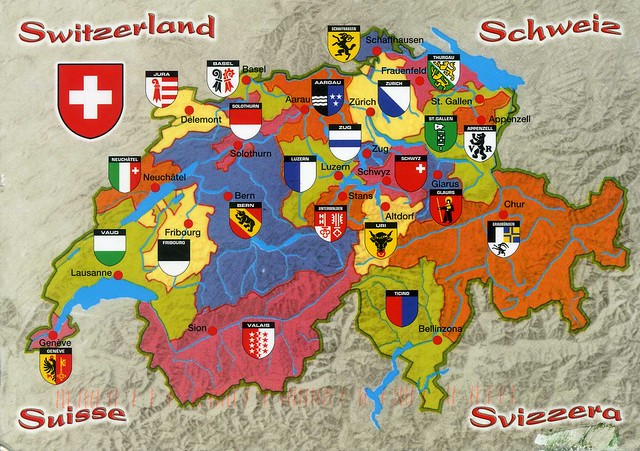
I haven't posted a card from Switzerland here for a while so here's one, a great map card I received from Andy (who runs the fab 'I'm going to vacation RR' on the Postcrossing forum).
Switzerland is a federal republic consisting of 26 cantons, with Bern as the seat of the federal authorities. Switzerland is a landlocked country geographically divided between the Alps, the Swiss Plateau and the Jura, spanning an area of 41,285 km2. While the Alps occupy the greater part of the territory, the Swiss population of approximately 8 million people is concentrated mostly on the Plateau, where the largest cities are to be found. Among them are the two global cities and economic centres of Zurich and Geneva.
The Swiss Confederation has a long history of armed neutrality—it has not been in a state of war internationally since 1815—and did not join the United Nations until 2002. It pursues, however, an active foreign policy and is frequently involved in peace-building processes around the world. Switzerland is also the birthplace of the Red Cross and home to a large number of international organizations, including the second largest UN office. On the European level, it is a founding member of the European Free Trade Association and is part of the Schengen Area – although it is notably not a member of the European Union, nor the European Economic Area.
Switzerland comprises three main linguistic and cultural regions: German, French, and Italian, to which the Romansh-speaking valleys are added. The Swiss, therefore, though predominantly German-speaking, do not form a nation in the sense of a common ethnic or linguistic identity. The strong sense of belonging to the country is founded on the common historical background, shared values (federalism and direct democracy) and Alpine symbolism. The establishment of the Swiss Confederation is traditionally dated to 1 August 1291; Swiss National Day is celebrated on the anniversary.
Switzerland is a federal republic consisting of 26 cantons, with Bern as the seat of the federal authorities. Switzerland is a landlocked country geographically divided between the Alps, the Swiss Plateau and the Jura, spanning an area of 41,285 km2. While the Alps occupy the greater part of the territory, the Swiss population of approximately 8 million people is concentrated mostly on the Plateau, where the largest cities are to be found. Among them are the two global cities and economic centres of Zurich and Geneva.
The Swiss Confederation has a long history of armed neutrality—it has not been in a state of war internationally since 1815—and did not join the United Nations until 2002. It pursues, however, an active foreign policy and is frequently involved in peace-building processes around the world. Switzerland is also the birthplace of the Red Cross and home to a large number of international organizations, including the second largest UN office. On the European level, it is a founding member of the European Free Trade Association and is part of the Schengen Area – although it is notably not a member of the European Union, nor the European Economic Area.
Switzerland comprises three main linguistic and cultural regions: German, French, and Italian, to which the Romansh-speaking valleys are added. The Swiss, therefore, though predominantly German-speaking, do not form a nation in the sense of a common ethnic or linguistic identity. The strong sense of belonging to the country is founded on the common historical background, shared values (federalism and direct democracy) and Alpine symbolism. The establishment of the Swiss Confederation is traditionally dated to 1 August 1291; Swiss National Day is celebrated on the anniversary.
Thursday, 5 May 2011
Bernina Express, Switzerland
This very nice card arrived as an official earlier this year. The sender lives in Germany but she was on holiday in Switzerland and picked up this card from there. I'm not complaining, it's very pretty and for once I don't really mind it being a multiview.

DE-846421
The Bernina Express is an express train connecting Chur (or Davos) in Switzerland with Poschiavo and Tirano in Italy, by crossing the Swiss Alps from north to south. For most of its journey, the train also passes along and through the World Heritage Site known as the Rhaetian Railway in the Albula / Bernina Landscapes.
The train is operated by the Rhaetian Railway company. It is not an "express" in the sense of being a high-speed train, but, rather, in the sense that it provides a one-seat ride for a long duration trip. The Bernina Express itself is composed of panoramic coaches with a piped multi-lingual commentary, and a small supplement and seat reservation are both obligatory. The train is popular with tourists, and connects in Tirano with the Post Bus service via Lake Como in Italy to Lugano in Switzerland.
The Albula line and the Bernina line on the Bernina Express route were jointly declared a World Heritage Site in 2008. The trip on the Bernina Express through this World Heritage Site is a 4 hour railway journey across 196 bridges, through 55 tunnels and across the Bernina Pass on the highest point at 2,253 metres in altitude. The entire line is 1,000 mm (3 ft 3 3⁄8 in) (metre gauge).

This card was mailed from Germany. The stamp on the right was issued in 2006 and represents 'spring'. Unless I'm very much mistaken, it's from a set of 4 stamps depicting the four seasons. The other one is one of those automated labels, this one showing Brandenburg Gate in Berlin.

The Bernina Express is an express train connecting Chur (or Davos) in Switzerland with Poschiavo and Tirano in Italy, by crossing the Swiss Alps from north to south. For most of its journey, the train also passes along and through the World Heritage Site known as the Rhaetian Railway in the Albula / Bernina Landscapes.
The train is operated by the Rhaetian Railway company. It is not an "express" in the sense of being a high-speed train, but, rather, in the sense that it provides a one-seat ride for a long duration trip. The Bernina Express itself is composed of panoramic coaches with a piped multi-lingual commentary, and a small supplement and seat reservation are both obligatory. The train is popular with tourists, and connects in Tirano with the Post Bus service via Lake Como in Italy to Lugano in Switzerland.
The Albula line and the Bernina line on the Bernina Express route were jointly declared a World Heritage Site in 2008. The trip on the Bernina Express through this World Heritage Site is a 4 hour railway journey across 196 bridges, through 55 tunnels and across the Bernina Pass on the highest point at 2,253 metres in altitude. The entire line is 1,000 mm (3 ft 3 3⁄8 in) (metre gauge).

This card was mailed from Germany. The stamp on the right was issued in 2006 and represents 'spring'. Unless I'm very much mistaken, it's from a set of 4 stamps depicting the four seasons. The other one is one of those automated labels, this one showing Brandenburg Gate in Berlin.
Friday, 8 October 2010
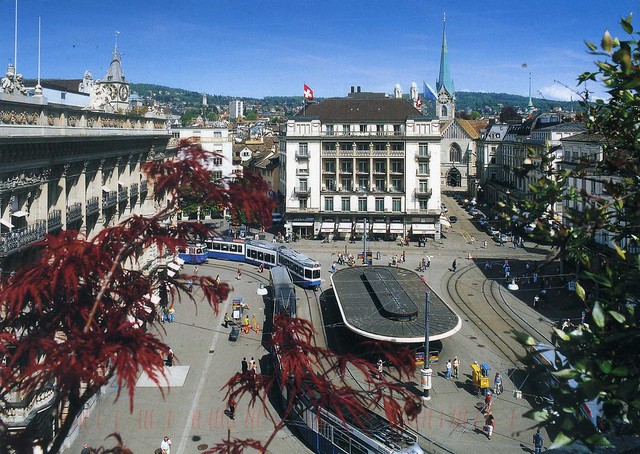
Zürich, Switzerland
Here's a slightly different postcard from Switzerland. ..and by 'different' I mean that it doesn't feature mountains or cute little houses, or chocolate. Don't get me wrong, I like all those things, but it's nice to see something else occasionally as well.

This card shows the Paradeplatz, a square at the Bahnhofstrasse in downtown Zürich. It is one of the most expensive pieces of real estate in Switzerland and has become synonymous with wealth and the Swiss banks, being the location of the headquarters of both UBS and Credit Suisse.
The site of the square lay without the medieval city walls, and was incorporated into the town with the construction of the new ramparts in 1642. During the 17th century, it served as a lifestock market, known as Säumärt ("pig market"), renamed to Neumarkt "new market" in 1819 and finally to its current name following the construction of Bahnhofstrasse (1865). The hotel Baur en Ville on the eastern end of the square opened in 1838. The Paradeplatz was the scene of clashes between insurgents and cantonal troops during the 1839 Züriputsch.
Sounds like a pretty freaky place - an area with nothing but banks! O_o The trams look really nice, and I like the flowers (or trees?) at the front, I think they add a nice touch to the card and make it less "business-like", if you can say so.

So many stamps! The one on the right is a commemorative one, issued earlier this year to mark the 250th birth (?) anniversary of Johann Peter Hebel. The stamps next to it are from a set of 4 stamps issued in 2008, representing Cereals. The one in the middle is barley, and the two others are rye.

This card shows the Paradeplatz, a square at the Bahnhofstrasse in downtown Zürich. It is one of the most expensive pieces of real estate in Switzerland and has become synonymous with wealth and the Swiss banks, being the location of the headquarters of both UBS and Credit Suisse.
The site of the square lay without the medieval city walls, and was incorporated into the town with the construction of the new ramparts in 1642. During the 17th century, it served as a lifestock market, known as Säumärt ("pig market"), renamed to Neumarkt "new market" in 1819 and finally to its current name following the construction of Bahnhofstrasse (1865). The hotel Baur en Ville on the eastern end of the square opened in 1838. The Paradeplatz was the scene of clashes between insurgents and cantonal troops during the 1839 Züriputsch.
Sounds like a pretty freaky place - an area with nothing but banks! O_o The trams look really nice, and I like the flowers (or trees?) at the front, I think they add a nice touch to the card and make it less "business-like", if you can say so.

So many stamps! The one on the right is a commemorative one, issued earlier this year to mark the 250th birth (?) anniversary of Johann Peter Hebel. The stamps next to it are from a set of 4 stamps issued in 2008, representing Cereals. The one in the middle is barley, and the two others are rye.
Wednesday, 7 July 2010
Solothurn, Switzerland
My last postcard for today comes from Switzerland and was sent to me by my postcard pal Christophe. Solothurn calls itself Switzerland's most beautiful Baroque City (well, it does look very pretty!).
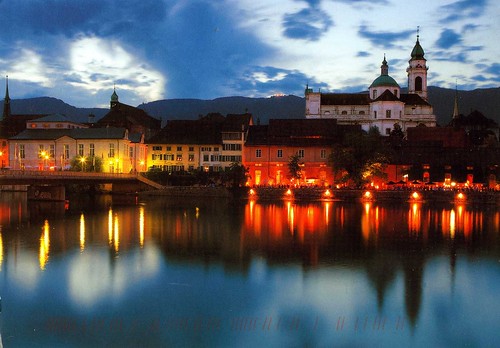
Solothurn is the capital of the Canton of Solothurn in Switzerland. The city also comprises the only municipality of the district of the same name. It is located in the north-west of Switzerland on the banks of the Aare and on the foot of the Weissenstein Jura mountains, in the German-speaking part of the country.
This Celtic settlement was renewed around AD 14–37 by the Roman emperor Claudius, and became a Roman stronghold (castrum) under the name of Salodurum. Its strategical importance lay in the position at the approach to the Rhine from southeast.
In the Middle Ages the settlement grew around the remains of the Roman fortress and the religious house of St. Ursen, dedicated to Ursus of Solothurn, founded in the 8th century. In 1127, it was acquired by the dukes of Zähringen, and became a free imperial city in 1218 when that dynasty extinguished. After the alliance with Berne in 1295, it became part of the Swiss Confederation. In 1382 the Habsburgs attacked the city, involving Solothurn in the Battle of Sempach. By the treaty of two years later, the Habsburgs renounced all claims to the territory of the city. The latter was expanded by acquisition of neighbouring lands in the 15th century, roughly up to the today's canton area.
In 1481, it obtained full membership in the Swiss Confederation, and in 1530–1792 it was the seat of the French ambassador to the Swiss.
Solothurn has a special affinity for the number eleven. The Canton of Solothurn was the eleventh to become part of the Swiss Confederation. There are eleven churches and chapels, as well as eleven historical fountains and eleven towers. The St. Ursus cathedral has eleven altars and eleven bells, and the stairs in front of the cathedral have levels between every eleven steps.

The stamp is from a set of 2 stamps issued in 2009, showing birds. This one is the Rock Partridge.
Solothurn is the capital of the Canton of Solothurn in Switzerland. The city also comprises the only municipality of the district of the same name. It is located in the north-west of Switzerland on the banks of the Aare and on the foot of the Weissenstein Jura mountains, in the German-speaking part of the country.
This Celtic settlement was renewed around AD 14–37 by the Roman emperor Claudius, and became a Roman stronghold (castrum) under the name of Salodurum. Its strategical importance lay in the position at the approach to the Rhine from southeast.
In the Middle Ages the settlement grew around the remains of the Roman fortress and the religious house of St. Ursen, dedicated to Ursus of Solothurn, founded in the 8th century. In 1127, it was acquired by the dukes of Zähringen, and became a free imperial city in 1218 when that dynasty extinguished. After the alliance with Berne in 1295, it became part of the Swiss Confederation. In 1382 the Habsburgs attacked the city, involving Solothurn in the Battle of Sempach. By the treaty of two years later, the Habsburgs renounced all claims to the territory of the city. The latter was expanded by acquisition of neighbouring lands in the 15th century, roughly up to the today's canton area.
In 1481, it obtained full membership in the Swiss Confederation, and in 1530–1792 it was the seat of the French ambassador to the Swiss.
Solothurn has a special affinity for the number eleven. The Canton of Solothurn was the eleventh to become part of the Swiss Confederation. There are eleven churches and chapels, as well as eleven historical fountains and eleven towers. The St. Ursus cathedral has eleven altars and eleven bells, and the stairs in front of the cathedral have levels between every eleven steps.

The stamp is from a set of 2 stamps issued in 2009, showing birds. This one is the Rock Partridge.
Saturday, 5 June 2010
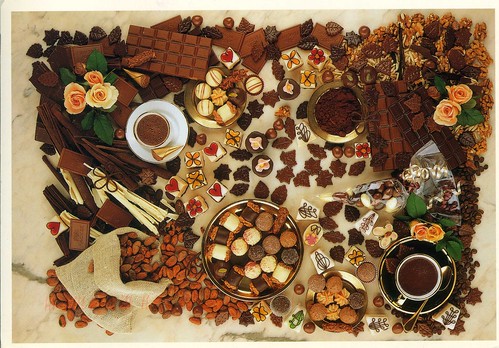
chocolate from Switzerland
I'll be off to writing some postcards in a moment, but I wanted to post this first. Doesn't it look delicious?! Mmmmm, so much chocolate!

CH-53312
It's an official I received yesterday. I'd so love to try some of the goodies shown on the card!

The stamps are great, to! The one on the right is an Europa 2010 stamp, this year's theme is children's books. I have no idea which book this is supposed to represent.. And I also don't have any info on the red stamp, although I'd imagine it's an old definitive stamp (I've seen these before).

It's an official I received yesterday. I'd so love to try some of the goodies shown on the card!

The stamps are great, to! The one on the right is an Europa 2010 stamp, this year's theme is children's books. I have no idea which book this is supposed to represent.. And I also don't have any info on the red stamp, although I'd imagine it's an old definitive stamp (I've seen these before).
Monday, 17 May 2010
First post
Hello, and welcome to my new postcard blog! I have seen so many nice postcard blogs lately that I wanted to try having my own. Let's see how this will go...

CH-8925
I thought I'd start this off with a bit of nostalgia and post about my first official postcrossing postcard received. It arrived on the 22nd of November 2007 from Switzerland, from the lovely Zasa. I remember being very excited to receive the card - someone had made it specially for me, and written it full of nice text.

This was the stamp on the card. It shows Leonhard Euler, a pioneering Swiss mathematician and physicist.

I thought I'd start this off with a bit of nostalgia and post about my first official postcrossing postcard received. It arrived on the 22nd of November 2007 from Switzerland, from the lovely Zasa. I remember being very excited to receive the card - someone had made it specially for me, and written it full of nice text.

This was the stamp on the card. It shows Leonhard Euler, a pioneering Swiss mathematician and physicist.
Subscribe to:
Posts (Atom)


Maroon