Showing posts with label outer hebrides. Show all posts

Wednesday, 15 September 2010

Barra, Outer Hebrides, Scotland

...and here's the final Scotland postcard from Andy. This one shows Barra on the Outer Hebrides.


Kisimul Castle dominates Castlebay, the main settlement of Barra. The most southerly of the Outer Hebrides, Barra is a very attractive island which has been aptly described as the "Hebrides in Miniature". The vessel MV "Lord of the Isles" provides the daily ro-ro link with Oban.

The 2001 census showed that the resident population was 1,078. The area of Barra is roughly 60 square kilometres, the main village being Castlebay (Bàgh a' Chaisteil). Barra is now linked by a man-made causeway to the neighbouring island of Vatersay (Eilean Bhatarsaigh). The Isle of Barra is a predominantly Gaelic-speaking island.

The west of the island has white sandy beaches backed by shell-sand machair and the east has numerous rocky inlets. Barra is abundant with stunning scenery, rare flowers and wildlife, which can be appreciated by coastal or hill walks, drives or cycle rides along the various small roads. Car and bicycle hire are available locally.

Uniquely in Europe, Barra's tiny airport, near Northbay, uses the beach called An Tràigh Mhòr (English: The Big Beach) as a runway. Planes can only land and take off at low tide meaning that the timetable varies. Barra's airport is the only airport in the world to have scheduled flights landing on a beach. The aircraft currently in operation on Barra is the de Havilland Canada DHC-6 Twin Otter, flown by Loganair on services to Glasgow and Benbecula from where connections to Stornoway are also available. There are no flights on Sundays.

Tuesday, 15 June 2010

North Uist, Scotland

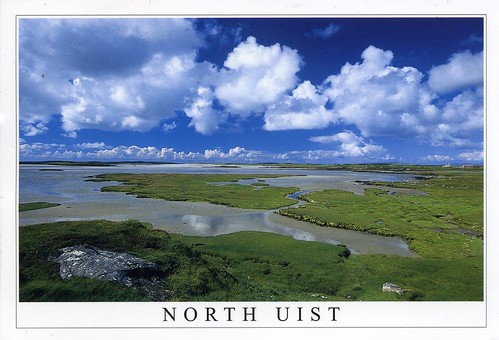
Another card from the Western Islands in Scotland and also from Sarah (who doesn't seem to be active on postcrossing anymore :( ). I received this one last year as well, but it's such a lovely card that it definitely deserves a spot here. :)


This card shows Vallay Strand in North Uist. Uist (or The Uists) are the central group of islands in the Outer Hebrides of Scotland. The Outer Hebrides is a chain of more than 100 islands and small skerries located about 70 kilometres west of mainland Scotland. There are 15 inhabited islands in this archipelago, which is also known as the Western Isles and archaically as the Long Isle.

Lewis and Harris is the largest island in Scotland and the third largest in the British Isles, after Great Britain and Ireland. It incorporates Lewis in the north and Harris in the south, both of which are frequently referred to as individual islands, although they are joined by a land border. The largest settlement in Lewis and in the Outer Hebrides is Stornoway.

The Outer Hebrides had a population of 26,502 in 2001. The area has historically been a strong Scottish Gaelic (Gàidhlig) speaking area. Despite recent declines, in the 2001 census more than 50% of the resident population in each island was able to speak Gaelic, for an overall total of 15,842 speakers throughout the archipelago. The modern economy centres on tourism, crofting, fishing, and weaving, the latter of which includes the manufacture of Harris tweed. The archipelago is exposed to wind and tide, and there are numerous lighthouses as an aid to navigation.

Monday, 14 June 2010

St Kilda, Scotland

I thought I'd throw in a random card as I'm currently transferring (a ton of) photos from my laptop to an external harddrive, and it's taking ages. :S I received this card last year and it's still one of my favourites. It's very beautiful, AND it's from Scotland and a Unesco site as well.


This volcanic archipelago, with its spectacular landscapes, is situated off the coast of the Hebrides and comprises the islands of Hirta, Dun, Soay and Boreray. It has some of the highest cliffs in Europe, which have large colonies of rare and endangered species of birds, especially puffins and gannets. The archipelago, uninhabited since 1930, bears the evidence of more than 2,000 years of human occupation in the extreme conditions prevalent in the Hebrides. Human vestiges include built structures and field systems, the cleits and the traditional Highland stone houses. They feature the vulnerable remains of a subsistence economy based on the products of birds, agriculture and sheep farming.

You can read more about St Kilda here. Sarah, who sent me this card, told me that she can see this place on the horizon from her village!


The stamp is from a set of 6 stamps representing Cathedrals, issued in 2008. This one shows the Lichfield Cathedral.