I somehow ended up with two 'Greetings from' Indonesia cards. Ooops. I don't really mind, though, as they are both lovely - beautiful stamps and gorgeous decorations on the back. ^_^
I had to look up the symbol in the middle as I seem to remember there was initially a picture of a coconut tree there but it was changed. This is what I found, and I think it's pretty cool:
Bhinneka Tunggal Ika is the official national motto of Indonesia. The phrase is Old Javanese translated as "Unity in Diversity". It is inscribed in the Indonesian national symbol, Garuda Pancasila (written on the scroll gripped by the Garuda's claws), and is mentioned specifically in article 36A of the Constitution of Indonesia. The Garuda is a mythical bird and the mount of Lord Vishnu.
It is a quotation from an Old Javanese poem Kakawin Sutasoma, written by Mpu Tantular during the reign of the Majapahit empire sometime in the 14th century, under the reign of King Rājasanagara, also known as Hayam Wuruk. Kakawin contains epic poems written in metres.
This poem is notable as it promotes tolerance between Hindus (especially Shivaites) and Buddhists.
...and the stamps on the second card:
Showing posts with label indonesia. Show all posts
Wednesday, 12 August 2015
Sunday, 1 March 2015
Year of the Goat, Indonesia
It's Year of the Sheep/Goat this year. I'm trying to collect these stamps from different countries again and have a pretty reasonable collection already. This one is from dear Shinta in Indonesia.
It seems like this year is the Year of Goat rather than Sheep in a lot of countries. I seem to remember someone saying this is because a goat is a higher status animal...??
I love the special cancellations! I wish you could get them in England, too, when sending regular postcards/letters, but it seems like you have to do some special arrangements to get them..?
Labels:
2015,
cancellations,
indonesia,
RR,
stamps,
year of the sheep
Sunday, 15 February 2015
Papua, Indonesia
A lovely map postcard from dear Shinta in Indonesia! :)
Papua is a province of Indonesia. It comprises most of the western half of the island of New Guinea and nearby islands. Its capital is Jayapura. It is the largest and easternmost province of Indonesia.
The province originally covered the entire western half of New Guinea. In 2003, the Indonesian government formed the westernmost part of the island, around the Bird's Head (Doberai) and Bomberai peninsulas, together with the surrounding islands of Raja Ampat, into a separate province; its name was (at first) West Irian Jaya, and is now West Papua.
The remaining part retained the name of Papua Province. It is bordered by the nation of Papua New Guinea to the east, and by the new West Papua Province to the west.
Saturday, 20 October 2012
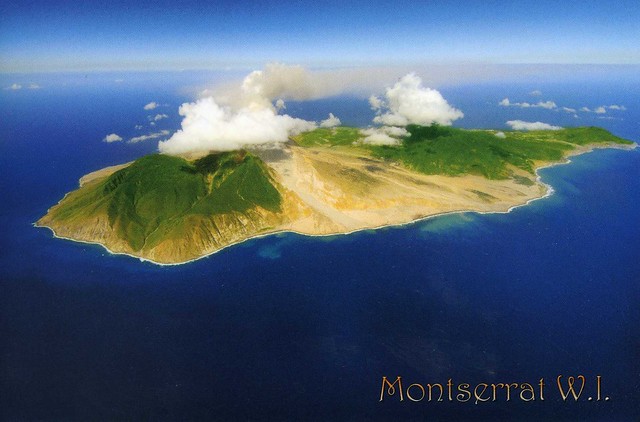
Montserrat W.I.
So much for trying to catch up with this blog... Well, I haven't really been in the mood for updating for a while now (or doing much else.. :/). I thought I'd give this a try now... Starting off with this great postcard of Montserrat that I received via a swap with dear Shinta in Indonesia (so it's not like I have a written and stamped postcard from Montserrat :P Oh well, this is still really nice!).
Montserrat is a Caribbean island that is a British overseas territory. It is located in the Leeward Islands, part of the chain of islands known as the Lesser Antilles, in the West Indies. The island of Montserrat measures approximately 16 km long and 11 km wide, with approximately 40 kilometres of coastline.
On July 18 1995, the previously dormant Soufrière Hills volcano became active. Eruptions destroyed Montserrat's Georgian era capital city of Plymouth and two-thirds of the island's population was forced to flee. The volcanic activity continues to the present, the affected areas currently being mostly in the vicinity of Plymouth, including its docking facilities, and also on the eastern side of the island in the area around the former W. H. Bramble Airport, the remnants of which were buried by flows from volcanic activity on February 11, 2010.
An "exclusion zone" extending from the south coast of the island north to parts of the Belham Valley has been imposed because of the size of the existing volcanic dome and the resulting potential for pyroclastic activity. Presently visitors are not permitted entry into the exclusion zone, but an impressive view of the destruction of Plymouth can be seen from the top of Garibaldi Hill in Isles Bay. Relatively quiet since early 2010, the volcano continues to be closely monitored by the Montserrat Volcano Observatory.
A new town and port is being developed at Little Bay in the northwest of the island. While construction proceeds, the centre of government rests at Brades.
Saturday, 15 September 2012
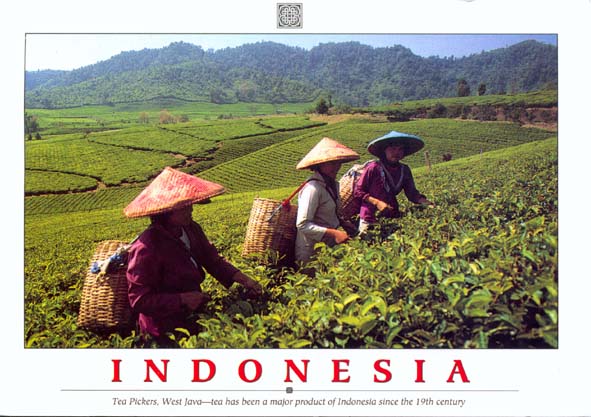
Tea Pickers, West Java, Indonesia
This is a really old postcard, received back in 1997 from Terhi who used to be my
penpal way back then. She moved to Indonesia for a couple of years as her dad got a job there, and she sent me some postcards from there which I still have (I probably have all her letters still somewhere, too, as I don't like throwing mail away). I don't think I used email too much back then as Terhi sent me this card to let me know of her new address...
I don't have much to say about the card itself, and the text on the card pretty much says it all. I'm not sure if I've ever had tea from Indonesia, btw... I'm going to need some extra cups of the stuff this weekend as I've managed to catch a cold, ugh. :/
Wednesday, 1 June 2011
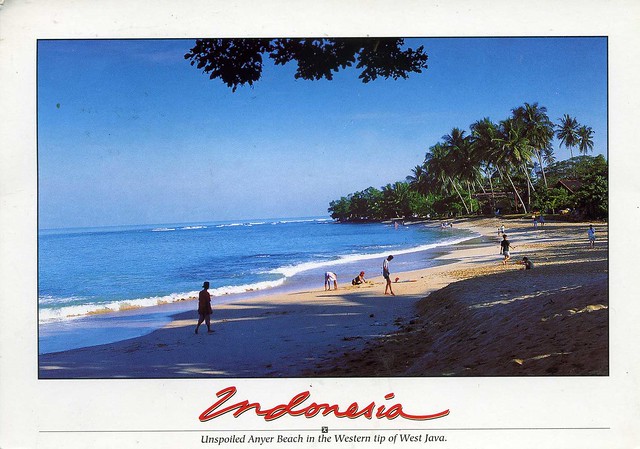
Anyer Beach, West Java, Indonesia
This postcard is pretty old, in my stardards anyway. It's way back from 1997 and was sent to me by a girl who was my penpal back then. She was Finnish but her family moved to Indonesia for a couple of years as her dad got a job offer in Jakarta. We haven't been writing to each other for years and years now, she suddenly just stopped writing to me and wouldn't reply to the couple of letters I sent to her, wondering what was going on. I do wish people would let me know if they don't want to/can't write to me anymore. This is especially true with this girl as her letters were always so long and lovely, I really enjoyed reading them. Anyway, she sent me a couple of postcards from Indonesia and I thought I'd post one of them here. She sent me this one when she'd only just moved to Indonesia and was still trying to get used to living in a new country. She'd only just been to this beach with her family and told me that the sea was almost as warm as the air (over +30 C). Ahhhh, I'd love to be on a beach like this right now!

West Java, with a population around 43 million, is the most populous and most densely populated province of Indonesia. Located on the island of Java, it is slightly smaller in area than densely populated Taiwan, but nearly double the population. Its capital city is Bandung.
West Java borders Jakarta and Banten province to the west, and Central Java to the east. To the north is Java Sea. To the south is the Indian Ocean. Unlike most other provinces in Indonesia which have their capitals in coastal area, the provincial capital Bandung is located in a mountainous area. Banten province was formerly part of West Java province, but was created a separate province in 2000. West Java is located in the densely populated Western third of Java island, which is home to 1 out of every 4 Indonesians.
West Java and Banten provinces have more mountains than any other province in Indonesia. The province's landscape is one of volcanic mountains, steep terrain, forest, mountains rivers, fertile agricultural land, and natural sea harbours.

The stamp is from a set of 2 greetings stamps issued in 1997.
Saturday, 26 February 2011
Year of the Rabbit
Another Year of the Rabbit postcard, this time from the lovely Shinta in Indonesia.

Isn't it a cute little rabbit? I sometimes wish I had a rabbit, but then I don't think I could handle it as they need hay and I'm allergic to it. :( A friend of mine used to have a rabbit years ago, it was adorable but also a bit silly at times as it kept trying to hump the family's cat. :D Obviously it thought it was a cat.. Haha, well, Matt's family have a duck and she also seems to think she's a cat sometimes (as she keeps trying to eat cat food)!

And look, this card came with a matching stamp! Or rather, stamps. The two rabbit ones are from a set of 3 Year of the Rabbit stamps issued earlier this year. I couldn't find any info about the third stamp so I'm not sure what it's supposed to show...
Labels:
2011,
chinese new year,
indonesia,
swap,
year of the rabbit
Saturday, 22 January 2011
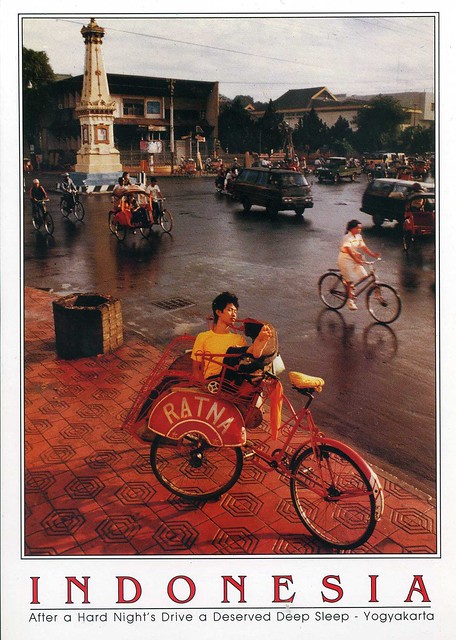
Yogyakarta, Indonesia
I don't normally have any luck in lotteries and such, which is also why I never buy scratch cards - what's the point when I'm not going to win anything? :P ..sooo, I was really surprised when I recently won a lot of goodies in a lottery on the postcrossing forum. ..and it was hosted by Shinta, a wonderful Indonesian postcrosser. :) To celebrate, I started my own lottery today. It's here if you want to join. :) Well, that lottery is also to celebrate the fact that I finally finished my big translation assignment yesterday. Or I hope I did, if the client doesn't want any extra work done and is happy with what I've done...

This is one of the many postcards Shinta sent me. This is one of my favourites - I love seeing street views and ordinary life on postcards (wish I could find such cards here, too...).
Yogyakarta is renowned as a centre of classical Javanese fine art and culture such as batik, ballet, drama, music, poetry, and puppet shows. It is also famous as a centre for Indonesian higher education and the seat of Gadjah Mada University, one of the three most prestigious universities in Indonesia. Yogyakarta was the Indonesian capital during the Indonesian National Revolution from 1945 to 1949. It has a population of roughly 388,000.

...and here's another card from Shinta, showing a typical Indonesian market where you can (=must) bargain over the price, and have a chit-chat with the seller. :)

There were so many pretty, colourful stamps on the envelope! The one on top left is from a set of 6 stamps issued in 2010, showing Indonesian Cultural Heritage. The one next to it is from a set of 2 stamps from 2009, a joint issue with Iran. The stamp on the right is from a set of 7 stamps issued in 2008, with the theme "Road to Jakarta". The bird stamp was issued in 2008 and comes from a set of 11 (or 12?) stamps depicting Indonesian flora and fauna. The stamp at the bottom is from a set of 3 stamps issued in 2009 to commemorate the Year of the Ox.
Friday, 10 September 2010
Minangkabau traditional houses, Indonesia
Another cool card from Shinta's envelope. I also have to say, at the moment I'd love to be somewhere warm like Indonesia.. England is so cold and wet! :(

The Minangkabau ethnic group (also known as Minang or Padang) is indigenous to the highlands of West Sumatra, in Indonesia. Their culture is matrilineal, with property and land passing down from mother to daughter, while religious and political affairs are the province of men (although some women also play important roles in these areas). Today 4 million Minangs live in West Sumatra, while about 3 million more are scattered throughout many Indonesian and Malay peninsula cities and towns.
The Minangkabau are strongly Islamic, but also follow their ethnic traditions, or adat. The Minangkabau adat was derived from animist beliefs before the arrival of Islam, and remnants of animist beliefs still exist even among some practicing Muslims.
Rumah gadang (Minangkabau: 'big house') are the traditional homes of the Minangkabau. The architecture, construction, internal and external decoration, and the functions of the house reflect the culture and values of the Minangkabau. A rumah gadang serves as a residence, a hall for family meetings, and for ceremonial activities. With the Minangkabau society being matrilineal, the rumah gadang is owned by the women of the family who live there - ownership is passed from mother to daughter.
The houses have dramatic curved roof structure with multi-tiered, upswept gables. Shuttered windows are built into walls incised with profuse painted floral carvings. The term rumah gadang usually refers to the larger communal homes, however, smaller single residences share many of its architectural elements.
Indonesia
A wonderful map card from the lovely Shinta in Indonesia.

I actually received an envelope full of beautiful postcards from Shinta, and it's difficult to choose my favourite. I do have a soft spot for maps so it was pretty obvious I'd post about this card.
Indonesia is a country in Southeast Asia and Oceania. It comprises 17,508 islands. With a population of around 230 million people, it is the world's fourth most populous country, and has the world's largest population of Muslims. Indonesia is a republic, with an elected legislature and president. The nation's capital city is Jakarta.
Years and years ago I used to have a Finnish penpal who moved to Jakarta for over a year as her dad got a job there. I remember reading her letters and marvelling at a place so different from Finland and so far away. Sadly I haven't heard from Terhi for ages now, she was such a nice person. I hope she's doing well.


Shinta always uses the most gorgeous stamps on her postcards and envelopes, and this one was no exception.
The silver stamp is from a set of 6 stamps issued in 2009 for theInternational Year of Astronomy. The two yellow stamps next to it commemorate the World Cup in South Africa this summer. The final stamp I couldn't find any info about, so all I know is that it depicts Indonesian folktales.
Subscribe to:
Posts (Atom)


Maroon