Showing posts with label st petersburg. Show all posts

Saturday, 22 January 2011

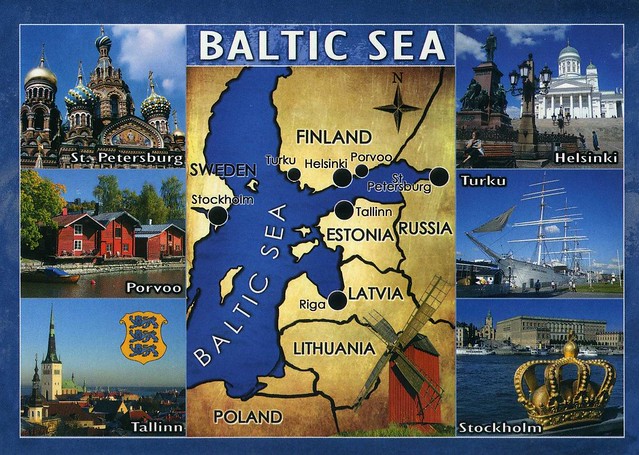
Baltic Sea

A slightly different map card I received in a swap from Finland...


The Baltic Sea is a brackish mediterranean sea located in Northern Europe. It is bounded by the Scandinavian Peninsula, the mainland of Europe, and the Danish islands. It drains into the Kattegat by way of the Øresund, the Great Belt and the Little Belt. The Kattegat continues through Skagerrak into the North Sea and the Atlantic Ocean. The Baltic Sea is connected by man-made waterways to the White Sea via the White Sea Canal, and to the North Sea via the Kiel Canal. The Baltic Sea might be considered to be bordered on its northern edge by the Gulf of Bothnia, on its northeastern edge by the Gulf of Finland, and on its eastern edge by the Gulf of Riga. However, these various gulfs can be considered to be simply offshoots of the Baltic Sea, and therefore parts of it.


The small stamps are from a set of 6 definitives issued in 2008, with the theme 'water & landscape views'. The bigger stamp is from 2008 as well and shows a snowflake. The stamp is actually transparent, although you can't really see that here.

Sunday, 26 September 2010

The Summer Garden, St Petersburg, Russia

Another autumn card, this one arrived about a year ago from the "Autumn tag" on the postcrossing forum.


Can you believe the place here is actually called the Summer Garden?! Well, it is. A Summer Garden in autumn. :D The Summer Garden occupies an island between the Fontanka, Moika, and the Swan Canal in St Petersburg and shares its name with the adjacent Summer Palace of Peter the Great. The park, first conceived by Peter in 1704, was laid out by foreign garden planners between 1712 and 1725 in a Dutch Baroque style. Three years later, the walks were lined with a hundred allegorical marble sculptures, executed by Francesco Penso, Pietro Baratta, Marino Gropelli, Alvise Tagliapietra, and other Venetian sculptors. In the late 20th century, 90 surviving statues were moved indoors, while modern replicas took their place in the park.


Nice stamps on the card, too, both issued in 2009. The one on the left is Russia's contribution to the Europa series, last year's theme being Astronomy. The second stamp commemorates the 75th Anniversary of the Birth of U.A. Gagarin (1934-1968), first Astronaut in the World.

Wednesday, 4 August 2010

The Chesme Church, St Petersburg, Russia

There seems to be lots of absolutely stunning architecture in Russia, and many churches and cathedrals particularly are wonderfully colourful. This one is no exception, in fact this might just be my favourite of the ones I've seen so far - it looks like a candy! :)
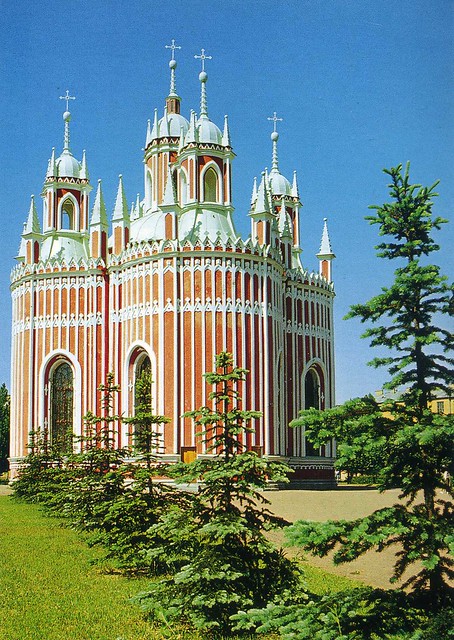


This fairytale gothic church is one of St. Petersburg's most unusual and most delightful, although it is a little off the beaten track for most tourists. Located in the far south of the city, it was built under Catherine the Great as the house church for the Chesme Palace, a resting post between St. Petersburg and the Summer Palace in Tsarskoe Selo. It has since been subsumed in a mostly Stalinist residential region, and is now well within the city limits.

One of two fascinating gothic churches designed by the German-Russian court architect Yury Felton, the Chesme Church was consecrated in 1780, on the tenth anniversary of Russia's naval victory over the Turkish fleet at Chesme Bay, which occurred on the birthday of John the Baptist, hence the church's name. A wedding-cake structure with striped crenellated walls and five gothic turrets in place of traditional onion domes, this truly unique church has survived almost fully intact to this day, despite the fact that it was turned, along with the Chesme Palace, into part of a forced labour camp by the Soviet government - the cross on the central turret was replaced with a hammer, tongs and anvil to symbolize the toil of the proletariat. Just before the Second World War, the complex was given over to the Institute of Aviation Technology, which still occupies the palace to this day.

Used as a burial site for war heroes almost since its consecration, the area around the church became a graveyard for soldiers who died during the Siege of Leningrad. In the 1970s, the church became a Museum of the Battle of Chesme, and was eventually returned to the Orthodox Church in 1990. It is now an extremely popular church, with regular services and numerous visitors who come to pay their respects to the war dead.


The stamp on the right is from the Europa series, this year's theme being Children's Books and this is the Russian contribution to the series. The stamp next to that is from the Russian "Regions" serie, unfortunately I have no idea which region this represents as I can't read Russian. :( The stamp under it is from 2009, a definitive from a set of 12 showing Russian Kremlins. This one here is the Kazan Kremlin. The small stamp on the left is a definitive from 1998 from a set of 11, this one related to agriculture.
Thursday, 15 July 2010

Peterhof, St Petersburg, Russia

I'm getting rather annoyed with the size of pictures in this blog if I just upload them from my computer. I'm going to try uploading them off my flickr instead and see if that's any better; I'd like to have the pictures of the postcards a bit bigger!


RU-181788


This official from Russia arrived a few days ago and I really, really like it. I'm quite fond of black and white cards in general, and they often seem to show places and people from a slightly different angle. I love the minimalism of this card and the atmosphere in it. I wouldn't have guessed the picture is from Peterhof in St Petersburg unless the sender hadn't told me!

Peterhof is said to be the Russian "Versailles", and the capital of Russian fountains. Having seen more pictures of the place and read more about it since joining Postcrossing (hurrah for postcrossing teaching me more about the world! This is so much more fun than history or geography lessons back at school!) I can totally agree.

Monday, 5 July 2010

St Petersburg, Russia

This might just be one of my favourite Russian postcards, or at least postcards from St Petersburg. I actually already had a copy from a swap with the lovely Katya, but this one came as an official last week.


RU-171063


I think Katya mentioned earlier that this kind of houses are typical in St Petersburg. In any case, I think they look very pretty, and I love the colours here. This actually reminds me of Finland; I love the old blocks of flats there, I find them very charming for some reason. Also, I REALLY really like the little green heart on the bottom left corner in this postcard, so cute!


The big stamp on the right is from a set of 4 stamps issued in 2009, representing World Cultural Heritage in Russia. This one here shows Solovetsky Islands.The stamp next to that is from a set of 12 definitive stamps issued in 2009, depicting Russian Kremlins. This one shows the Moscow Kremlin. The smallest stamps are from a set of 15 definitive stamps issued in 2008, showing animals, these being the Hare and Fox.

Thursday, 24 June 2010

Peterhof, St Petersburg, Russia

I'm a little surprised I haven't had more swap requests through the official postcrossing site since I changed my preferences to "yes, I'm interested in direct swaps", considering I get them all the time on the forum, despite pointing out in my signature that I'm NOT interested. (Can't people read?!?) Anyway, the following card is the first I received via a swap through the official site since changing the status. Isn't it beautiful?!


The card shows the Chinese Garden in the Lower Park of Peterhof Palace in St Petersburg, Russia. Peterhof is actually a series of palaces and gardens, laid out on the orders of Peter the Great. These Palaces and gardens are sometimes referred as the "Russian Versailles". The palace-ensemble along with the city centre is recognised as a UNESCO World Heritage Site.

Annoyingly, I couldn't find much information about the Chinese Garden or the red house. Any help would be greatly appreciated!


The stamp on the right is from a set of 3 stamps issued in 2008, representing Archeological Heritage of Russia, this stamp showing a metal plate featuring deer. The one next to it is from a set of 5 stamps issued in 2009, commemorating the 200th Anniversary of the Birth of N.V. Gogol (1809-1852), this stamp showing "Tarars Bulba" (1835). The small stamps are from a set of 15 definitive stamps issued in 2008, showing animals. Here you can see the Hare and Fox.