Showing posts with label bulgaria. Show all posts

Monday, 16 May 2016

Greetings from Bulgaria

For some reason I thought I'd already posted about this card here. :o Nevermind... This is from a Facebook swap from last year. Another successful swap with Donka. :) Thank you so much!


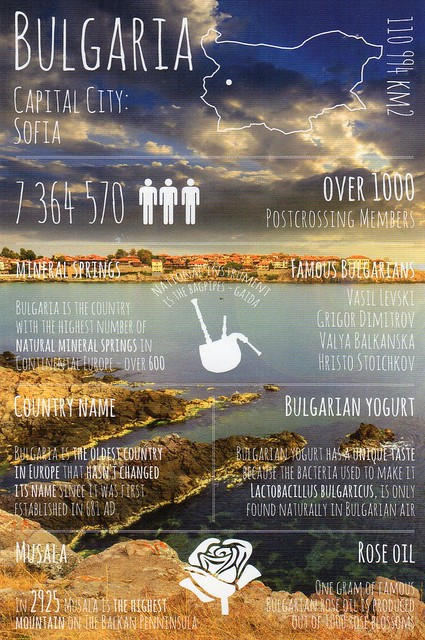
This is one of the nicer cards in this series I think. I love the blue tones and the slightly darker colour - and the stormy-looking sky! :D I also love the fact that this card mentions Bulgarian yogurt. I really, really like it and tend to have at least some every time I go to Finland. For some reason I haven't been able to find it here in England (and Turkish yogurt seems impossible to find here as well for some reason, whereas it seems to be fairly popular in Finland). All you get here is Greek yogurt and while that's VERY nice as well, it's totally different. Bulgarian yogurt is a lot more sour I think (and yummy :)).

Wednesday, 22 July 2015

Srebarna Nature Reserve, Bulgaria

Another Unesco card, this time from Bulgaria.


The Srebarna Nature Reserve is a nature reserve in northeastern Bulgaria (Southern Dobruja), near the village of the same name, 18 km west of Silistra and 2 km south of the Danube. It comprises Lake Srebarna and its surroundings and is located on the Via Pontica, a bird migration route between Europe and Africa.

The Srebarna Nature Reserve is a freshwater lake adjacent to the Danube and extending over 600 ha. It is the breeding ground of almost 100 species of birds, many of which are rare or endangered. Some 80 other bird species migrate and seek refuge there every winter. Among the most interesting bird species are the Dalmatian pelican, great egret, night heron, purple heron, glossy ibis and white spoonbill.

Tuesday, 14 April 2015

Obzor, Bulgaria

A swap card I received last week from Bulgaria. This looks like a pretty typical view from the Black Sea coast of Bulgaria, not quite as touristy as some of the main resorts, though.


Obzor is a small town and seaside resort on the Black Sea coast of Bulgaria. It is part of Nesebar municipality, Burgas Province.

The Thracian and ancient Greek name of Obzor was Naulochos, a small port on the coast of Thrace, a colony of Mesembria. The ancient Romans named it Templum Iovis (Temple of Jupiter); Pliny called it Tetranaulochus. During the Ottoman rule of Bulgaria, it was known as Gözeken. The modern name was introduced in 1936; Obzor obtained town privileges on 9 September 1984.

Sunday, 15 March 2015

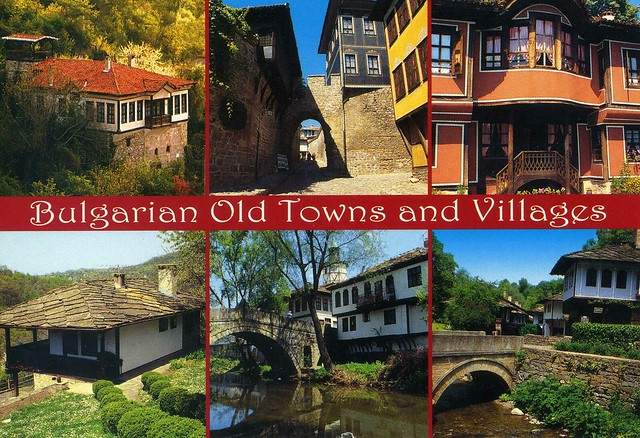
Bulgaria - old towns and villages

A lovely Bulgarian postcard I received a few years ago.


The towns and villages here are (on the top row, from left to right) Melnik, Plovdiv and Koprivshtitsa and (bottom row, left to right again) Bozhentsi, Tryavna and Etura. They all look so pretty!

Saturday, 14 December 2013

Bulgaria

Time for another wee post, long overdue again. Oops.. I received this beautiful card from dear Snježana earlier this year from her holiday in Bulgaria. It must be lovely there!


Bulgaria, officially the Republic of Bulgaria, is a country located in Southeastern Europe. It is bordered by Romania to the north, Serbia and Macedonia to the west, Greece and Turkey to the south, and the Black Sea to the east. With a territory of 110,994 square kilometres, Bulgaria is Europe's 14th-largest country.

Organised Prehistoric cultures began developing on Bulgarian lands during the Neolithic period. Its ancient history saw the presence of the Thracians, and later the Greeks and Romans. The emergence of a unified Bulgarian state dates back to the establishment of the First Bulgarian Empire in 681 CE, which dominated most of the Balkans and functioned as a cultural hub for Slavic peoples during the Middle Ages. With the downfall of the Second Bulgarian Empire in 1396, its territories came under Ottoman rule for nearly five centuries. The Russo-Turkish War of 1877–1878 led to the formation of the Third Bulgarian State. The following years saw several conflicts with its neighbours, which prompted Bulgaria to align with Germany in both World Wars. In 1946 it became a single-party Socialist state as part of the Soviet-led Eastern Bloc. In 1989 the ruling Communist Party allowed multi-party elections, which subsequently led to Bulgaria's transition into a democracy and a market-based economy.

Bulgaria's population of 7.36 million people is predominantly urbanised and mainly concentrated in the administrative centres of its 28 provinces. Most commercial and cultural activities are centered on the capital and largest city, Sofia. The strongest sectors of the economy are heavy industry, power engineering, and agriculture, all of which rely on local natural resources.

Saturday, 17 December 2011

Hissar, Bulgaria

I'm pretty nervous at the moment - tomorrow it'll be Aikido gradings in Birmingham and I'm be going for brown belt. I keep thinking what if my mind goes blank and I just forget everything, or do something stupid... Wish me luck! I'm also a bit worried about actually getting to Birmingham (and then back home) as it's supposed to snow here this weekend and the traffic is always a total chaos if it does. :S ...that, and I wish my friend Miranda was there tomorrow, I could do with some support from her. She's on holiday at the moment, though, back home in Hong Kong and she'll also be visiting Taiwan (and she said she'd bring me back postcards :)). She gets to travel so much! Earlier this year she visited Bulgaria. It wasn't just for fun and relaxation although she did get to do that as well. Anyway, she brought me back a couple of postcards and I thought I'd show one of them here.
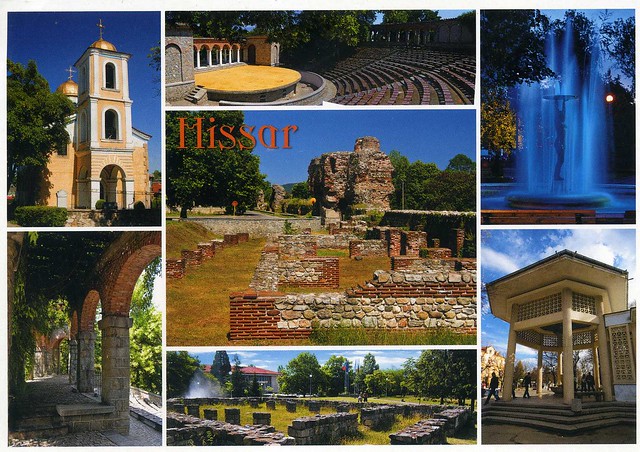


Hissar is a small resort town in Bulgaria, in Plovdiv Province. Located in the outskirts of the Sredna Gora mountain range, it boasts of a very mild climate and over two dozen different mineral springs, which make it a favorite spa for many Bulgarian and foreign tourists. The town's population is 7,691. The population of the municipality is approximately 14,826.

Because of these springs, the town was founded thousands of years ago. Some pre-historic remains have been found in what is now the town centre. Later, it became a Thracian city, and when Thrace fell to the Romans and became a Roman province, Hisarya became a Roman town - one of the three most important towns in the province. At various times it was called Augusta, Diocletianopolis (after emperor Diocletian) and a couple of other names. It was a famous resort even in those times, which is proved by the fact that emperor Septimius Severus himself visited the city.

Many Roman ruins are still visible everywhere - public buildings, a small amphitheatre, the barracks of the Roman garrison, the foundations of a couple of the oldest churches in Bulgaria, as well as the best preserved Roman fortress in Bulgaria. The southern gate is known as "The Camels", because it had broken in the middle and looked like two camels facing each other, before it was partially restored in the early 20th century.
Saturday, 31 July 2010

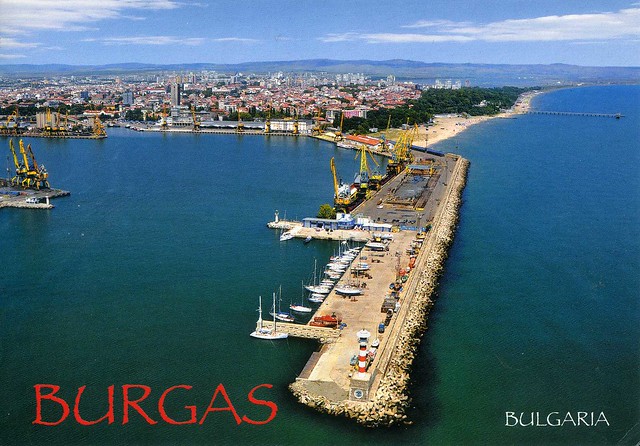
Burgas, Bulgaria

I'm not very good at geography, although I do think I'm better than my boyfriend's sister who was asking yesterday if Kenya was in Europe (!!!). I did wonder if she was joking... Anyway, I've only just realised that Bulgaria is Turkey's neighbour so I thought it'd be appropriate to post this card next.


It's from a RR on the postcrossing forum, the theme was lighthouses. It took me a while to realise that, but there really is a lighthouse in this card, right at the front. I don't know why, but I was always under the impression that lighthouses were built in fairly remote locations, and this doesn't seem particularly remote to me... Guess I should find out more about that at some point...

Burgas is the second-largest city and seaside resort on the Bulgarian Black Sea Coast with population 210,260. It is also the fourth-largest by population in the country, after Sofia, Plovdiv and Varna. It is the capital of Burgas Province and an important industrial, transport, cultural and tourist centre.

Surrounded by the coastal Burgas Lakes and located at the westernmost point of the Black Sea, the large Burgas Bay, Burgas has the largest and most important Bulgarian port. Today, it is a key economic, cultural and tourist centre of southeastern Bulgaria, with the Burgas Airport serving the resorts of the southern Bulgarian coast.


I couldn't find any info about the smaller stamp, but the bigger one is from a set of 2 stamps issued in 2008 with the theme "120 Years of Orient Express".