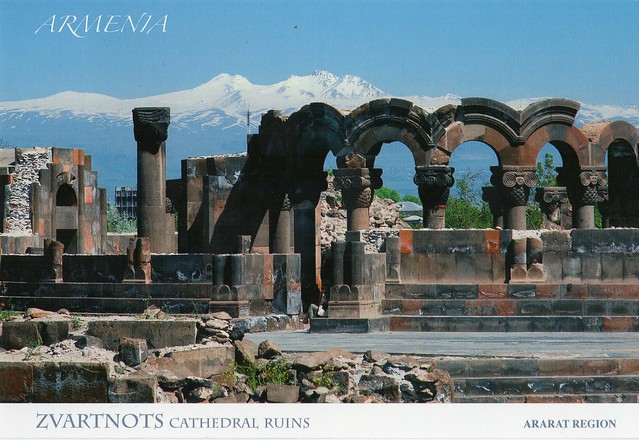
The cathedral and churches of Echmiatsin and the archaeological remains at Zvartnots graphically illustrate the evolution and development of the Armenian central-domed cross-hall type of church, which exerted a profound influence on architectural and artistic development in the region.
The city of Echmiatsin is located in the Armavir Marz region of Armenia. The settlement has existed since ancient times, as evidenced by Stone, Bronze, and Iron Age archaeological sites located in and near the city. The oldest written information about Echmiatsin refers to the period of the Urartian King Rusa II (685-645 BC). The settlement was mentioned in the Urartian cuneiform inscription by the name of Kuarlini. Life in this Armenian settlement has continued uninterrupted. The town has been called, successively, Artimed, during the rule of Yervandunis (as evidenced by Armenian historian Movses Khorenatsi (5th century AD)), Vardgesavan, and afterwards Vagharshapat, during the age of development under the rule of King Vagharsh I Arshakuni (AD 117-140). The name Echmiatsin was used along with that of Vagharshapat after the adoption of Christianity (AD 301).
The inscribed property is divided into three separate areas: the first area includes the Mother Cathedral of Echmiatsin and St Gayane Church. The area is about 30.2 ha. 18.8 ha belongs to the Mother See of Echmiatsin (the Mother Cathedral and surrounding constructions covering 16.4 ha, the St Gayane Church and surrounding buildings covering 2.0 ha, and the cemetery of the congregation covering 0.4 ha) and 11.4 ha belongs to the community of Echmiatsin City. The second area includes St Hripsime Church and St Shoghakat Church. This area is about 25.3 ha, with 6.2 ha being the territory of St Hripsimeh Church, belonging to the Mother See. The remaining 19.2 ha belongs to the community of Echmiatsin City.
The third area consists of the archaeological site of Zvartnots, with the ruins of the temple, Catholicos Palace and other constructions, and occupies about 18.8 ha.
The religious buildings of Echmiatsin and the archaeological remains at Zvartnots bear witness to the implantation of Christianity in Armenia and to the evolution of a unique Armenian ecclesiastical architecture, which exerted a profound influence on architectural and artistic development in the region. They graphically illustrate the evolution and flowering of the Armenian central-domed cross-hall type of church.





 Maroon


