I *still* haven't received any officials from Argentina, but at least I have some postcards from there thanks to swaps, like this one I received last year.
Avenida 9 de Julio is the widest avenue in the world. It is located in the city of Buenos Aires, Argentina. Its name honors Argentina's Independence Day, July 9, 1816.
The avenue runs roughly 1 kilometre to the west of the Río de la Plata waterfront, from the Retiro district in the north to Constitución station in the south. The avenue has up to seven lanes in each direction and is flanked on either side by parallel streets of two lanes each.
Showing posts with label argentina. Show all posts
Saturday, 15 September 2012
Thursday, 12 April 2012
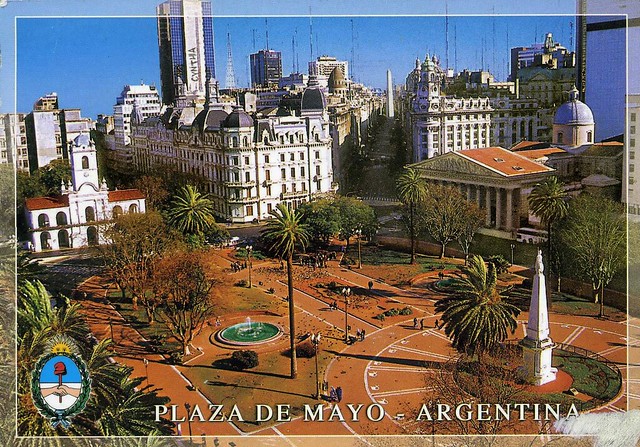
Plaza de Mayo, Buenos Aires, Argentina
Moving on the somewhere warmer.. I'm not sure why but palm trees really fascinate me. ...maybe because they don't grow where I live, at least not proper palm trees? :P This view of Buenos Aires sort of reminds me of Barcelona for some reason as well O_o

Buenos Aires is the capital and largest city of Argentina, and the second-largest metropolitan area in South America, after Greater Sao Paulo. It is located on the western shore of the estuary of the Río de la Plata, on the southeastern coast of the South American continent. Greater Buenos Aires conurbation, which also includes several Buenos Aires Province districts, constitutes the third-largest conurbation in Latin America, with a population of around thirteen million.
The city of Buenos Aires is not a part of Buenos Aires Province, nor is it the Province's capital, but an autonomous district. In 1880, after decades of political infighting, Buenos Aires was federalised and removed from Buenos Aires Province. The city limits were enlarged to include the towns of Belgrano and Flores (both are currently neighborhoods of the city). The 1994 constitutional amendment granted the city autonomy, hence its formal name: Ciudad Autónoma de Buenos Aires (Autonomous City of Buenos Aires). Its citizens first elected a Chief of Government (i.e. Mayor) in 1996; before, the Mayor was directly appointed by the President of the Republic
People from Buenos Aires are referred to as porteños (people of the port). Buenos Aires is a top tourist destination, and is known for its European style architecture and rich cultural life.
The Plaza de Mayo is the main square in the Monserrat barrio of central Buenos Aires, Argentina. It is flanked by Hipólito Yrigoyen, Balcarce, Rivadavia and Bolívar streets. Since being the scene of the 25 May 1810 revolution that led to independence, the plaza has been a hub of political life in Argentina.
Thursday, 8 March 2012
Córdoba, Argentina
This is another treat from Jane who was still living in Peru not that long ago. She visited Argentina last September and offered to send me this beautiful postcard from there. Thank you so much!

Córdoba is a city located near the geographical center of Argentina, in the foothills of the Sierras Chicas on the Suquía River, about 700 km northwest of Buenos Aires. It is the capital of Córdoba Province. Córdoba is the second-largest city in Argentina after the federal capital Buenos Aires, with about 1.3 million inhabitants according to the 2001 census. The city was founded on 6 July 1573 by Jerónimo Luis de Cabrera, who named it after Córdoba, Spain. It was one of the first Spanish colonial capitals of the region that is now Argentina (the older city was Santiago del Estero, founded in 1553). The Universidad Nacional de Córdoba is the oldest university in Argentina. It was founded in 1613 by the Jesuit Order.
Córdoba has many historical monuments preserved from the times of Spanish colonialism, especially buildings of the Roman Catholic Church. The most recognizable is perhaps the Jesuit Block (Spanish: Manzana Jesuítica), declared in 2000 as a World Heritage Site by UNESCO which consists of a group of buildings dating from the 17th century, including the Montserrat School and the colonial university campus (today the historical museum of the Universidad Nacional de Córdoba, which since the early 20th century has been the second-largest in the country (after the University of Buenos Aires) in terms of the number of students, faculty, and academic programs.
Saturday, 18 February 2012
Mate, Argentina
One more card for today... and such a nice one, too! Dear Jane (who used to live in Peru until recently but is now back in England) saw this in my favourites and very kindly offerent to send me a copy. So sweet of her! Mmmm, I would really like something warming like this right now - I'm freezing in my room :S I'll have to go make myself a nice hot cup of tea after I've finished this post.. ;)

Mate, also known as chimarrão or cimarrón, is a traditional South American infused drink, particularly in Argentina, Uruguay, Paraguay, southern states of Brazil, south of Chile, the Bolivian Chaco, and to some extent, Syria and Lebanon. It is prepared from steeping dried leaves of yerba maté in hot water.
Mate is served with a metal straw from a shared hollow calabash gourd. The straw is called a bombilla in some Latin American countries, a bomba in Portuguese, and a bombija or, more generally, a masassa (type of straw) in Arabic. The straw is traditionally made of silver. Modern, commercially available straws are typically made of nickel silver, called Alpaca; stainless steel, or hollow-stemmed cane. The gourd is known as a mate or a guampa; while in Brazil, it has the specific name of cuia. Even if the water is supplied from a modern thermos, the infusion is traditionally drunk from mates or cuias.
As with other brewed herbs, yerba mate leaves are dried, chopped, and ground into a powdery mixture called yerba. The bombilla acts as both a straw and a sieve. The submerged end is flared, with small holes or slots that allow the brewed liquid in, but block the chunky matter that makes up much of the mixture. A modern bombilla design uses a straight tube with holes, or spring sleeve to act as a sieve.
Mate is traditionally drunk in a particular social setting, such as family gatherings or with friends. The same gourd and straw are used by everyone drinking. Passing this drink around to the people you're with is a symbol of friendship.

Jane sent this postcard from Peru, hence the Peruvian stamp.
Tuesday, 28 December 2010
Caminito, Buenos Aires, Argentina
Postcards from Argentina are pretty rare in my collection; I think I only have a couple from there. It's a shame, as it looks like a very beautiful country. I had seen pictures of Caminito before and always loved the bold, vibrant colours. Now I have a postcard of it!

Caminito ("little walkway" or "little path" in Spanish) is a short street in La Boca, a neighbourhood, or barrio of the Argentine capital, Buenos Aires. It retains a strong European flavour, with many of its early settlers being from the Italian city of Genoa.

The stamp is from a set of 4 issued earlier this year, regarding the World Cup Football.
Subscribe to:
Posts (Atom)

Maroon