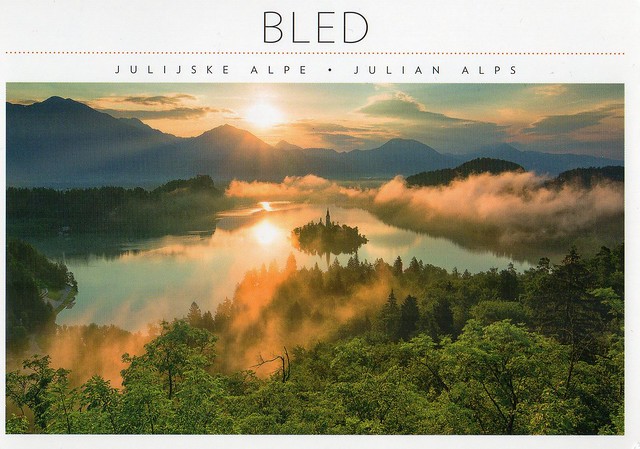
Slovenia seems like SUCH a beautiful country, it would be wonderful to get to visit it one day. A Finnish friend of mine, Keiju, got to visit it earlier this summer and treated me to this GLORIOUS postcard (the top one; the second one is from a swap with Europa stamps). Apparently it's always raining at Bled! Just look at these stunning views, though!
Lake Bled is a lake in the Julian Alps of the Upper Carniolan region of northwestern Slovenia, where it adjoins the town of Bled. The area is a tourist destination. The lake is 35 km from Ljubljana International Airport and 55 km from the capital city, Ljubljana.
The lake is of mixed glacial and tectonic origin. It is 2,120 m long and 1,380 m wide, with a maximum depth of 29.5 m, and it has a small island. The lake lies in a picturesque environment, surrounded by mountains and forests. Medieval Bled Castle stands above the lake on the north shore and has a museum. The Zaka Valley lies at the west end of the lake. The World Rowing Championships in 1966, 1979, 1989, and 2011 were held at Lake Bled.
The lake surrounds Bled Island (Blejski otok). The island has several buildings, the main one being the pilgrimage church dedicated to the Assumption of Mary (Cerkev Marijinega vnebovzetja), built in its current form near the end of the 17th century, and decorated with remains of Gothic frescos from around 1470 in the presbyterium and rich Baroque equipment. The church has a 52 m tower and there is a Baroque stairway dating from 1655 with 99 stone steps leading up to the building. The church is frequently visited and weddings are held there regularly. Traditionally it is considered good luck for the groom to carry his bride up the steps on the day of their wedding before ringing the bell and making a wish inside the church.
^The stamp on Keiju's card. We were both wondering if this is a real stamp as the image is so blurry?!?
^...and the stamps on the second card. How beautiful are they?! Once again I'm annoyed at the Royal Mail for not issuing a Europa stamp this year. Why, WHY are they not interested in participating??
Showing posts with label friends. Show all posts
Thursday, 25 July 2019
Stockholm, Sweden
Another holiday postcard here, this time from the lovely Ana. She has been to so many awesome places! I think I've only been to Stockholm once, I would really love to go there again some time!
Stockholm is the capital of Sweden and the most populous urban area in the Nordic countries; 965,232 people live in the municipality, approximately 1.6 million in the urban area, and 2.4 million in the metropolitan area. The city stretches across fourteen islands where Lake Mälaren flows into the Baltic Sea. Outside the city to the east, and along the coast, is the island chain of the Stockholm archipelago. The area has been settled since the Stone Age, in the 6th millennium BC, and was founded as a city in 1252 by Swedish statesman Birger Jarl. It is also the county seat of Stockholm County.
Stockholm is the cultural, media, political, and economic centre of Sweden. The Stockholm region alone accounts for over a third of the country's GDP, and is among the top 10 regions in Europe by GDP per capita. It is an important global city, and the main centre for corporate headquarters in the Nordic region. The city is home to some of Europe's top ranking universities, such as the Stockholm School of Economics, Karolinska Institute and Royal Institute of Technology (KTH). It hosts the annual Nobel Prize ceremonies and banquet at the Stockholm Concert Hall and Stockholm City Hall. One of the city's most prized museums, the Vasa Museum, is the most visited non-art museum in Scandinavia. The Stockholm metro, opened in 1950, is well known for the decor of its stations; it has been called the longest art gallery in the world. Sweden's national football arena is located north of the city centre, in Solna. Ericsson Globe, the national indoor arena, is in the southern part of the city. The city was the host of the 1912 Summer Olympics, and hosted the equestrian portion of the 1956 Summer Olympics otherwise held in Melbourne, Victoria, Australia.
Stockholm is the seat of the Swedish government and most of its agencies, including the highest courts in the judiciary, and the official residencies of the Swedish monarch and the Prime Minister. The government has its seat in the Rosenbad building, the Riksdag (Swedish parliament) is seated in the Parliament House, and the Prime Minister's residence is adjacent at Sager House. Stockholm Palace is the official residence and principal workplace of the Swedish monarch, while Drottningholm Palace, a World Heritage Site on the outskirts of Stockholm, serves as the Royal Family's private residence.
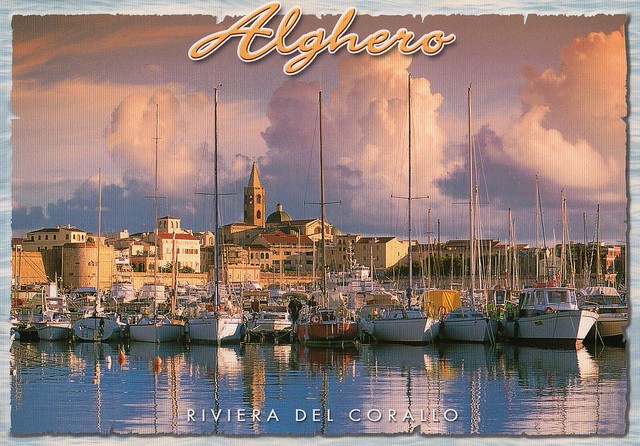
Alghero, Sardinia, Italy
Ooops... It's been almost a year since I last posted here! That certainly wasn't my intention. Things have happened during this time, though, and my life has been pretty much turned upside down. In October last year I was diagnosed with bowel cancer that had also spread to my liver and lungs. Not something I would have expected as a 36-year old! I had rather an evently 6-week hospital stay, and have been having chemotherapy since. (My next session is tomorrow.) Needless to say postcards got neglected for a while after the diagnosis, but I got back to swapping and collecting postcards fairly quickly again as it's one of the things that keep me at least somewhat sane and brings me joy. I'm trying to remain positive, and postcards have definitely helped with that!
There's a theme for today's cards - apart from a couple, they were all sent by friends or other Postcrossers from their holidays. It has been really interesting to hear more about their trips, and while I'm not able to travel anywhere outside of the UK at the moment (or even too far in the UK), this still brings me into holiday mood. :)
Today's first card is from my friends Keith and Jackie. They were on holiday in Sardinia earlier this summer. I asked them if they could send me a postcard, and they did! This might be my first postcard from Sardinia as well, I'm not quite sure. Hmmm...
Alghero, also known in the local Algherese dialect as L'Alguer, is a town of about 45,000 inhabitants in the Italian insular province of Sassari in northwestern Sardinia, next to the Mediterranean Sea. Part of its population descends from Catalan conquerors from the end of the Middle Ages, when Sardinia was part of the Crown of Aragon. Hence, the Catalan language is co-official (a unique situation in Italy) and known as the Alguerès dialect. The name Alghero comes from Aleguerium, which is a mediaeval Latin word meaning "stagnation of algae" (Posidonia oceanica).
Alghero is the third university center in the island, coming after Cagliari and Sassari. It hosts the headquarters of the Università degli Studi di Sassari’s Architecture and Design department. In 2012 it was the 10th most visited city by tourists in Italy.
Sardinia is the second-largest island in the Mediterranean Sea (after Sicily and before Cyprus). It is located west of the Italian Peninsula and to the immediate south of the French island of Corsica.
Sardinia is politically a region of Italy, whose official name is Regione Autonoma della Sardegna / Regione Autònoma de Sardigna (Autonomous Region of Sardinia), and enjoys some degree of domestic autonomy granted by a specific Statute. It is divided into four provinces and a metropolitan city, with Cagliari being the region's capital and also its largest city. Sardinia's indigenous language and the other minority languages (Sassarese, Corsican Gallurese, Algherese Catalan and Ligurian Tabarchino) spoken on the island are recognized by the regional law and enjoy "equal dignity" with Italian.
Due to the variety of its ecosystems, which include mountains, woods, plains, largely uninhabited territories, streams, rocky coasts and long sandy beaches, the island has been defined metaphorically as a micro-continent. In the modern era, many travelers and writers have extolled the beauty of its untouched landscape, which houses the vestiges of the Nuragic civilization.
I don't normally comment on stamps here, but this one is just weird! Anyone got any information on this? It reminds me of the stamps I once bought in Spain... Why does the cancellation say 'San Marino'?? Strange!
Sunday, 26 August 2018
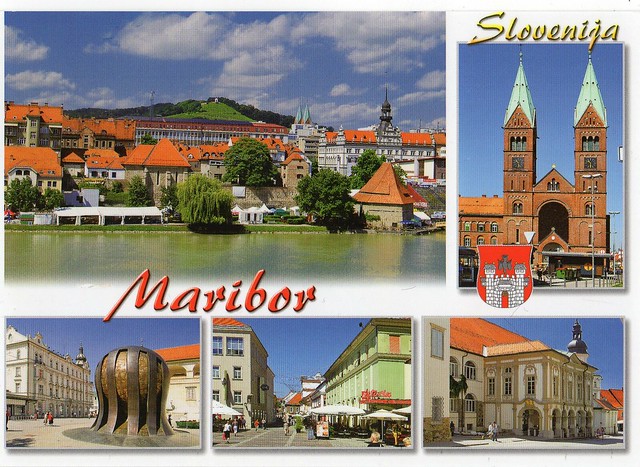
Maribor, Slovenia
Just one more card for today. This one is from dear Ana from her holidays in December last year. Maribor certainly looks lovely and cosy! I'm looking forward to sending some holiday cards in October as well. :) I also have two days holiday next month - my sister is coming to London so I'll go see her (I just need to book train or coach tickets and accommodation now...). I don't think I'll send any postcards from London though. :P I'm more looking forward to meeting my sister again as I haven't seen her for quite a while.
Maribor is the second-largest city in Slovenia and the largest city of the traditional region of Lower Styria. It is also the seat of the City Municipality of Maribor.
Saturday, 14 July 2018
Maldives
We have been having a heatwave here in England for... umm.. I can't even remember how long for now, it must be at least three weeks or that what it feels like. I know I shouldn't complain because normally I'm too cold, but it's getting rather uncomfortable when I can't sleep properly at night (even with a fan on in my bedroom and the window open) and I'm constantly tired. If you close your eyes you can almost imagine being in a tropical paradise :p I wouldn't say no to a calm beach like this!
This postcard is from a friend, his mum had a stack of postcards from different places that he found when she passed away... This is one of them. I don't know whether she actually ever visited the Maldives, probably. She was such an amazing woman, I miss her.
The Maldives remained largely unknown to tourists until the early 1970s. Only 185 islands are home to its 300,000 inhabitants. The other islands are used entirely for economic purposes, of which tourism and agriculture are the most dominant. Tourism accounts for 28% of the GDP and more than 60% of the Maldives' foreign exchange receipts. Over 90% of government tax revenue comes from import duties and tourism-related taxes.
Sunday, 3 April 2016
Just a small post for today as it's late already and I was hoping to have an early night... I managed to spend today mostly doing nothing that exciting - washing a lot of clothes ready to take to a charity shop (finally doing some clearing and getting rid of stuff I don't need/use), catching up on my favourite tv shows...
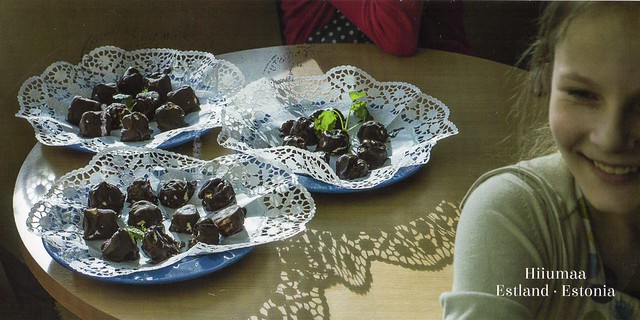
This card arrived from dear Rita last month. Such perfect timing, too, as I had been looking for something tasty to make for Easter. There's a recipe for these quark bites at the back of the card and I was dying to give them a try. I was hoping they would be like the 'kohuke' quark bars I bought in an Estonian shop in Finland last year. They were sooo good, but none of the grocery shops here selling Eastern European foods sell them :( Alas, they were not quite the same, but still very, very tasty and moreish. ...although I had to keep them in the freezer as they would've melted too much in the fridge (I couldn't have eaten them all in one go :P).
You'll need:
200 g quark
2 tablespoons sugar
a dash of vanilla extract
50 g butter
100 g dark chocolate
50 g whipping/double cream
Mix the quark, soft butter, sugar and vanilla. Put the mixture into cupcake cases (I used paper cases but silicone ones might work better... although I'd recommend using fairly small ones!!) and freeze. Melt the chocolate with the cream. Dip the frozen quark bites into the chocolate, cool in the fridge (and store in the freezer?! ... in that case just let them soften for a bit before eating).
Saturday, 12 September 2015
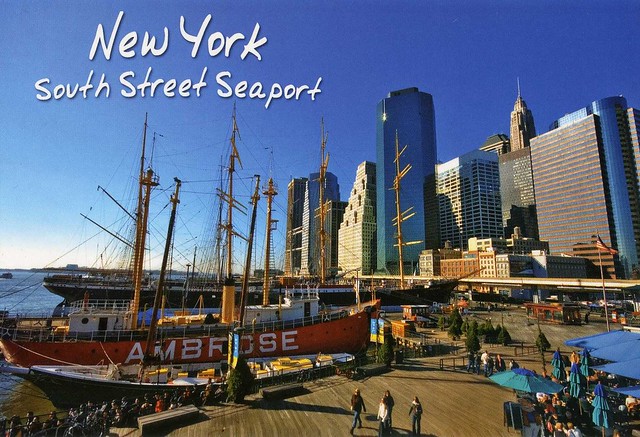
South Street Seaport, New York, USA
I got this postcard from my friend Wanda a few years ago. I really like this postcard, and it's nice to see a slightly different view of New York.
The South Street Seaport is a historic area in the New York City borough of Manhattan, centered where Fulton Street meets the East River, and adjacent to the Financial District. The Seaport is a designated historic district, and is distinct from the neighboring Financial District. It is part of Manhattan Community Board 1 in Lower Manhattan, and is bounded by the Financial District to the west, southwest, and north; the East River to the southeast; and Two Bridges to the northeast.
It features some of the oldest architecture in downtown Manhattan, and includes the largest concentration of restored early 19th-century commercial buildings in the city. This includes renovated original mercantile buildings, renovated sailing ships, the former Fulton Fish Market, and modern tourist malls featuring food, shopping, and nightlife, with a view of the Brooklyn Bridge.
Sunday, 6 September 2015
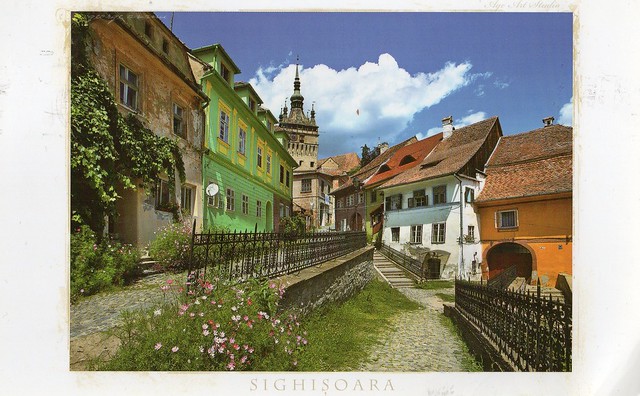
Sighișoara, Romania
Today's last card was a surprise from my friend Astrid, who attended a Postcrossing meet-up in Romania. I had no idea she was planning on going there! It must have been a pretty interesting place to visit as well, and looks very beautiful.
Sighișoara is a city on the Târnava Mare River in Mureș County, Romania. Located in the historic region of Transylvania, Sighișoara has a population of 28,102 according to the 2011 census.
Historic Centre of Sighişoara is a Unesco site. Founded by German craftsmen and merchants known as the Saxons of Transylvania, Sighişoara is a fine example of a small, fortified medieval town which played an important strategic and commercial role on the fringes of central Europe for several centuries.
Transylvania is a historical region in the central part of Romania. Bounded on the east and south by its natural borders, the Carpathian mountain range, historical Transylvania extended in the west to the Apuseni Mountains; however, the term sometimes encompasses not only Transylvania proper, but also the historical regions of Crișana, Maramureș, and Romanian part of Banat. The region of Transylvania is known for the scenic beauty of its Carpathian landscape and its rich history. In the English-speaking world it has been commonly associated with vampires, chiefly due to the influence of Bram Stoker's famous novel Dracula as well as the many later film adaptations.
Labels:
2015,
friends,
romania,
sighișoara,
transylvania,
unesco
Sunday, 19 April 2015
Ulcinj, Montenegro
I received a bunch of postcards of Ulcinj, Montenegro from dear Snježana last month. It looks like such a pretty little town! Here are a few of the postcards.
old town
Ulcinj is the southernmost town in Montenegro. The town of Ulcinj has a population of 10,707 (2011 census) of which the majority are Albanians. Ulcinj is the centre of Ulcinj Municipality and the centre of the Albanian community in Montenegro. The Day of Ulcinj is held every first Saturday of April. It symbolizes the end of the collection of olives, the output of the sailors at the sea, and the beginning of the tourist season. Ulcinj is founding member of National Assembly of Albanian Municipalities created in 26 November 2012.
Klezna River Bridge
Mendra lighthouse
Labels:
2015,
bosnia and herzegovina,
friends,
lighthouses,
montenegro,
ulcinj
Monday, 13 April 2015
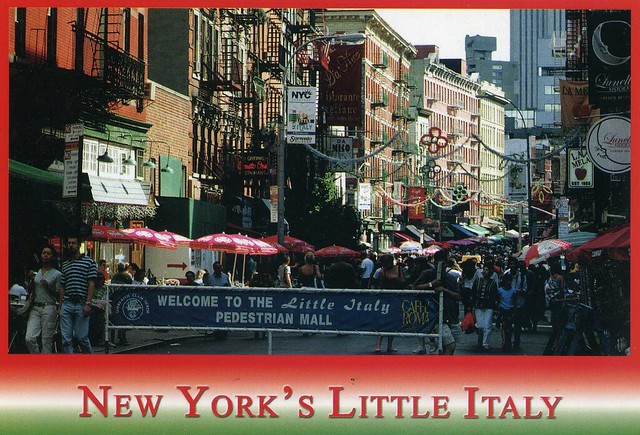
New York's Little Italy, USA
I got some New York postcards from Wanda a few years ago. This is one of them. I really like street views like this!
Little Italy is a neighborhood in lower Manhattan, New York City, once known for its large population of Italians. Today the neighborhood consists of only a few Italian stores and restaurants. It is bounded on the west by Tribeca and Soho, on the south by Chinatown, on the east by the Bowery and Lower East Side, and on the north by Nolita.
Little Italy on Mulberry Street used to extend as far south as Worth Street, as far north as Kenmare Street, as far west as Lafayette Street, and as far east as Bowery. It is now only three blocks on Mulberry Street.
As of the 2000 U.S. Census, 1,211 residents claiming Italian ancestry lived in three census tracts that make up Little Italy. Those residents comprise 8.25% of the population in the community, which is similar to the proportion of those of Italian ancestry throughout New York City.
Sunday, 22 March 2015
Barbados
...and here is the second postcard I received from Phyllis from her holiday last year. :) She does travel quite a bit - she'll be going away again on Tuesday. I'm not jealous at all, nooo... :P
Not that much to say about this... except that the views do look gorgeous and I wouldn't mind visiting Barbados at all. :D
Wednesday, 18 March 2015
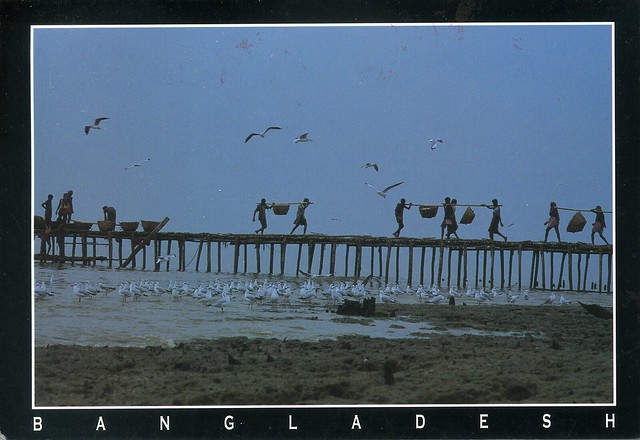
Dubla Island, the Sundarbans, Bangladesh
My dear friend Wanda visited Bangladesh a little over a year ago. I was cheeky and asked if she could send me some postcards, and she did. :) I've already posted one here before, but here's another. This one is actually a Unesco site as well!
The Sundarbans is a natural region in Bengal. It is the largest single block of tidal halophytic mangrove forest in the world. The Sundarbans covers approximately 10,000 square kilometres of which 60 percent is in Bangladesh with the remainder in India. The Sundarbans is a UNESCO World Heritage Site.
The Sundarbans National Park is a National Park, Tiger Reserve, and a Biosphere Reserve located in the Sundarbans delta in the Indian state of West Bengal. Sundarbans South, East and West are three protected forests in Bangladesh. This region is densely covered by mangrove forests, and is one of the largest reserves for the Bengal tiger.
Sunday, 15 March 2015
Les Saintes, Terre-de-Haut, Guadeloupe
Phyllis, a friend of mine from volunteering, went on a Caribbean cruise last year. I was cheeky and asked if she could send me a couple of postcards from her trip, and she did send me two: this one of Guadeloupe mailed from Barbados, and one from Barbados. It would be so cool to go on one of those cruises myself one day... My Canadian pen friend has just been on one, too... *jealous* ..and my sister-in-law has just got a job on a cruise line so she'll get to visit some pretty amazing places as well, I'd think.
The Îles des Saintes ("Islands of the Saints"), also known as Les Saintes, is a small archipelago of the French Antilles located to the south of Basse-Terre Island, west of Marie-Galante and north of Dominica. It is a dependency of Guadeloupe, which, in turn, is an overseas department and region of France.
Terre-de-Haut is a commune in the French overseas department of Guadeloupe, including Terre-de-Haut Island and a few other small uninhabited islands of the archipelago (les Roches Percées; Îlet à Cabrit; Grand-Îlet; la Redonde). It is the most populous island of the archipelago of the les Saintes.
Labels:
2014,
barbados,
friends,
guadeloupe,
les saintes,
terre-de-haut
Saturday, 28 February 2015
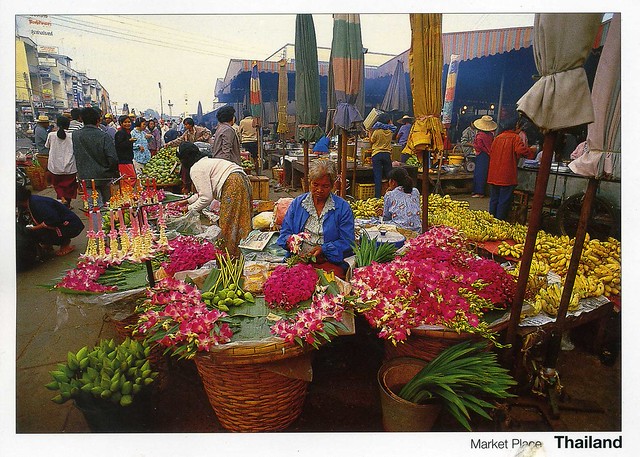
Market place, Surin, Thailand
Today's last card is from dear Heather. I love market scenes like this, so pretty and colourful!
This is an early morning scene at a market in Surin, a town in Thailand, capital of Surin province. It is the site of the annual Surin Elephant Round-up. As of 2000, Surin had a population of 41,582.
Heather mailed the card from Australia. I just love Australian stamps and these are no exception.
This is an early morning scene at a market in Surin, a town in Thailand, capital of Surin province. It is the site of the annual Surin Elephant Round-up. As of 2000, Surin had a population of 41,582.
Heather mailed the card from Australia. I just love Australian stamps and these are no exception.
Saturday, 21 February 2015
Budapest, Hungary
I just realised a few days ago that I haven't posted any cards from Hungary here yet. How did that happen?? Well, here's one that I received from my friend Amanda last year from her holiday to Budapest.
Budapest is the capital and the largest city of Hungary, and one of the largest cities in the European Union. It is the country's principal political, cultural, commercial, industrial, and transportation centre, sometimes described as the primate city of Hungary. In 2011, according to the census, Budapest had 1.74 million inhabitants, down from its 1989 peak of 2.1 million due to suburbanisation. The Budapest Metropolitan Area is home to 3.3 million people. The city covers an area of 525 square kilometres within the city limits. Budapest became a single city occupying both banks of the river Danube with its unification on 17 November 1873 of Buda and Óbuda, on the west bank, with Pest, on the east bank.
Cited as one of the most beautiful cities in Europe, Budapest's extensive World Heritage Site includes the banks of the Danube, the Buda Castle Quarter, Andrássy Avenue, Heroes' Square and the Millennium Underground Railway, the second-oldest metro line in the world. It has around 80 geothermal springs, the world's largest thermal water cave system, second largest synagogue, and third largest Parliament building. The city attracts about 4.3 million tourists a year, the 25th most popular city in the world, and the 6th in Europe, according to Euromonitor.
Hungary is a landlocked country in Central Europe. It is situated in the Carpathian Basin and is bordered by Slovakia to the north, Ukraine and Romania to the east, Serbia and Croatia to the south, Slovenia to the southwest and Austria to the west. The country's capital and largest city is Budapest. Hungary is a member of the European Union, NATO, the OECD, the Visegrád Group, and the Schengen Area. The official language is Hungarian, which is the most widely spoken non-Indo-European language in Europe.
Following centuries of successive habitation by Celts, Romans, Huns, Slavs, Gepids, and Avars, the foundation of Hungary was laid in the late 9th century by the Hungarian grand prince Árpád in the Honfoglalás ("homeland-conquest"). His great-grandson Stephen I ascended to the throne in 1000 CE, converting the country to a Christian kingdom. By the 12th century, Hungary became a middle power within the Western world, reaching a golden age by the 15th century. Following the Battle of Mohács in 1526 and about 150 years of partial Ottoman occupation (1541–1699), Hungary came under Habsburg rule, and later formed a significant part of the Austro–Hungarian Empire (1867–1918).
Hungary's current borders were first established by the Treaty of Trianon (1920) after World War I, when the country lost 71% of its territory, 58% of its population, and 32% of ethnic Hungarians. Following the interwar period, Hungary joined the Axis Powers in World War II, suffering significant damage and casualties. Hungary came under the influence of the Soviet Union, which contributed to the establishment of a four-decade long communist dictatorship (1947–1989). The country gained widespread international attention regarding the Revolution of 1956 and the seminal opening of its previously-restricted border with Austria in 1989, which accelerated the collapse of the Eastern Bloc.
On 23 October 1989, Hungary again became a democratic parliamentary republic, and is today an upper-middle income country with a very high Human Development Index. Hungary is a popular tourist destination attracting 10.675 million tourists a year (2013). It is home to the largest thermal water cave system and the second largest thermal lake in the world (Lake Hévíz), the largest lake in Central Europe (Lake Balaton), and the largest natural grasslands in Europe (the Hortobágy National Park).
Friday, 20 February 2015
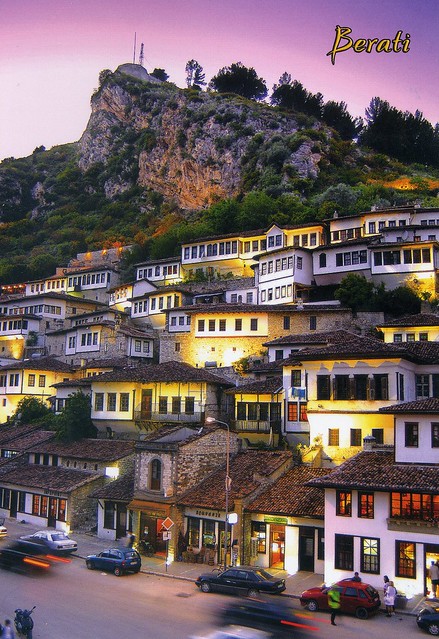
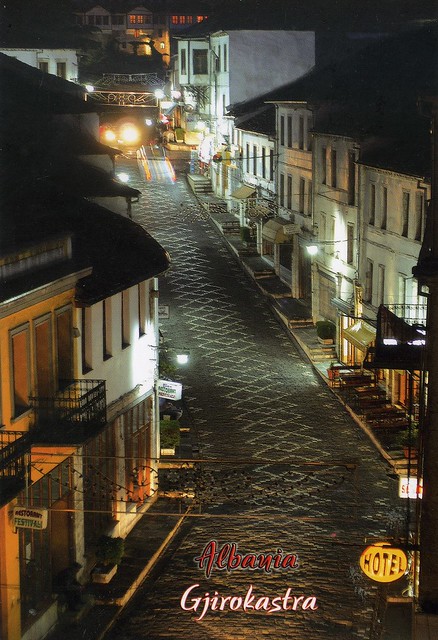
Historic Centres of Berat and Gjirokastra, Albania
I just realised the other day that Albania is the only European country in my collection that I don't have a written and stamped postcard from. Maybe one day... I did receive a few blank ones from dear Snježana a while ago. They are still pretty gorgeous. Here are two of them that also happen to show a Unesco site. Well, the first one definitely should, I'm not sure if the Gjirokastra one shows the historic centre...?? If anyone can tell me I'd appreciate the help!
Berat and Gjirokastra are inscribed as rare examples of an architectural character typical of the Ottoman period. Located in central Albania, Berat bears witness to the coexistence of various religious and cultural communities down the centuries. It features a castle, locally known as the Kala, most of which was built in the 13th century, although its origins date back to the 4th century BC. The citadel area numbers many Byzantine churches, mainly from the 13th century, as well as several mosques built under the Ottoman era which began in 1417. Gjirokastra, in the Drinos river valley in southern Albania, features a series of outstanding two-story houses which were developed in the 17th century. The town also retains a bazaar, an 18th-century mosque and two churches of the same period.
The stamps on the envelope.
Berat and Gjirokastra are inscribed as rare examples of an architectural character typical of the Ottoman period. Located in central Albania, Berat bears witness to the coexistence of various religious and cultural communities down the centuries. It features a castle, locally known as the Kala, most of which was built in the 13th century, although its origins date back to the 4th century BC. The citadel area numbers many Byzantine churches, mainly from the 13th century, as well as several mosques built under the Ottoman era which began in 1417. Gjirokastra, in the Drinos river valley in southern Albania, features a series of outstanding two-story houses which were developed in the 17th century. The town also retains a bazaar, an 18th-century mosque and two churches of the same period.
Santiago de Compostela, Spain
I'm normally at volunteering on Fridays but I'm not feeling too well - I've had a cold for a few days now, although it does seem to be getting better. It better had, too, because I'm supposed to go to the cinema with Matt and some friends on Sunday. I'd hate to have to miss that.
Anyway.. I've had enough of lying in bed so I thought I'd update here. Today's first card is from my dear friend Wanda. She lives in England now but frequently goes back to Santiago de Compostela where she's from. It looks like such a beautiful city, I'd love to visit one day. Wanda has already invited me and Matt over a few times... :P
This is Plaza de las Platerías which, unless I'm very much mistaken, is located in the Old Town of Santiago de Compostela. I've already posted about Santiago de Compostela here so I won't repeat myself now.
Wanda always seems to decorate the backs of the postcards she sends and this one is not an exception. This is just a glimpse of her drawing as I don't want to show the message here, but the rest of it is pretty amazing as well. I wish I was that talented, too...!
Sunday, 15 February 2015
Kakum National Park, Ghana
This is one of the postcards my friend William sent me from Ghana a couple of years ago. This is one of my favourites, too - I like pictures of national parks! Kakum National Park is also a tentative Unesco site.
Kakum National Park, located in the coastal environs of the Central Region of Ghana, covers an area of 375 square kilometres. Established in 1931 as a reserve, it was gazetted as a national park only in 1992 after an initial survey of avifauna was conducted. The area is covered with tropical rainforest. The uniqueness of this park lies in the fact that it was established at the initiative of the local people and not by the State Department of wildlife who are responsible for wildlife preservation in Ghana. It is also the only park in Africa with a canopy walkway, which is 350 metres long and connects seven tree tops which provides access to the forest.
The most notable endangered species of fauna in the park are Diana monkey, giant bongo antelope, yellow-backed duiker and African elephant. It is also an Important Bird Area recognized by the Bird Life International with the bird area fully overlapping the park area. The bird inventory confirmed 266 species in the park, including eight species of global conservation concern. One of these species of concern is the white-breasted guineafowl. Nine species of hornbill and the African grey parrot have been recorded. It is very rich in butterflies as well, and a new species was discovered in 1993. As of 2012, the densest population of forest elephants in Ghana is located in Kakum.
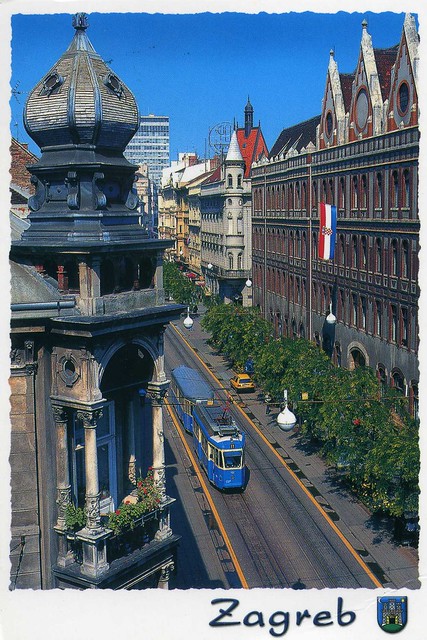
Zagreb, Croatia
A lovely view of Zagreb I received from dear Nives a few years ago.
This is one of my favourite received views of Zagreb. The blue tram might have something to do with that... :) The building on the right is the central postal building in Zagreb.
By the way, if you want to see more nice views of Zagreb (and other places in Croatia), check out Nives's instagram. If only photos like that were turned into postcards, too....!
Saturday, 4 October 2014
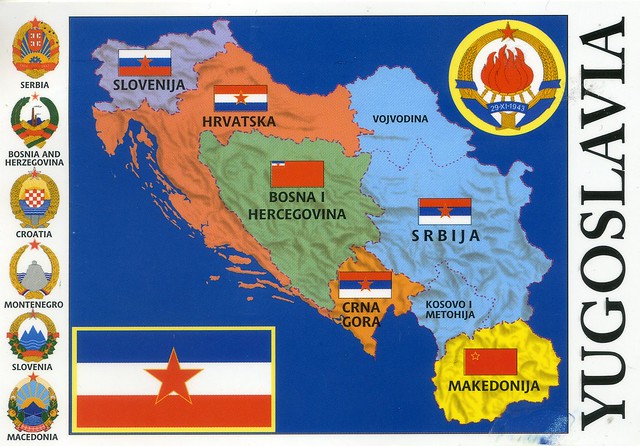
Yugoslavia map
It's been a while since I posted here again. Uh-oh... Not much has been going on and I haven't even received that many postcards. ...but then again, it's not like I've sent too many, I just can't afford it.
A bit of self-promoting for the day: I'm in the Postcrossing spotlight! I can't help wondering who gave my name to the Postcrossing team and asked for me to be included.. as it does seem like they take recommendations when someone gets interviewed. I hope the person I suggested will get interviewed as well :)
Anyway, I thought I'd try to post a few cards today, starting with this lovely meet-up card I received from dear Snjezana last year.
I had been hoping to receive this for a while so I was really excited to find it in my mailbox. And better yet - to see familiar signatures on the back of the card :)
Subscribe to:
Posts (Atom)


Maroon