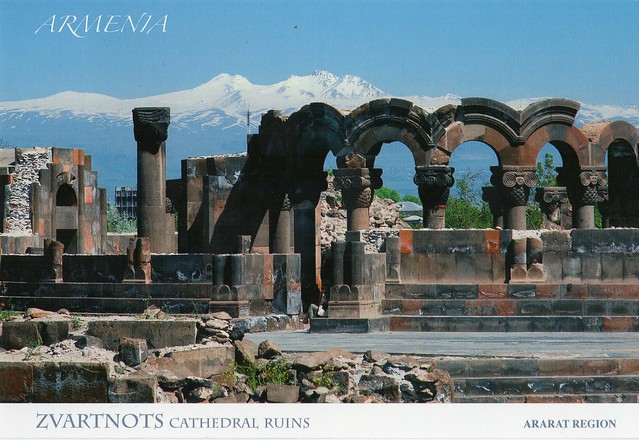
Today's last card is from the lovely Sini who keeps surprising me with lots of lovely postcards from her travels. She has visited some amazing places, it's always fascinating to read about her travels.
The cathedral and churches of Echmiatsin and the archaeological remains at Zvartnots graphically illustrate the evolution and development of the Armenian central-domed cross-hall type of church, which exerted a profound influence on architectural and artistic development in the region.
The city of Echmiatsin is located in the Armavir Marz region of Armenia. The settlement has existed since ancient times, as evidenced by Stone, Bronze, and Iron Age archaeological sites located in and near the city. The oldest written information about Echmiatsin refers to the period of the Urartian King Rusa II (685-645 BC). The settlement was mentioned in the Urartian cuneiform inscription by the name of Kuarlini. Life in this Armenian settlement has continued uninterrupted. The town has been called, successively, Artimed, during the rule of Yervandunis (as evidenced by Armenian historian Movses Khorenatsi (5th century AD)), Vardgesavan, and afterwards Vagharshapat, during the age of development under the rule of King Vagharsh I Arshakuni (AD 117-140). The name Echmiatsin was used along with that of Vagharshapat after the adoption of Christianity (AD 301).
The inscribed property is divided into three separate areas: the first area includes the Mother Cathedral of Echmiatsin and St Gayane Church. The area is about 30.2 ha. 18.8 ha belongs to the Mother See of Echmiatsin (the Mother Cathedral and surrounding constructions covering 16.4 ha, the St Gayane Church and surrounding buildings covering 2.0 ha, and the cemetery of the congregation covering 0.4 ha) and 11.4 ha belongs to the community of Echmiatsin City. The second area includes St Hripsime Church and St Shoghakat Church. This area is about 25.3 ha, with 6.2 ha being the territory of St Hripsimeh Church, belonging to the Mother See. The remaining 19.2 ha belongs to the community of Echmiatsin City.
The third area consists of the archaeological site of Zvartnots, with the ruins of the temple, Catholicos Palace and other constructions, and occupies about 18.8 ha.
The religious buildings of Echmiatsin and the archaeological remains at Zvartnots bear witness to the implantation of Christianity in Armenia and to the evolution of a unique Armenian ecclesiastical architecture, which exerted a profound influence on architectural and artistic development in the region. They graphically illustrate the evolution and flowering of the Armenian central-domed cross-hall type of church.
Showing posts with label cathedrals. Show all posts
Saturday, 14 July 2018
Wednesday, 14 March 2012
St. George's Cathedral, Guyana
One more card for today, this time from South America. ..and I could tick a country off my 'missing countries and territories' list with this one! :) I found out last year that you can get a written and stamped postcard from Guyana from PostcardLocker, how was I supposed to resist?! :P I've been toying with the idea of ordering some postcards from that site for use on Postcrossing, maybe later?

Guyana, officially the Co-operative Republic of Guyana, previously the colony of British Guiana, is a sovereign state on the northern coast of South America that is culturally part of the Anglophone Caribbean. Guyana was a former colony of the Dutch and (for over 200 years) of the British. It is the only state of the Commonwealth of Nations on mainland South America, and the only one on that continent where English is an official language. It is also a member of the Caribbean Community (CARICOM), which has its secretariat headquarters in Guyana's capital, Georgetown. Guyana achieved independence from the United Kingdom on 26 May 1966, and became a republic on 23 February 1970.
Historically, the region known as "Guiana" or "Guayana" comprised the large shield landmass north of the Amazon River and east of the Orinoco River known as the "Land of many waters". Historical Guyana is made up of three Dutch colonies: Essequibo, Demerara, and Berbice. Modern Guyana is bordered to the east by Suriname, to the south and southwest by Brazil, to the west by Venezuela, and on the north by the Atlantic Ocean.
At 215,000 km2, Guyana is the third-smallest independent state on the mainland of South America (after Uruguay and Suriname). Its population is approximately 770,000.
- -
St. George's Anglican Cathedral in Georgetown, Guyana is one of the tallest wooden churches in the world, at a height of 43.5 metres. It was designed by Sir Arthur Blomfield and opened on 24 August 1892. The building was completed in 1899. It is located on Church Street in Georgetown, and has been designated a National Monument. St. George's Cathedral is characterised mainly by Gothic arches, clustered columns and flying buttresses.

Guyana, officially the Co-operative Republic of Guyana, previously the colony of British Guiana, is a sovereign state on the northern coast of South America that is culturally part of the Anglophone Caribbean. Guyana was a former colony of the Dutch and (for over 200 years) of the British. It is the only state of the Commonwealth of Nations on mainland South America, and the only one on that continent where English is an official language. It is also a member of the Caribbean Community (CARICOM), which has its secretariat headquarters in Guyana's capital, Georgetown. Guyana achieved independence from the United Kingdom on 26 May 1966, and became a republic on 23 February 1970.
Historically, the region known as "Guiana" or "Guayana" comprised the large shield landmass north of the Amazon River and east of the Orinoco River known as the "Land of many waters". Historical Guyana is made up of three Dutch colonies: Essequibo, Demerara, and Berbice. Modern Guyana is bordered to the east by Suriname, to the south and southwest by Brazil, to the west by Venezuela, and on the north by the Atlantic Ocean.
At 215,000 km2, Guyana is the third-smallest independent state on the mainland of South America (after Uruguay and Suriname). Its population is approximately 770,000.
- -
St. George's Anglican Cathedral in Georgetown, Guyana is one of the tallest wooden churches in the world, at a height of 43.5 metres. It was designed by Sir Arthur Blomfield and opened on 24 August 1892. The building was completed in 1899. It is located on Church Street in Georgetown, and has been designated a National Monument. St. George's Cathedral is characterised mainly by Gothic arches, clustered columns and flying buttresses.
Subscribe to:
Comments (Atom)


Maroon