Saturday, 17 March 2012

Poznań, Poland

I do love it when people pick me a postcard from my favourites on the official Postcrossing site. It's so thoughtful of them, and then usually these same people also write lots on the card :) This treat arrived last year from Poland.


PL-288718


Poznań is a city on the Warta river in west-central Poland, with a population of 556,022 in June 2009. It is among the oldest cities in Poland, and was one of the most important centres in the early Polish state, whose first rulers were buried at Poznań's cathedral. It is sometimes claimed to be the first capital of the kingdom of Poland.

Poznań is now Poland's fifth largest city. It is the historical capital of the Wielkopolska ("Greater Poland") region, and is currently the administrative capital of the province called Greater Poland Voivodeship.

Poznań is an important centre of trade, industry, and education, and hosts regular international trade fairs. It was the host city for the United Nations Climate Change Conference in December 2008, a key stage in the creation of a successor to the Kyoto Protocol. Poznań was a candidate city for European Capital of Culture in 2016. Poznań is currently bidding to host the 2018 Summer Youth Olympics.

Wednesday, 14 March 2012

St. George's Cathedral, Guyana

One more card for today, this time from South America. ..and I could tick a country off my 'missing countries and territories' list with this one! :) I found out last year that you can get a written and stamped postcard from Guyana from PostcardLocker, how was I supposed to resist?! :P I've been toying with the idea of ordering some postcards from that site for use on Postcrossing, maybe later?


Guyana, officially the Co-operative Republic of Guyana, previously the colony of British Guiana, is a sovereign state on the northern coast of South America that is culturally part of the Anglophone Caribbean. Guyana was a former colony of the Dutch and (for over 200 years) of the British. It is the only state of the Commonwealth of Nations on mainland South America, and the only one on that continent where English is an official language. It is also a member of the Caribbean Community (CARICOM), which has its secretariat headquarters in Guyana's capital, Georgetown. Guyana achieved independence from the United Kingdom on 26 May 1966, and became a republic on 23 February 1970.

Historically, the region known as "Guiana" or "Guayana" comprised the large shield landmass north of the Amazon River and east of the Orinoco River known as the "Land of many waters". Historical Guyana is made up of three Dutch colonies: Essequibo, Demerara, and Berbice. Modern Guyana is bordered to the east by Suriname, to the south and southwest by Brazil, to the west by Venezuela, and on the north by the Atlantic Ocean.

At 215,000 km2, Guyana is the third-smallest independent state on the mainland of South America (after Uruguay and Suriname). Its population is approximately 770,000.

- -

St. George's Anglican Cathedral in Georgetown, Guyana is one of the tallest wooden churches in the world, at a height of 43.5 metres. It was designed by Sir Arthur Blomfield and opened on 24 August 1892. The building was completed in 1899. It is located on Church Street in Georgetown, and has been designated a National Monument. St. George's Cathedral is characterised mainly by Gothic arches, clustered columns and flying buttresses.

Montréal, Canada

Let's stay in the Americas today.. I received this pretty postcard from my French friend Tiphaine who visited Canada last year with her boyfriend. It sounded like a pretty amazing trip, I'd love to have a similar one one day!
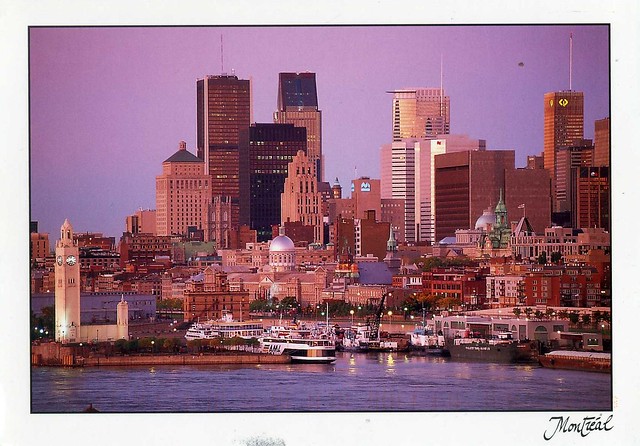


Montreal is the largest city in the province of Quebec, the second-largest city in Canada and the fifteenth largest in North America. Originally called Ville-Marie, or "City of Mary", the city takes its present name from Mount Royal, the triple-peaked hill located in the heart of the city, whose name was also initially given to the island on which the city is located, or Mont Réal as it was spelled in Middle French, (Mont Royal in present French).

As of February 2012, Statistics Canada identifies Montreal's Census Metropolitan Area (CMA) (land area 4,259 square kilometres) as Canada's second most populous with an estimated metropolitan area population of 3,824,221 and a population of 1,886,481 in the "agglomeration" of Montreal, which includes all of the municipalities on the island of Montreal. The city of Montreal proper had a population of 1,649,519 as of the 2011 census.

French is the city's official language and is also the language spoken at home by 60.5% of the population in the city of Montréal proper, followed by English at 21.2% and 23.4% other languages (as of 2006 census). In the larger Montreal Census Metropolitan Area, 70.5% of the population speaks French at home, compared to 18.5% who speak English. 56% of the population is able to speak both English and French. Montreal is the second largest primarily French-speaking city in the Western world, after Paris.

Montreal is consistently rated as one of the world's most livable cities, was called "Canada's Cultural Capital" by Monocle Magazine and recently was named a UNESCO City of Design. Though historically the commercial capital of Canada, it was surpassed in population, as well as economic strength, by Toronto after 1976. Today it continues as an important centre of commerce, aerospace, finance, pharmaceuticals, technology, design, culture, tourism, film and world affairs.


The stamp is a standard one, but the cancellation makes this pretty special - Tiphaine mailed my card from the Green Gables on the Prince Edward Island! How cool is that?!

Panama Canal Railway

Another train postcard from the Americas :D This arrived through a swap last year. I just love the colours here!


The Panama Canal Railway Company is a railway line that links the Atlantic Ocean to the Pacific Ocean across Panama in Central America. It is jointly owned by the Kansas City Southern Railway and Mi-Jack Products. The route stretches 76.6 km across the Isthmus of Panama from Aspinwall (now called Colón) to Panama City (by way of Gatun lake, Bujio, Barbacoas, Matachin, and Summit).

The infrastructure of this still functioning railroad (formerly the Panama Railway or Panama Rail Road) was of vital importance for construction of the Panama Canal over a parallel route half a century later. The principal incentive for the building of the rail line was the vast increase in traffic to California owing to the 1849 California Gold Rush. Construction on the Panama Railroad began in 1850 and the first revenue train ran over the full length on January 28, 1855. Referred to as being an inter-oceanic railroad when it opened, it was later also described by some as representing a "transcontinental" railroad despite only transversing the narrow isthmus connecting the North and South American continents.

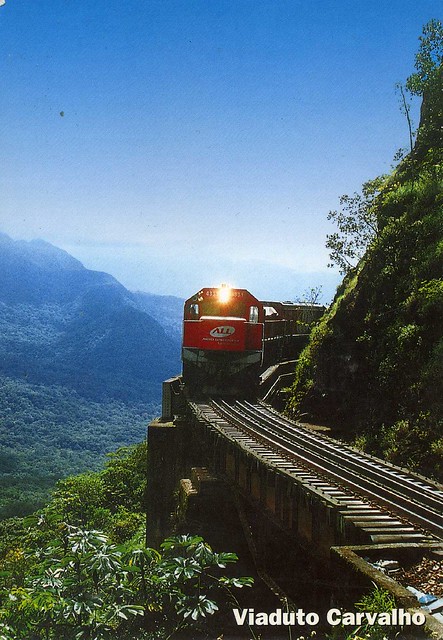
Viaduto Carvalho, Brazil

I only just realised that I haven't posted any Brazilian cards in this blog at all. Ooops! I didn't mean that to happen, after all I have so many beautiful postcards from there. I was sort of reminded last week when I received two officials from Brazil. This GORGEOUS train card was the first one.


BR-193744


The Curitiba-Paranaguá train ride is one of the most exciting and scenic travel routes in Brazil. It winds its way across the mountains of Serra do Mar - Brazil's coastal range - in the southern state of Paraná. The trip covers 62 miles.

The journey between Curitiba, the state capital, and the port city of Paranaguá, owes its appeal to the engineering feats accomplished in the construction of the railway as well as to the natural beauty and cultural attractions along its path. [source]

It does look amazing, the views look breathtaking and SO lush!

Sunday, 11 March 2012

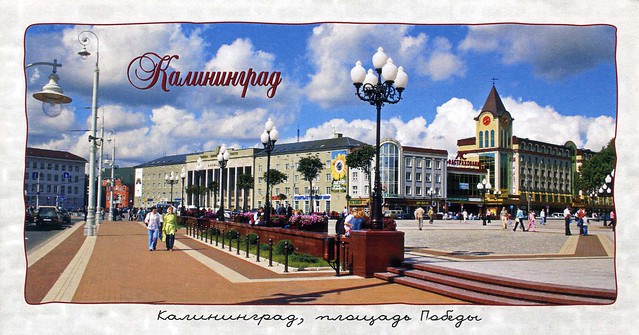
Kaliningrad, Russia

I only just realised that I haven't posted a Russian postcard here since December. ..and I have SO many I want to blog about! The ones here are from a swap I did with Maria last year. I couldn't decide which one to post about so I decided to include both :)


Kaliningrad is a seaport city and the administrative center of Kaliningrad Oblast, the Russian exclave between Poland and Lithuania on the Baltic Sea. The territory, the northern part of the former East Prussia, borders on NATO and EU members Poland and Lithuania, and is geographically separated from the rest of Russia.

Originally named Königsberg in German, the town was founded in 1255 by the order of the Teutonic Knights in honour of the Czech king Přemysl Otakar II and was part of Prussia and then of Germany until 1945, but was largely destroyed during World War II. Its ruins were occupied by the Red Army in 1945 and its German population forced out. It was renamed Kaliningrad in 1946 in honor of Mikhail Kalinin.

According to the preliminary results of the 2010 Census, its population was 431,491 — an increase from 430,003 recorded in the 2002 Census. Its ethnic composition is 77.9% Russians, 8.0% Belarusians, 7.3% Ukrainians, 1.9% Lithuanians, 0.6% Germans, and 0.5% Poles.

On the left on this card you can see the Cathedral. This inactive Cathedral is located in the historic district of Kaliningrad, the former Kneiphof. It's a historical and cultural monument. Prior to the reformation oon the XVI century it was the main Catholic church of Königsberg, and then the main Lutheran church of Russia. Now it's one of the symbols of Kaliningrad. The Cathedral was built in the style of Gothic Baltic and it's one of the few Gothic structures in Russia. The Cathedral is used for museum and concerts. The German philosopher Immanuel Kant was buried there in 1804 and was the last man buried there.

On the right you can see the historical and architectural complex "Fishing Village". It represents a quarter built in Germany style.


This postcard shows the Pobeda Square. In the centre of the card you can see the Kaliningrad Business Center and on the right the shopping center "Kaliningrad Passage". In 1996, near the square began the construction of the Cathedral of the Christ the Savior. On the 950th Anniversary of Kaliningrad in 2005 Pobeda Square was reconstructed. During the reconstruction of the square fountains and Triumphal column were added (those are not shown on this card).


Maria sent the cards in this beautiful envelope showing the Curonian Spit. The stamp on the right is pretty amazing - the sand part is textured!

Bran Castle, Romania

A very nice postcard of Bran Castle in Romania I received last summer. I had swapped with Oana through the main Postcrossing site before and soon after she hosted a RR on the forum. I like coincidences like that! :)


Bran Castle, situated near Bran and in the immediate vicinity of Braşov, is a national monument and landmark in Romania. The fortress is situated on the border between Transylvania and Wallachia, on DN73. Commonly known as "Dracula's Castle" (although it is one among several locations linked to the Dracula legend, including Poenari Castle and Hunyad Castle), it is marketed as the home of the titular character in Bram Stoker's Dracula. There is, however, no evidence that Stoker knew anything about this castle, which has only tangential associations with Vlad III, voivode of Wallachia, the putative inspiration for Dracula.

The castle is now a museum open to tourists, displaying art and furniture collected by Queen Marie. Tourists can see the interior individually or by a guided tour. At the bottom of the hill is a small open air museum park exhibiting traditional Romanian peasant structures (cottages, barns, etc.) from across the country.

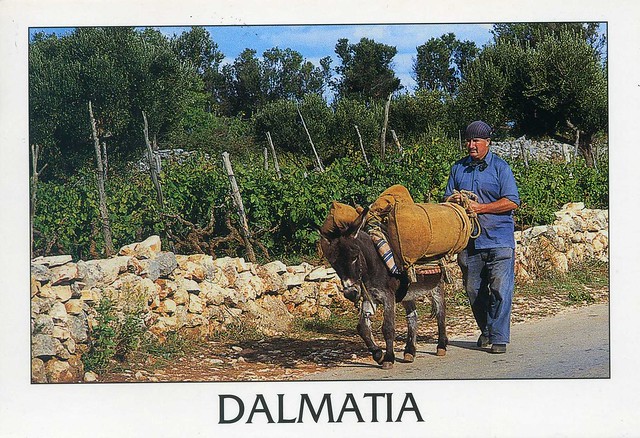
Dalmatia, Croatia

Just a wee update for today as I've got some time before going out for a meal with a friend. ...and I have tons of postcards that I want to blog about, I'm starting to doubt whether I'll ever get through it!

Anyway. This is one of the Year of the Dragon stamp swap cards, this time from Croatia. Thank you so much, Agi!


I really like this card, it seems like it would've been a warm, sunny day and I want to imagine the guy had no hurry going anywhere. Mmmmmm, I'd like that too!

Dalmatia is a historical region on the eastern coast of the Adriatic Sea. It stretches from the island of Rab in the northwest to the Bay of Kotor in the southeast. The hinterland, the Dalmatian Zagora, ranges from fifty kilometers in width in the north to just a few kilometers in the south. The Dalmatian dog received its name from Dalmatia, as does the dalmatic, a Roman Catholic liturgical vestment worn by deacons and bishops.

Saturday, 10 March 2012

Hell, Cayman Islands

Today's last card was SUCH a treat to receive. Not only is it my first written and stamped postcard from Cayman Islands, but it's also directly from Hell! :D Well, I already had a postcard from Hell in Norway, but now I have Cayman Islands as well, yay! My Canadian penpal Lauren went on a Caribbean cruise recently and very kindly offerent to send me some postcards from her vacation, Hell being one of the destinations. You can read more about her vacation here, with very detailed descriptions and tons of photos. I'd love to go on a similar cruise one day, it sounded like so much fun (and I wouldn't mind going somewhere WARM right now :p). Newspapers over here do advertise Caribbean cruises, but they always cost a fortune. :(


I won't write too much about Hell here as you can read about it on the card above. Briefly put, Hell is a group of short, black, limestone formations located in Grand Cayman, Cayman Islands. Located in West Bay, Grand Cayman, it is roughly the size of half a soccer field. People are not allowed to be amongst the limestone formations but viewing platforms do exist for visitors.

I did receive an unwritten postcard of the former Hell Post Office from a swap last year so I thought I'd include a picture here:


Anyway, here's proof that I've received a written and stamped postcard from Hell, with a special cancellation. I really like the stamp, too!

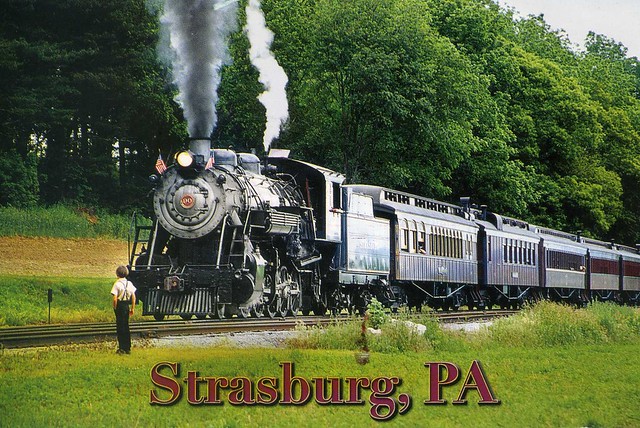
Strasburg Railroad, USA

Another great official I received last year, this time from the USA.


US-1381171


The Strasburg Railroad is a heritage railroad located near Strasburg, Pennsylvania. It operates excursion trains hauled by steam locomotives in the heart of Pennsylvania Dutch Country. The sender, Mimi, tells me this is a big attraction in the area, offering afternoon train rides through the beautiful local Amish farms. There is also a store on the grounds that contains every train related item that you could ever imagine. Sounds pretty great, and steam trains seem so fascinating!

The Netherlands

This pretty official arrived last year. It's even more special as the sender, Sylvia, used one of the Postcrossing stamps issued in the Netherlands last year. Those are *brilliant*, I think it's fantastic that the Dutch postal services agreed with the idea. I don't think the Royal Mail would ever do anything like that.


NL-851447


I just love the brightness of the tulip field! So pretty. It would be so great to get to take photos somewhere like that some day...! Tulips seem like such a Dutch thing, as do windmills. The cultivated forms of the tulip are often called "Dutch tulips." In addition to the tulip industry and tulip festivals, The Netherlands has the world's largest permanent display of tulips at Keukenhof, although the display is only open to the public seasonally.


I was pretty amused by this particular stamp when I first saw it - the postcard featured on the right is Finnish and reads 'Talviset terveiset' ('Winter greetings'). Heeee!

Tromsø, Norway

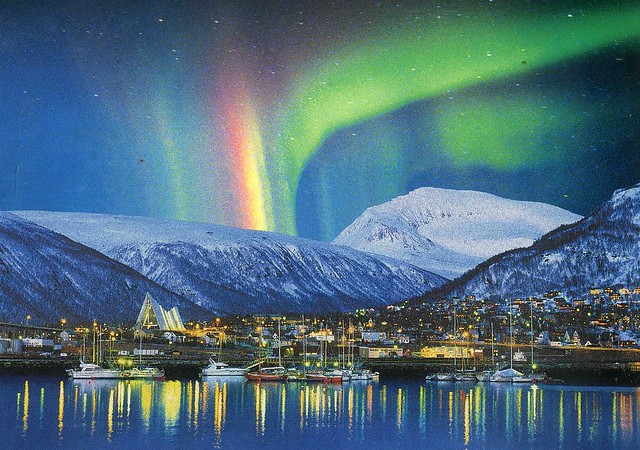
This AWESOME card arrived in a swap earlier this year. I totally adore it, it looks like something out of a fairytale with all those lights and snow, and the amazing northern lights. Thank you so much, Sissel! Oh, and... I'm always looking for more postcards from Norway so if you are reading this and want to swap, get it touch!


Tromsø is a city and municipality in Troms county, Norway. The administrative centre of the municipality is the city of Tromsø.

Tromsø city is the ninth largest urban area in Norway by population, and the seventh largest city in Norway by population. It is the largest city and the largest urban area in Northern Norway, and the second largest city and urban area in Sápmi (following Murmansk). Most of Tromsø, including the city centre, is located on the small island of Tromsøya in the county of Troms, 350 kilometres inside the arctic circle. Substantial parts of the urban area are also situated on the mainland to the east, and on parts of Kvaløya - a large island to the west. Tromsøya is connected to the mainland by the Tromsø Bridge and the Tromsøysund Tunnel, and to the island of Kvaløya by the Sandnessund Bridge. The city is warmer than most other places located on the same latitude, due to the warming effect of the Gulf Stream.

The city centre of Tromsø contains the highest number of old wooden houses in Northern Norway, the oldest house dating from 1789. The Arctic Cathedral, a modern church from 1965, is probably the most famous landmark in Tromsø. The city is a cultural centre for its region, several festivals taking place in the summer. Some of Norways most known musicians, Torbjørn Brundtland and Svein Berge of the electronica duo Röyksopp, both grew up and started their careers in Tromsø.