Saturday, 10 March 2012

Klaipėda, Lithuania

This great card arrived from one of my favourite RR's on the Postcrossing forum - 'Choose a Country RR'. It's always so much fun and everyone participating in that RR seems to put a lot of thought into the cards they send, which is great. That, and the host, Peggy is awesome ^_^ This particular card is from the surprise group earlier this year in which everyone was assigned one partner but you didn't know in advance who you would received a postcard from. So much fun!


Klaipėda is a city in Lithuania situated at the mouth of the Dange River where it flows into the Baltic Sea. It is the third largest city in Lithuania and the capital of Klaipėda County.

The city has a complex recorded history, partially due to the combined regional importance of the Port of Klaipėda, a usually ice-free port on the Baltic Sea, and the Akmena - Dange River. It has been controlled by the Teutonic Knights, the Duchy of Prussia, the Kingdom of Prussia, the German Empire, the Entente States immediately after World War I, Lithuania as a result of the 1923 Klaipėda Revolt, and the Third Reich following the 1939 German ultimatum to Lithuania. The city was incorporated into Lithuania during its tenure as a Soviet Socialist Republic and has remained within Lithuania following its re-establishment as an independent state.

The population shrank from 207,100 in 1992 to 177,823 in 2011. Popular seaside resorts found close to Klaipėda are Nida to the south on the Curonian Spit, and Palanga to the north.


I really like the special cancellation! :)

Jame' 'Asr Hassanil Bolkiah, Brunei

This is one of the very few postcards I've received from Brunei, so it's quite a treat. ..and it's even better as it features a mosque - for some reason I find postcards with them really fascinating.


Jame' 'Asr Hassanil Bolkiah is one of the largest mosques in Brunei. It is located in Kampong Kiarong which lies close to the capital of Brunei, Bandar Seri Begawan. Built to celebrate and mark the silver anniversary of the reign of the sultan of the country, Jame'Asr Hassanil Bolkiah Mosque of Brunei narrates the story of the royal dynasty.

A place of worship as well as an architectural masterpiece, Jame'Asr Hassanil Bolkiah Mosque in Brunei is popularly called Kiarong Mosque by the local people. The shining gold domes of the mosque overlook a landscape of attractive gardens and fountains. Along with them are the ornamented towers that can be seen from the main road. The interiors of the mosque combine the profoundness of art and the religious significance of Islam. [source]

Mount Maunganui, New Zealand

Dear Heather decided to send me a postcard on leap year day. What an awesome idea, thank you so much! :D I would've loved to do it myself, too, but you can't get nice cancellations over here and it seems like half the time postcards I sent don't even get cancelled :(


Heather has been sending me some truly amazing New Zealand views recently. This one has to be one of my favourites, I just love the colours here!

Mauao, also known as Mount Maunganui, is an extinct volcanic cone at the end of a peninsula and the suburb of Mount Maunganui, by the eastern entrance to the Tauranga Harbour in New Zealand. It is considered very important and tapu (sacred) by the local Māori iwi, featuring extensively in local mythology. It is also of significant historical value. The highest point is 232 metres above sea level.

In recent years there have been several fires on the mountain, in turn triggering a number of replanting efforts. Since Mount Maunganui has been open to the general public it has become a popular location for many activities including scenic walks, jogging and even hang gliding.


...and here's the cancellation, with some really great stamps.

Thursday, 8 March 2012

Ngorongoro Crater, Tanzania

One more card for today, from a pretty different location. It's not like I receive postcards from Africa all the time.. Last year I found a thread on the Postcrossing forum about donating some money to a charity called 'Hearts in Unity' and then receiving a postcard from Tanzania as a thank you. I couldn't resist the offer, and the money went to a good cause anyway. This pretty postcard arrived in December.


The United Republic of Tanzania is a country in East Africa bordered by Kenya and Uganda to the north, Rwanda, Burundi, and the Democratic Republic of the Congo to the west, and Zambia, Malawi, and Mozambique to the south. The country's eastern border lies on the Indian Ocean.

Tanzania is a state composed of 26 regions (mikoa), including those of the semi-autonomous region of Zanzibar. The head of state is President Jakaya Mrisho Kikwete, elected in 2005. Since 1996, the official capital of Tanzania has been Dodoma, where Parliament and some government offices are located. Between independence and 1996, the main coastal city of Dar es Salaam served as the country's political capital. Today, Dar es Salaam remains the principal commercial city of Tanzania and the de facto seat of most government institutions. It is the major seaport for the country and its landlocked neighbours.

The picture on this postcard shows the Ngorongoro Crater. It is located in the Ngorongoro Conservation Area (NCA),a conservation area and a UNESCO World Heritage Site situated 180 km west of Arusha in the Crater Highlands area of Tanzania. The conservation area is administered by the Ngorongoro Conservation Area Authority, an arm of the Tanzanian government, and its boundaries follow the boundary of the Ngorongoro Division of Ngorongoro District.

Córdoba, Argentina

This is another treat from Jane who was still living in Peru not that long ago. She visited Argentina last September and offered to send me this beautiful postcard from there. Thank you so much!


Córdoba is a city located near the geographical center of Argentina, in the foothills of the Sierras Chicas on the Suquía River, about 700 km northwest of Buenos Aires. It is the capital of Córdoba Province. Córdoba is the second-largest city in Argentina after the federal capital Buenos Aires, with about 1.3 million inhabitants according to the 2001 census. The city was founded on 6 July 1573 by Jerónimo Luis de Cabrera, who named it after Córdoba, Spain. It was one of the first Spanish colonial capitals of the region that is now Argentina (the older city was Santiago del Estero, founded in 1553). The Universidad Nacional de Córdoba is the oldest university in Argentina. It was founded in 1613 by the Jesuit Order.

Córdoba has many historical monuments preserved from the times of Spanish colonialism, especially buildings of the Roman Catholic Church. The most recognizable is perhaps the Jesuit Block (Spanish: Manzana Jesuítica), declared in 2000 as a World Heritage Site by UNESCO which consists of a group of buildings dating from the 17th century, including the Montserrat School and the colonial university campus (today the historical museum of the Universidad Nacional de Córdoba, which since the early 20th century has been the second-largest in the country (after the University of Buenos Aires) in terms of the number of students, faculty, and academic programs.

Taiwan

I had had this postcard in my favourites for quite a while so I was really happy to finally receive it from a tag. It has a mailbox AND a bicycle on it, perfect! ..and the cancellation on this card is pretty amazing as well.


The sender, Sue, tells me this is a vintage mailbox - mailboxes in Taiwan nowadays are square and more convenient for the mailman to take out the letters. There are still some old mailboxes in touristy areas, though.

The design of this mailbox reminds me of some mailboxes over here. I have no idea how convenient they are to the mailman, but they sure are pretty, so much nicer than the ugly modern ones.

schoolgirls, Vietnam

Another postcard with Year of the Dragon stamps! ...although in this case they came as a total surprise - I only knew I'd be receiving this particular postcard, I had no idea what stamps Gloria would be using on it. Vietnamese stamps all seem to be so pretty, to be honest, but I was still super happy to receive this.


I mustn't have been looking properly when I first saw this postcard as I had no idea the women on it were schoolgirls. They seemed a bit older to me somehow..! :O This is such a beautiful postcard anyway, the girls look so happy and the shaded street looks so peaceful and lush.

Belgrade, Serbia

I've been trying to collect Year of the Dragon stamps from different countries this year - it's been a bit easier to arrange swaps as there were actually some Lunar Year stamps issued in the UK this year (the Royal Mail don't normally issue them :(). Serbia is one of the latest additions to my collection, thanks to Ana who kindly offerent to swap with me. ...and she put the stamps on such a beautiful postcard, too!


I love autumn views on postcards which is probably why I like this one so much. :) There's some info on the back of the postcard about this place:

BELGRADE. The residence of Prince Miloš Obrenović in the suburbs of Topčider. It was built from 1831 to 1834 by master architects Janja Mihailović and Nikola Djordjević. The works were supervised by masterbuilder Hadži-Nikola Živković.

Ana also told me that this residence is now a part of the History Museum with an exhibition about the Serbian uprising against the Ottoman rule. Topčider, then, is a forest park and an urban neighborhood of Belgrade. Being close to downtown, it is one of the major locations for relaxation, picnics and fresh air for the citizens of Belgrade.

Minsk, Belarus

This is one of the nicest officials I've received from Belarus - I didn't realise that a part of Minsk was this colourful! This is a view of Troitsky Suburb and Upper town.


BY-253624


Minsk is the capital and largest city in Belarus, situated on the Svislach and Niamiha rivers. Minsk is also a headquarters of the Commonwealth of Independent States (CIS). As the national capital, Minsk has a special administrative status in Belarus and is also the administrative centre of Minsk Region (voblast) and Minsk raion (district). It has a population of 1,836,808 inhabitants (2009).

The earliest references to Minsk date to the 11th century (1067), when it was a provincial city within the principality of Polotsk. In 1242, Minsk became a part of the Grand Duchy of Lithuania, and it received its town privileges in 1499. From 1569, it was a capital of the Minsk Voivodship in the Polish–Lithuanian Commonwealth. It was annexed by Russia in 1793, as a consequence of the Second Partition of Poland. From 1919–1991, Minsk was the capital of the Belorussian Soviet Socialist Republic.

Saturday, 18 February 2012

Mate, Argentina

One more card for today... and such a nice one, too! Dear Jane (who used to live in Peru until recently but is now back in England) saw this in my favourites and very kindly offerent to send me a copy. So sweet of her! Mmmm, I would really like something warming like this right now - I'm freezing in my room :S I'll have to go make myself a nice hot cup of tea after I've finished this post.. ;)


Mate, also known as chimarrão or cimarrón, is a traditional South American infused drink, particularly in Argentina, Uruguay, Paraguay, southern states of Brazil, south of Chile, the Bolivian Chaco, and to some extent, Syria and Lebanon. It is prepared from steeping dried leaves of yerba maté in hot water.

Mate is served with a metal straw from a shared hollow calabash gourd. The straw is called a bombilla in some Latin American countries, a bomba in Portuguese, and a bombija or, more generally, a masassa (type of straw) in Arabic. The straw is traditionally made of silver. Modern, commercially available straws are typically made of nickel silver, called Alpaca; stainless steel, or hollow-stemmed cane. The gourd is known as a mate or a guampa; while in Brazil, it has the specific name of cuia. Even if the water is supplied from a modern thermos, the infusion is traditionally drunk from mates or cuias.

As with other brewed herbs, yerba mate leaves are dried, chopped, and ground into a powdery mixture called yerba. The bombilla acts as both a straw and a sieve. The submerged end is flared, with small holes or slots that allow the brewed liquid in, but block the chunky matter that makes up much of the mixture. A modern bombilla design uses a straight tube with holes, or spring sleeve to act as a sieve.

Mate is traditionally drunk in a particular social setting, such as family gatherings or with friends. The same gourd and straw are used by everyone drinking. Passing this drink around to the people you're with is a symbol of friendship.


Jane sent this postcard from Peru, hence the Peruvian stamp.

Faneuil Hall Marketplace, Boston, USA

I'd had this postcard in my favourites for a while so I was really excited to finally receive a copy in a swap from Precilla. Thank you so much! I really like the colours here.


Faneuil Hall, located near the waterfront and today's Government Center, in Boston, Massachusetts, has been a marketplace and a meeting hall since 1742. It was the site of several speeches by Samuel Adams, James Otis, and others encouraging independence from Great Britain, and is now part of Boston National Historical Park and a well-known stop on the Freedom Trail. It is sometimes referred to as "the Cradle of Liberty".

Faneuil Hall is now part of a larger festival marketplace, Faneuil Hall Marketplace, which includes three long granite buildings called North Market, Quincy Market, and South Market, and which now operates as an indoor/outdoor mall and food eatery. It was designed by Benjamin Thompson and Associates and managed by The Rouse Company; its success in the late 1970s led to the emergence of similar marketplaces in other U.S. cities.

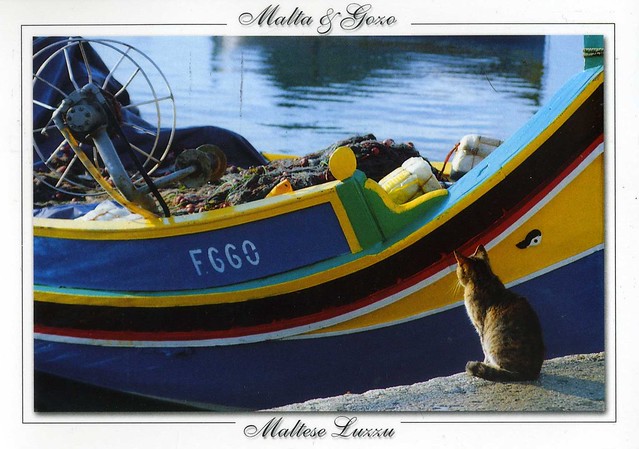
Maltese Luzzu, Malta

Another postcard from somewhere warm... I received this one as an "RAS" from Leena in Malta last summer. She always sends the most beautiful, colourful postcards!


A luzzu is a traditional fishing boat from the Maltese islands. They are brightly painted in shades of yellow, red, green and blue, and the bow is normally pointed with a pair of eyes. These eyes may be the modern survival of an ancient Phoenician custom (also practiced by the ancient Greeks); they are sometimes (and probably inaccurately) referred to as the Eye of Horus or of Osiris.

The luzzu has a double-ended hull. A variant, the kajjik, is similar in appearance, but has a square transom.

The design of the Luzzu, like that of another Maltese boat, the dghajsa, is believed to date back at least to the Phoenician times. The luzzu has survived because it tends to be a sturdy and stable boat even in bad weather. Originally, the luzzu was equipped with sails although nowadays almost all are motorised, with onboard diesel engines being the most common. Some luzzi have been converted to passenger carriers for tourists although the vast majority continue to be used as fishing vessels.

The town of Marsaxlokk is especially famous for the large numbers of luzzu and similar craft operating in its harbor.

The luzzu is one of the symbols of Malta and is featured on the reverse of the older series (1979-89) of Maltese lira coins.