Sunday, 13 June 2010

Sri Lanka

I said a while ago that I would post more about the postcards my ex-penpal, Dinushka, has sent me. Well, I thought I'd start with this map card..


This is what Dinushka wrote about the bottom right picture:

"The building is called 'Dargaba'. Normally there's one of each temple. Inside, those Dargabas in old temples they have kept a tooth relic of Lord Buddha. When we go to the temple we worship this 'Dargaba', Lord Buddha's statue & Sacred Bodhi tree."


I really love Sri Lankan stamps, and these are no exception. I couldn't find much info about these, this is what I did find. The one on the left was issued in 1997 and shows Thuparama (a 'dagaba' in Anuradhapura. King Devanampiyatissa built Thuparamaya in which was enshrined the collarbone of the Buddha. It is considered to be the first dagaba built in Sri Lanka following the introduction of Buddhism.) The stamp in the middle was issued in 1998 and commemorates 50 years of Sri Lankan cinema (of which I still know nothing, I have to admit. You can read more about it here.) The stamp on the right shows Solias Mendis paintings in Kaleniya Temple, situated about six miles from Colombo. The Kelaniya Raja Maha Vihara is one of the most sacred worshipping places of the Buddhists of Sri Lanka since it is a site made hallowed by the visit of Lord Buddha. In the past Kelaniya itself was a large city and the Kelani Raja Maha Viharaya was one of the largest and one of the most beautiful temples of Sri Lanka.

Saturday, 12 June 2010

Wadjemup Lighthouse, Australia

Today's last postcard is also a lighthouse one, but this time from Australia. It's a swap with Heather who has also sent me some other gorgeous postcards of Western Australia.


Info from the back of the card:

Wadjemup Lighthouse, Rottnest Island
Construction: White sandstone c1850.
Converted to automatic operation in Nov 1986.
Location: Lat 32° 0.5'S, Long 115° 30.1'E.
Character: Flashing every 7.5 seconds.
Light Source: 120v 1000w Tungsten Halogen lamp.
Intensity: 1,300,000 CD.
Elevation: 80.5 metres.
Range: 26 Nautical miles. 41km nominal.
Height: 38.7 metres.
Interesting fact: During the Meckering Earthquake in Oct 1968 a quantity of the mercury spilled out of its bath.


And again, amazing stamps! Heather even found a stamp from Rottnest Island, although it's a different lighthouse, just on the same island. It's from a set of 6 stamps issued in 2007, with the theme Australian Island Jewels. The other stamp is from a set of 4 stamps issued in 2009, depicting Australian Songbirds. This one is the Noisy Scrub-bird (love the name! :D).

Irish lighthouses

As I've said before, I really like the British Isles community on the postcrossing forum. I sometimes participate in "travelling envelopes" there, I love the idea of those! This card was in the latest envelope I received, with the theme "Seaviews - Harbours, Beaches, Boats,Rocks,islands".


On the back of this card it says "The wild and rugged coastline of Ireland has many lighthouses, some in the most dramatic of locations. This card features clockwise from top left, the Fastnet, Inisheer, Fanad and Hook lighthouses."

The Fastnet is located on Fastnet Rock, a small clay-slate island with quartz veins and the most southerly point of Ireland, 6.5 km southwest of Cape Clear Island (Oileán Chléire) in County Cork, which is itself 13 km from the mainland. It lies in the Atlantic Ocean 11.3 km south of mainland County Cork, at latitude 51.37°N. It rises to about 30 m above low water mark.

Inisheer is the smallest and most eastern of the three Aran Islands in Galway Bay. The nameless Inisheer lighthouse stands far out on the headland facing County Clare.

Fanad is a peninsula that lies between Lough Swilly and Mulroy Bay on the north coast of County Donegal. This lighthouse is classified as a sea light as distinct from a harbour light although it does mark the entrance into Lough Swilly which forms a natural harbour of refuge.

The Hook Lighthouse (also known as Hook Head Lighthouse), situated at the tip of the Hook Peninsula in County Wexford, in Ireland, is one of the oldest lighthouses in the world, and the oldest operating lighthouse in the British Isles.

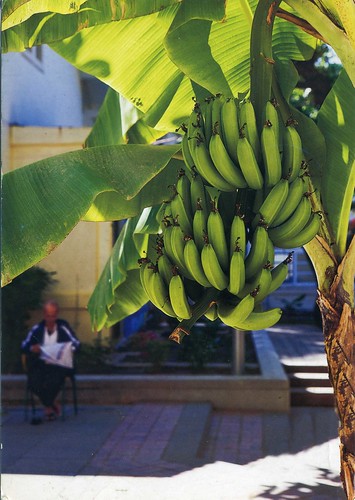
bananas in Taiwan

I seem to be receiving official postcrossing cards from Taiwan fairly regularly, and they are usually quite nice, too (don't really like some of the ad cards I've received from there, though). This one is probably one of my favourites, and I love it how it's so different from the other cards I've got from there.


TW-157693


I don't know if it's just me, but when I think of Taiwan, bananas are not the first thing that comes into mind. Chun-Ying, who sent me this card, told me that bananas are the most representative of Taiwan fruits, however. On the back of the card it says this is "Banana heaven" in Cishan Kaohsiung (Kaohsiung is a county in southern Taiwan).


Stamps from Taiwan always seem to be very beautiful. Unfortunately it also seems to be very difficult to find any information about them. Anyway, from what I could find, the bird stamp is from a set of 4 stamps issued in 2008, representing birds. This one is the Bronzed Drongo. The bridge stamp is also from a set of 4 stamps, issued in 2010, themed Bridges of Taiwan. This one shows Jinde Bridge in Donggang. The other two stamps I could find no info of.

Tinian, Northern Mariana Islands

This is technically not a new country - I already have a postcard from the Northern Mariana Islands but it's from Saipan, and it's unwritten (sent by my Japanese penpal who went on holiday there. Apparently, Saipan is pretty popular amongst the Japanese). This one, however, is a written and stamped card from Tinian. :)


How awesome is it that they have a Hot Pepper Festival?! Pretty damn awesome, I'd say. ...although I thought 'Bhut Jolokia' was the hottest chili pepper in the world, but maybe there's a difference?

Anyway, thank you so much for this card, Jude! I hope you like mine, too.


They use regular US stamps on the Northern Mariana Islands, but the card has has a Tinian cancellation which makes it special.

Tirana, Albania

I don't receive too many postcards from countries that are "new" to me, mainly because I'm not awfully active on the main postcrossing site and don't have postcards from "rare" countries for trade. That, plus I don't really know where to look for these swaps anyway. Occasionally there are offers on the forum, though, and I've got some great cards that way. This is one of such cards, and a new country to my collection. It was mailed from Italy, though, but it's still precious to me. Thank you, Luca!


Tirana is the capital and the largest city of Albania. Modern Tirana was founded in 1614 by Sulejman Pasha. Tirana became Albania's capital city in 1920. As of 2008, the city's urban population was officially estimated at 618,431.

The area now occupied by the city of Tirana has been populated since Paleolithic times dating back 10,000 to 30,000 years ago. On February 8, 1920, Tirana was chosen as the temporary capital of Albania, which had acquired independence in 1912, by the Congress of Lushnja. The city retained that status permanently on December 31, 1925. From 1920 to 1924 Tirana experienced attacks from the army of the Kingdom of Serbs, Croats and Slovenes and the forces of Zogu at the Shkalla e Tujanit (Step of Tujan).

In 1939, Tirana was captured by Fascist forces. In November 1941, Enver Hoxha with other Albanian communists founded the Communist Party of Albania. The town became the center of the Albanian communists' in mobilizing the people of Tirana to fight against the Italian fascists and later Nazi Germans, while spreading ideological propaganda. The town was liberated after a fierce battle between the Communists and the people of Tirana against the German forces, on November 17, 1944. The Nazis eventually withdrew and the communists seized power.

Following the communist takeover, the city experienced a significant period of development. In terms of urbanization, the city witnessed the creation of socialist-styled apartment complexes and factories. In the 1960s, the historical identity of the city faced a critical moment as the central square was redesigned. As a result, a number of buildings of cultural and historical significance were demolished to make way for the formation of present-day Skanderbeg Square.

The post communist period is described to have been the worst one in terms of the urban development of the city. Tirana experienced a chaotic development as high rise buildings started to be constructed without planning, and illegal structures rose on public areas. New informal districts started to form around the city as internal migrants gathered from around the country. During this period Tirana was transofrmed from a centrally planned economy to a market oriented economy. All the builidings and the apartaments were denationalized. A modern water-supply system and electrical-supply system was build during 1992-1996. These systems form the backbone of the modern Tirana.

The city experienced radical changes at the turn of the millennium. In 2000, a massive political campaign began to beautify and to liberate public space, which was previously occupied by illegal commercial establishments. The campaign, called Return to Identity, included the transformation of river banks, of parks, and of other public structures to their state before 1990. The overall infrastructure has improved as considerable number of roads have been reconstructed. More parks and squares have also been built giving Tirana a more "European" look. Common spaces between apartment buildings have been targeted by a subsequent campaign in bringing back green spaces and a vast number of illegal buildings have been demolished. It is observered that some existing green spaces are used for the construction of skyscrapers and multi-functional centers. Apartment buildings are being built on grounds of former residential houses.


As I said earlier, the card was mailed from Italy. The stamp is great, though. It's Italy's contribution to Europa 2010 stamp, this year's theme being children's books. Geronimo Stilton is a best-selling children's book series in Italy. In the series, the title character is a talking mouse who lives in New Mouse City on Mouse Island. A best-selling author, Geronimo Stilton works as a journalist for the fictional newspaper The Rodent's Gazette.

Tashkent, Uzbekistan

Moving on... This card was sent by Julia in Russia and it's from a tag on the postcrossing forum. It seems like a pretty old postcard, possibly from the Soviet era, it does have that feel to it. It's quite yellow and flimsy but lovely nonetheless. I quite like receiving proper vintage postcards.


Tashkent (literally "Stone City") is the capital of Uzbekistan and of the Tashkent Province. The officially registered population of the city in 2008 was 2.1 million.

At the moment, Tashkent is the most cosmopolitan city in Uzbekistan, with large ethnic Russian minority. The city is noted for its tree lined streets, numerous fountains, and pleasant parks. As capital of the nation, it has also been the target of several terrorist attacks since Uzbekistan gained independence, which the government has attributed to Islamic fundamentalists.

Since 1991, the city has changed economically, culturally, and architecturally. The largest statue ever erected for Lenin was replaced with a globe, complete with a geographic map of Uzbekistan over it. Buildings from the Soviet era have been replaced with new, modern buildings. One example is the "Downtown Tashkent" region, which includes the 22-story NBU Bank building, an Intercontinental Hotel, International Business Center, and the Plaza Building.

In 2007, Tashkent was named the cultural capital of the Islamic world as the city is home to numerous historic mosques and religious establishments.

What you can see on the card would seem to be Kukeldash Madrassah, one of the few remaining monumental architectural monuments of Tashkent. It was built in the second half of the 16th century in the time of Abdulla-Khan (1557-1598) under the Leadership of Kulbobo Kukeldash who was a vizier, a scientist and a poet. Madrasseh Kukeldash is under the authority of Religious Board of Maveraunnahr Moslems, and at present it is a regularly acting mosque. There is a primary school, which teaches the basis of Islam.

northern lights, Finland

Another card from the Finnish Summer RR...


I really, really love the colours in this one! Such lovely shades of pink and purple. ^_^ There's nothing on the card about where the picture was taken, but I'm assuming it was somewhere in Lapland.


And what made the card even better was that it came with a northern lights stamp. :) It's from a set of 3 stamps issued in 2009, representing northern lights (d'oh :P).

lynx, Finland

I decided to participate in the 'Kesä RR' ('Summer RR') in the Finnish postcrossing community on the forum this year. This was one of the first cards I received in that RR, and also one of the cutest.


Isn't it just adorable?! It's a little lynx baby. Lynx are quite common in Finland, and according to the Finnish Game and Fisheries Research Institute, he lynx population in Finland was 1900–2100 individuals in year 2008, and the number have been increasing every year since 1991. It has been estimated that lynx population in Finland is currently larger than ever before.


The stamp is from a set of 5 stamps issued earlier in 2010, representing countryside nostalgia. These stamps are so cute!

Sipadan, Malaysia

This card arrived a while ago and I've been wanting to post about it ever since. It's taken a while, though, as other stuff has happened and I haven't been able to get online for long enough.


MY-40365


I have to confess when I first saw this card it freaked me out a bit. The place looks gorgeous, like a paradise, but I guess I'm not the only Finnish person who associates the word 'Sipadan' with something else. I had to check the year, and it looks like it happened back in 2000 (is it really that long ago?!), then, 21 people were kidnapped by the Filipino Islamist terrorist group Abu Sayyaf. The armed terrorists arrived by boat and forced 10 tourists (including two Finns) and 11 resort workers at gun point to board the vessels and brought the victims to Mindanao, the Philippines. All victims were eventually released, but it seemed to take ages and the incident was widely covered in the Finnish media.

Anyway. Luckily, Sipadan is also known for much nicer things. Sipadan is the only oceanic island in Malaysia, rising 600 metres (2,000 ft) from the seabed. It is located in the Celebes Sea east of the major town of Tawau and off the coast of Sabah, East Malaysia on the island of Borneo. It was formed by living corals growing on top of an extinct volcanic cone that took thousands of years to develop. Sipadan is located at the heart of the Indo-Pacific basin, the centre of one of the richest marine habitats in the world. More than 3,000 species of fish and hundreds of coral species have been classified in this ecosystem. Sipadan has been rated by many dive journals as one of the top dive destinations in the world.


The bird stamp was probably issued in 2005 and is from a set of 8 stamps, representing birds. This one is the Spotted Dove. I couldn't find any info about the other stamps.

Monday, 7 June 2010

Western Australia

I said last week that I'd post more about Perth shortly.. well, here is the card. :) It's a swap with Heather in Western Australia.


I really, really like postcards in this series. I'm not usually too fond of multiviews, but these are great. I think the map certainly helps, but it also doesn't look as stuffed as some other multiviews, and you can still see what's in the pictures.

The top left picture is Perth, again seen from Kings Park. The picture under it shows the Bungle Bungles in Purnululu National Park. The flat, Kangaroo Paw and Black Swans are emblems of the State of Western Australia.

I had to find out more about the Bungle Bungles; the name alone is so cool and the rocks look very interesting. I found out that Purnululu National Park is a Unesco World Heritage site, located in north east of Western Australia. It contains the deeply dissected Bungle Bungle Range composed of Devonian-age quartz sandstone eroded over a period of 20 million years into a series of beehive-shaped towers or cones, whose steeply sloping surfaces are distinctly marked by regular horizontal bands of dark-grey cyanobacterial crust (single-celled photosynthetic organisms). These outstanding examples of cone karst owe their existence and uniqueness to several interacting geological, biological, erosional and climatic phenomena.


The stamps on the card are gorgeous, too! I wrote earlier that you are only supposed to use "International" stamps for mail sent outside of Australia. However, Heather used these amazing domestic stamps instead. They are from a set of 4 stamps issued last month, celebrating Great Australian Railway Journeys. Australian trains cross the continent east to west and south to north, covering great distances over often isolated and difficult terrain. They also cover much smaller distances in rugged and precipitous mountain country. These trains were once the primary means of linking isolated settlements with more populous centres. These stamps show (from left) The Ghan West Coast Wilderness Railway in Tasmania, and The Indian Pacific. I love it how the value of the stamps are in areas that look like train tickets! :D

Sri Lanka

Another post of an island... I have a soft spot for Sri Lanka - I used to have a penpal there for years when I was younger. I got the first letter from my English teacher in school, she asked if anyone would be interested in a penpal in Sri Lanka and no one else was apart from me... I think I was maybe 13 years old at the time. We don't write to each other anymore, which is a shame, I really miss Dinushka's letters and learning more about her country and culture. We lost contact for a couple of years, then a couple of years ago I found her in facebook and found out she had got married and moved to Australia with her husband.


I did a swap with Ravindra in Sri Lanka recently. I got two postcards from him, one showing Galle Lighthouse and one a scenic view of Kalutara in south west of Sri Lanka.

Galle Lighthouse is an offshore Lighthouse in Galle, Sri Lanka and is operated and maintained by the Sri Lanka Ports Authority. It is Sri Lanka's oldest light station dating back to 1848, but the original lighthouse was destroyed by fire in 1934. The light station is within the walls of the ancient Galle fort, a UNESCO world heritage site and well known tourist attraction, making this the country's most often visited lighthouse.

I also recognise this lighthouse from stamps on letters from Dinushka; I think it appeared on a number of them. I'll be posting about that more later, as well as some of the postcards she's sent me.


The other card is a view of Kalutara, a resort town located approximately 40 km south of Colombo, Sri Lanka's capital. Once an important spice-trading center, the city's name is derived from the Kalu Ganga River ('Black River' in native Sinhala). In the 11th Century, the town was temporarily made a capital on the orders of a South Indian Prince. The region was later planted with coconut trees, whose by-products are used for both internal and external trade. The location also boast fortifications dating back from the times when Portuguese, Dutch and British vied for control of the area.

The 38-meter long Kalutara Bridge was built at the mouth of the Kalu Ganga River and serves as a major link between the country's Western and Southern border. At the southern end of the bridge lies the 3 stories-high Kalutara Vihara, a Buddhist temple built in the 1960s which holds the distinction of being the only stupa in the world that is hollow.


I have always loved Sri Lankan postage stamps, and these are no exception. :) I couldn't find any info about these online, but the four bigger stamps were all issued in 2010. The one on the left commemorates the 125th Anniversary of the Buddhist Flag (the stamp is upside down here, btw!), the one next to it the arrival of Lord Buddha to Mahiyanganaya. The one next to that shows a Stupa (a mound-like structure containing Buddhist relics) in Mahiyangana. The stamp on the right depicts art and sculpture in Late Anuradhapura. The three smaller stamps are from a set of 16 stamps issued in 2007, representing Constellations. These ones show Aries and Aquarius.