Sunday, 10 July 2011

Cape Naturaliste Lighthouse, Dunsborough, Western Australia

Another gorgeous postcard from the lovely Heather. I know I've already posted about this lighthouse here but what can I do, it's so beautiful!


On the back of the card it says that walk trails near the lighthouse extend around Cape Naturaliste offering elevated views with the possibility of sighting migrating whales. I wonder if that's been the case here. It must be a pretty spectacular experience to see whales in the wild.


The stamps come from a set of 4 stamps issued earlier this year, depicting Christmas Island Crabs. I wouldn't want to come across one of these guys on a beach!

Barcelona, Spain

I'm so excited!! I think I've mentioned here that I'm getting married next month.. Well, this week me and Matt booked our honeymoon trip. We'll be going to Barcelona, Spain for a week at the beginning of September. I'm a little overwhelmed as this is our first proper holiday (= no family/parents) together in the 5+ years we've been together. And there's going to be so much see... I already know I want to see Park Güell, Casa Milà, Casa Batlló, Sagrada Família, Barri Gòtic and La Boqueria, but what else? Ahhh, I'm really looking forward to this trip! Hopefully it'll be a bit warmer there than it is in England at the moment. :P


My postcard pal Hanna was on an interrail in Europe this May/June and sent me this lovely card showing Casa Batlló from Barcelona. Casa Batlló is a building restored by Antoni Gaudí and Josep Maria Jujol, built in the year 1877 and remodelled in the years 1904–1906; located at 43, Passeig de Gràcia, in the Eixample district of Barcelona, Spain. Gaudí's assistants Domènec Sugrañes i Gras , Josep Canaleta y Joan Rubió also contributed to the renovation project.

The local name for the building is Casa dels ossos (House of Bones), and indeed it does have a visceral, skeletal organic quality. It was originally designed for a middle-class family and situated in a prosperous district of Barcelona.

The building looks very remarkable — like everything Gaudí designed, only identifiable as Modernisme or Art Nouveau in the broadest sense. The ground floor, in particular, is rather astonishing with tracery, irregular oval windows and flowing sculpted stone work.

It seems that the goal of the designer was to avoid straight lines completely. Much of the façade is decorated with a mosaic made of broken ceramic tiles (trencadís) that starts in shades of golden orange moving into greenish blues. The roof is arched and was likened to the back of a dragon or dinosaur. A common theory about the building is that the rounded feature to the left of centre, terminating at the top in a turret and cross, represents the lance of Saint George (patron saint of Catalonia, Gaudi's home), which has been plunged into the back of the dragon.

I most definitely want to see this building, if only from the outside.


The stamp is from a set of 4 stamps issued earlier this year, depicting butterflies.

Wednesday, 6 July 2011

Havana, Cuba

I'm keeping today's post a little smaller than usual, so I'll finish with this very nice card I got from a swap earlier this year. I'm quite excited about this card, too, as it's my first written and stamped postcard received from Cuba. :)


On this card you can see a view from the Old Havana. Havana was founded in 1519 by the Spanish. By the 17th century, it had become one of the Caribbean's main centres for ship-building. Although it is today a sprawling metropolis of 2 million inhabitants, its old centre retains an interesting mix of Baroque and neoclassical monuments, and a homogeneous ensemble of private houses with arcades, balconies, wrought-iron gates and internal courtyards. Old Havana is a Unesco World Heritage Site.

Havana is the capital city, major port, and leading commercial centre of Cuba. The city is one of the 15 Cuban provinces and the largest city in the country. Contemporary Havana can essentially be described as three cities in one: Old Havana, Vedado, and the newer suburban districts. Present day, the city is the center of the Cuban government, and various ministries and headquarters of businesses are based there.


Very nice stamps, I couldn't find any info on them, though.

St. Peter's Square, Vatican City

I received this nice card from a swap earlier this year. It's only my second postcard mailed from the Vatican City.


St. Peter's Square (Piazza San Pietro in Italian) is located directly in front of St. Peter's Basilica in Vatican City, the papal enclave within Rome (the Piazza borders to the East the rione of Borgo).

The open space which lies before the basilica was redesigned by Gian Lorenzo Bernini from 1656 to 1667, under the direction of Pope Alexander VII. Bernini had been working on the interior of St. Peter's for decades; now he gave order to the space with his renowned colonnades, using the Tuscan form of Doric, the simplest order in the classical vocabulary, not to compete with the palace-like façade by Carlo Maderno, but he employed it on an unprecedented colossal scale to suit the space and evoke emotions awe.

St. Peter's Square today can be reached from the Ponte Sant'Angelo along the grand approach of the Via della Conciliazione (in honor of the Lateran Treaty of 1929). The spina which once occupied this grand avenue leading to the square was demolished ceremonially by Benito Mussolini himself on October 23, 1936 and was completely demolished by October 8, 1937. St. Peter's Basilica was now freely visible from the Castel Sant Angelo. The effect of its demolition, however, was to destroy the characteristic Baroque surprise. The Via della Conciliazione was completed in time for the Great Jubilee of 1950.


The stamp is an Easter stamp issued earlier this year.

Chukotka, Russia

Another card from the diary swap I did with my Russian friend Katya earlier this year. I just love these views!


As I already wrote about Chukotka in that earlier post (link above), I won't repeat it here. Let me just say that I really love these views of Russian nature and wilderness. There is such diversity in that country, it's amazing. I'm thinking of starting a collection of all different regions of Russia, I was inspired by a post of the postcrossing forum. I need to go through all my cards first, though, and try to organise them by country. That's going to take some time...!


Katya always uses the most amazing stamps on her cards and this one is no exception. The stamp on top left is from 2003, from the 'Europa' series, that year's theme being Poster Art. The two flower stamps in the middle are from a set of 5 stamps issued in 1999, depicting roses. The stamp on the right is from a sheet of 5 stamps issued in 2005, depicting insects, and the stamp on the bottom is from a set of 3 stamps issued in 2004, commemorating the Birth Bicentenary of M.I.Glinka.

Tampere, Finland

They have SO many postcrossing meet-ups in Finland, I'm a little jealous. It's nice to receive cards from these meet-ups, though, and the kindness of some postcrossers is really touching. This card is from an international meet-up in Tampere this May.


I've been to Tampere quite a few times as I have relatives who don't live too far from there. It's a really nice town, not too small but not overwhelmingly huge, either. I would've really liked to go to university there but so do a lot of other people as well, and my points in the entrance examination were only enough for me to get a place in Savonlinna. Oh well. At least I'm out of Savonlinna now :P

Tampere is a city in southern Finland. It has a population of 213,344, growing to approximately 300,000 people in the conurbation and over 340,000 in the metropolitan area. Tampere is the third most-populous municipality in Finland, after the Greater Helsinki municipalities of Helsinki and Espoo.

Tampere is located between two lakes, Näsijärvi and Pyhäjärvi. Since the two lakes differ in level by 18 metres (59 ft), the rapids linking them, Tammerkoski, have been an important power source throughout history, most recently for generating electricity. Tampere is dubbed the "Manchester of Finland" for its industrial past as the former center of Finnish industry, and this has given rise to its Finnish nickname "Manse" and terms such as "Manserock".

Tampere is known for its active cultural life. Some of the most popular writers in Finland, such as Väinö Linna, Kalle Päätalo and Hannu Salama, hail from Tampere. These are all known as writers depicting the lives of working class people. Also from a working class background was the famous poet Lauri Viita of the Pispala district (which is the original home of Hannu Salama too). Tampere also has old theatre traditions, with such established institutions as Tampereen Työväen Teatteri, Tampereen Teatteri and Pyynikin Kesäteatteri, which is an open-air theatre with the oldest revolving auditorium in Europe. Tampereen Teatterikesä or Tampere Theatre Festival is an international theatre festival held in Tampere every August.

The main tourist attraction is the Särkänniemi amusement park, which includes a dolphinarium and the landmark Näsinneula tower, topped by a revolving restaurant. Other sites of interest are Tampere Cathedral, Tampere City Library Metso ("wood grouse"), Kaleva Church (both designed by Reima Pietilä), the Tampere Hall for conferences and the Tampere Market Hall.

Tampere is also home to one of the last museums in the world dedicated to Vladimir Ilyich Lenin. Lenin moved to Tampere in August 1905 and during a subsequent Bolshevik conference in the city met Joseph Stalin for the first time. Lenin eventually fled Tampere (for Sweden) in November 1907 when being pursued by the Russian Okhrana. Lenin would not return to any part of the Russian Empire until ten years later, when he heard of the start of the Russian Revolution of 1917. ...and there is a Spy Museum in Tampere as well, which I'd love to visit one day. :D


The stamp on the left was issued earlier this year and shows the Finnish flag. The smaller stamp is from a set of 2 definitives, also issued this year, depicting birch trees.

Saturday, 2 July 2011

Zambia

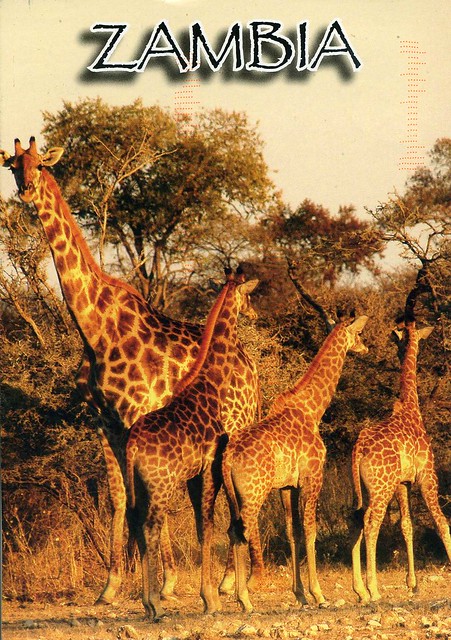
The final card for today comes from Africa, a continent sadly underrepresented in my postcard collection. But then again, it makes it more special when one does show up in my mailbox. This one is from a new country, too - Zambia.


I was already vaguely familiar with Zambia as Matt's older sister Rachel used to work there some years ago. I'm not sure in what capacity, I think she was doing some sort of volunteer work there. I don't know so much because I didn't yet know Matt when she was there.. I've just heard stories (and seen a cool handmade postcard she sent to her family from there ;)). I sometimes think it might be nice to do volunteer work somewhere like Zambia, but that's not really a possibility now that I'm not single anymore, and life would just get in the way too much. That, and I've got the impression that you'd still have to pay for your travel to the destination and back, and possibly your living expenses there as well so it's not like I could afford it anyway.

This postcard is from a Taiwanese volunteer worker in Zambia (it seems like a lot of Taiwanese postcrossers are doing volunteer work abroad?!). Zambia is a landlocked country in Southern Africa. The neighbouring countries are the Democratic Republic of the Congo to the north, Tanzania to the north-east, Malawi to the east, Mozambique, Zimbabwe, Botswana and Namibia to the south, and Angola to the west. The capital city is Lusaka, located in the south-central part of the country. The population is concentrated mainly around the capital Lusaka in the south and the Copperbelt to the northwest. Zambia has a tropical climate and consists mostly of high plateau, with some hills and mountains, dissected by river valleys.

Zambia has been inhabited for thousands of years by hunter-gatherers, gradually leading to a multiethnic country. After visits by European explorers starting in the 18th century, Zambia became the British Colony of Northern Rhodesia towards the end of the nineteenth century. This was achieved through consessions and agreements between local paramount chiefs and representatives of the British Empire. For most of the colonial period, the country was governed by an administration appointed from London with the advice of the British South Africa Company.

On 24 October 1964, the country declared independence from the United Kingdom and prime minister Kenneth Kaunda became the first head of state. The new name of Zambia was derived from the Zambezi river (Zambezi may mean "God's river") which flows through the western region of the country.

Zambia is one of the most highly urbanized countries in sub-Saharan Africa with 44% of the population concentrated in a few urban areas along the major transport corridors, while rural areas are sparsely populated. Unemployment and underemployment in urban areas are serious problems, while most rural Zambians are subsistence farmers. The population comprises approximately 72 ethnic groups, most of which are Bantu-speaking.


I couldn't find any info on the stamp so all I know is what I can read on the stamp - issued in 2000, showing the Sacred Ibis.

India

It's always nice to see postcards showing people around the world, and I particularly like Indian postcards because so many of them are so wonderfully colourful. Like this one here...


The sender, Rajagopal, tells me this is a typical Indian scene where the priests and some devotees arrange a procession for their chosen dieties. Here, since the procession takes place in a village, a tractor has been temporarily modified for the purpose.


The stamp on the right was issued in 2009 and shows C.V. Raman. The stamp on the left is from a set of 5 (?) stamps issued in 2008, depicting people, this one here being Dr. B.R. Ambedkar.

La Coca Falls, El Yunque, Puerto Rico

A very beautiful waterfall postcard I received earlier this year.


Coca Falls are located in El Yunque National Forest in northeastern Puerto Rico. It is the only tropical rain forest in the United States National Forest System inventory. The forest is commonly known as El Yunque. The second-tallest mountain within El Yunque is also named El Yunque. El Yunque National Rainforest is located on the slopes of the Sierra de Luquillo Mountains and it encompasses 113.32 km² of land, making it the largest block of public land in Puerto Rico. El Toro, the highest mountain peak in the forest rises 1,065 meters above sea level. Ample rainfall (over 200 inches a year in some areas) creates a jungle-like setting - lush foliage, crags, waterfalls and rivers are a prevalent scene. The forest has a number of trails from where the jungle-like territory's flora and fauna can be appreciated.

Steamtown National Historic Site, Scranton, Pennsylvania, USA

This is one of my oldest received official Postcrossing cards - I received it over three years ago! I think that might have been when you were only allowed to have five postcards travelling at the same time so I didn't get many officials back then. Maybe that's why they are so special to me??


US-179407


This card came from a young boy who had just been to the Steamtown National Park to see lots of old trains. It must have been an awesome place! Old trains look so beautiful and seem to have a lot more character than modern trains. I've seen some in Finland and thought they were really cool, so a bigger place like this must be fantastic.

Steamtown National Historic Site is a railroad museum and heritage railroad located on 25.3 ha in downtown Scranton, Pennsylvania, at the site of the former Scranton yards of the Delaware, Lackawanna and Western Railroad. The museum is built around a working replica turntable and a roundhouse that is largely a replica but which includes two authentic sections built in 1902 and 1937. All the buildings on the site are listed with the National Register of Historic Places.

On this postcard you can see a Lehigh Valley Caboose 95003, built in 1941. Cabooses served as rolling offices for the conductor, brakemen, and flagmen (freight train workers).


The stamp on top left was issued in 2000 under the theme 'summer sports'. The stamp next to it is from a sheet of 10 stamps issued in 2006, depicting Southern Florida Wetland. The stamp on the bottom, then, is from a set of 8 stamps issued in 1981 (!!!) under the theme 'Space Flights'.

map of Finland

Let's move back to Finland.. I received this very cool map card from the lovely Liisa in Finland. It's always a joy to receive mail from her and this card is no exception.


This is not your typical map of Finland - as you can see, none of the major towns are marked on it, apart from Helsinki and Tampere. Instead there are a bunch of small towns. This card is actually an ad for the 'Kipa' book shop chain. They have shops in these smaller towns as a bigger, more conventional book shop wouldn't really work in these places. I would probably be pretty frustrated if I was stuck living in one of these places as I love to visit book shops and these small ones are, well, a bit *too* small for me. But at least they're something.

The card is illustrated by Marjaliisa Pitkäranta. I remember her illustrations from my childhood, she's pretty well-known in Finland.


Liisa got this card mailed from Åland, yay! I love seeing stamps from there as so many of them are so pretty. This one is extra special - it's from the Europa series from last year. I've been wanting this stamp ever since I saw it, I'm sooo excited to finally have it! Thank you, Liisa!

Stockholm, Sweden

I've lived most of my life next to Sweden but only ever visited the country once (?), very briefly. I'm a little jealous of my family who went there twice this June, first for a day when dad ran a marathon there, and then for a few days a couple of weeks later. I want to go, too! Well, at least they sent me a postcard. ;)


Here's a slightly different view of Gamla Stan (the old town)... Gamla stan consists primarily of the island Stadsholmen. The surrounding islets Riddarholmen, Helgeandsholmen, and Strömsborg are officially part of, but not colloquially included in, Gamla stan. The word "stan" is simply a contraction of the word "staden" ("sta'n"), meaning "the town."

The town dates back to the 13th century, and consists of medieval alleyways, cobbled streets, and archaic architecture. North German architecture has had a strong influence in the Old Town's construction.


Such cool stamps! And so old, too, I'm surprised they still sell stamps this old. My absolute favourite here is the squirrel stamp in the middle. Squirrels are some of my favourite animals and I have quite a collection of squirrel postcards, but it's also nice to see these cute little animals on stamps. The one here is from a set of 5 animal stamps issued in 1992. The stamp on the left is from a set of 3 definitives issued in 1989 with the theme Royalty, the one here showing Carl XVI Gustaf, the King of Sweden. The boat stamp I'm not sure of as I couldn't find any info on it. Swedish stamps really confuse me, too, because even if they look old they might still be brand new!