Thursday, 20 January 2011

Zagreb, Croatia

The last couple of weeks have been pretty hectic - I got a big translation assignment to do and have been really busy and stressed with it. It's so much bigger than anything I've done before so I think that's the main reason why I have been feeling so nervous about it. Anyway, I'm almost done now so I wanted to update this blog again. :)


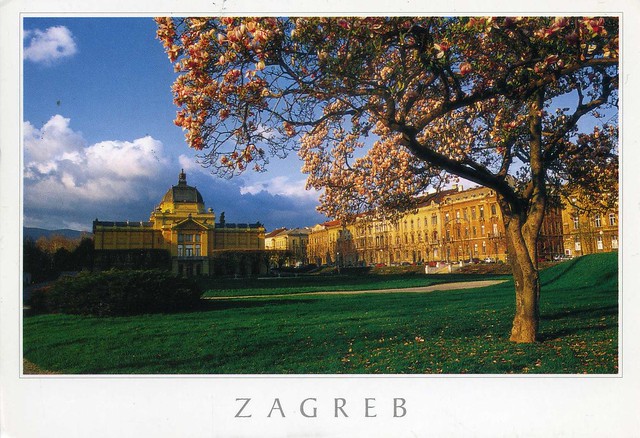
I've been having lots of weird dreams recently. Mostly work-related and some rather unpleasant ones, but a couple of nights ago I had this really beautiful dream where I was taking photos of magnolia blossoms in the snow (as in, there were lots of magnolia trees blossoming but it was also snowing O_o). The part of spring with blossoming trees is one of my favourite times of year, I've been thinking about it recently actually, looking forward to lighter days and spring. We've had some nice, sunny days recently and it's giving me hope. Anyway, that's why I like this card from the lovely Nives so much. It has a blossoming magnolia tree on it! ...or at least it looks like one. I really like the yellow light here, too, so pretty!

Wednesday, 5 January 2011

Hua Hin Railway Station, Thailand

My last card for today was sent to me by my grandma last year. She's actually in Thailand at the moment again, staying there for a while. She told me she needed to go somewhere warm and apparently Thailand is one of the only places where you get guaranteed sunshine. :D (That, and it's not overly expensive over there. I don't think grandma could afford the Caribbean...) So yeah, I might have another postcard coming from Thailand soon. :)


The Hua Hin Railway Station is one of the oldest railway stations in Thailand. Its most striking feature is the unique Royal Waiting Room in Thai architectural style. The Royal Waiting Room was built in the reign of King Rama VI in order to welcome the King and his entourage. The outstanding feature of the station is the pavilion constructed in in the reign of King Rama VI; it was originally named as "Plub Pla Sanamchan", and it was initially situated at Sanacham Palace in Nakorn Pathom Province. The Royal Waiting Room, the original building built in the same architectural style as Maruekkhathayawan Palace, stands adjacent to the station, and is a favourite spot for taking pictures for both Thai and foreign tourists. [source]


The smaller stamp is from a set of 6 "Greetings" stamps issued in 2010. The bigger stamp is from a miniature sheet of 12 stamps issued in 2008, with the subject Chatukham Rammathep.

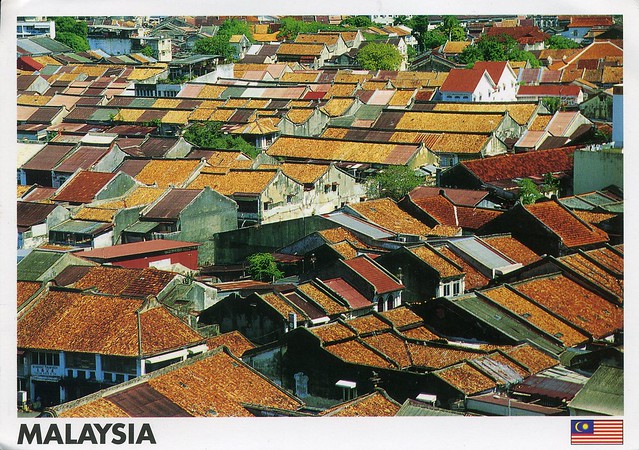
Georgetown, Penang, Malaysia

This card is from a swap with SL Liew in Malaysia. I just love the colourful rooftops here!


Georgetown is the capital of the state of Penang in Malaysia. Named after Britain's King George III, Georgetown is located on the north-east corner of Penang Island and has about 220,000 inhabitants, or about 400,000 including the suburbs. The inner city of Georgetown is a UNESCO World Heritage Site.

Georgetown has the largest concentration of pre-war terracotta rooftop double storey terrace houses which are shops on the ground floor, with air wells and residential on top floor. Due to rent control after war set by the British administration, there was no urban renewal, thus indirectly preserving them. The rent control was repealed a decade ago.


The stamp is from a set of 3 stamps issued in 2009, depicting palm trees.

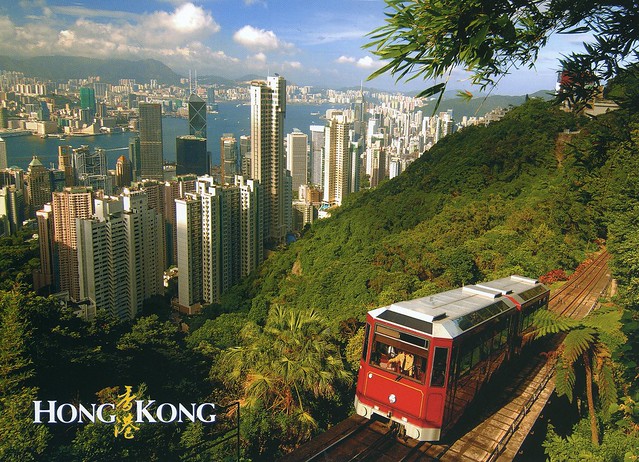
The Peak Tram, Hong Kong

This card is from a swap with a very nice postcrosser, but it reminds me more of friends. One of my best friends here in England is from Hong Kong, and she once sent this same card (or at least I think it's the same) to two other friends of ours when she was visiting home, in fact I think they still have the card over their fireplace. ;)


Hong Kong's oldest form of mechanical transport, the Peak Tram opened in 1888. Originally run by steam it converted to electricity in 1926 and then to microprocessor control in 1989. The upper terminus is 397 metres above sea level and the single journey takes 8 minutes from the lower terminus in St John's Building.

Trakai, Lithuania

I seem to be sending quite a lot of official postcrossing cards to Lithuania but haven't received many from there. It's a shame, I'd like to see more of this country!


This card had been in my favourites for a while, and last year I finally got it via a tag on the postcrossing forum. Isn't it a gorgeous view?! It sort of reminds me of Savonlinna where I used to study, except that Trakai looks a little more beautiful. :)

Trakai Island Castle is located in Trakai, Lithuania on an island of Lake Galvė. The castle is sometimes referred to as "Little Marienburg". The construction of the stone castle was begun in the 14th century by Kęstutis, and around 1409 major works were completed by his son Vytautas the Great, who died in this castle in 1430. Trakai was one of the main centers of the Grand Duchy of Lithuania and the castle held great strategic importance.

Vladivostok, Russia

I thought I'd post a few older cards for a change. I've got so many nice ones I received before starting this blog and it would be a shame to leave them all aside.

I'm starting with this lovely card from Russia I received through a swap. I totally adore it - the old house looks very charming and the black cat just adds to the charm. ...AND the card is from Vladivostok, a place I find fascinating due to its remote location.
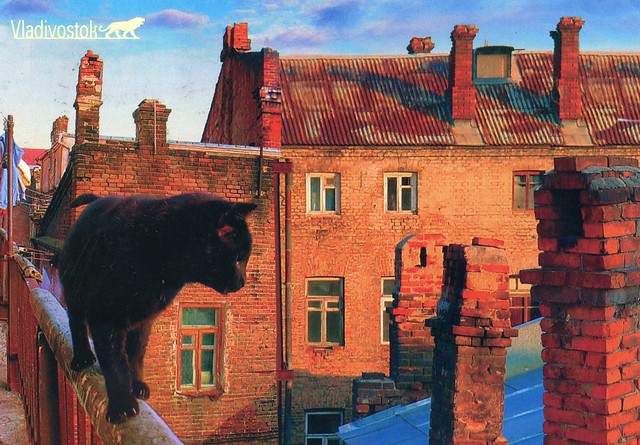


Vladivostok is Russia's largest port city on the Pacific Ocean and the administrative center of Primorsky Krai. It is situated at the head of the Golden Horn Bay, not far from Russia's border with China and North Korea. It is the home port of the Russian Pacific Fleet. The population of the city, as of 2010, is 578,000.

From 1958 to 1991, only Soviet citizens were allowed to live in Vladivostok or visit it (and even then had to obtain an official permission). Before this closure, the city had large Korean and Chinese populations. Some Koreans who were deported during Stalin's rule from the Russian Far East have since returned, particularly to Vladivostok.

The Trans-Siberian Railway was built to connect European Russia with Vladivostok, Russia's most important Pacific Ocean port. Finished in 1905, the rail line ran from Moscow to Vladivostok via several of Russia's main cities. Part of the railroad, known as the Chinese Eastern Line, crossed over into Manchuria, China, passing through Harbin, a major city in Manchuria. During the Soviet era, Vladivostok's status as a closed city meant that ferry-passenger tourists arriving from Japan to travel the Trans-Siberian railway westbound had to embark in Nakhodka. Today, Vladivostok serves as the main starting point for the Trans-Siberian portion of the Eurasian Land Bridge.

The picture on this card is from the Old City (Millionka) in Vladivostok. ...and could you have guessed that this is an ad card? I sure couldn't if I didn't know! Just goes to show that there are nice ad cards around so I don't think people should be so negative about all ad cards. (The card advertises a café and Vladivostok TAXI.)
Sunday, 2 January 2011

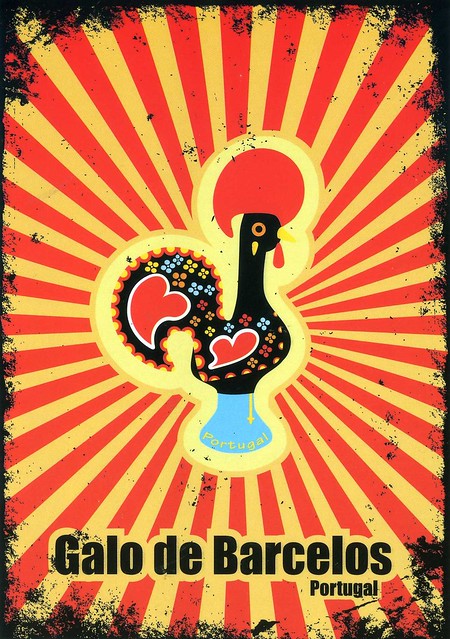
Galo de Barcelos, Portugal

Most of the cards I got from Wanda for Christmas were from Spain, but there were a few Portuguese ones there as well. This one is probably my favourite.


There is some info at the back of the card:

In the town of Barcelos there is a very famous symbol called o Galo de Barcelos in Portuguese. The legend says that a rich man made a big party. When the party was over, the rich man noticed that his sterling cutlery was stolen by a guest. He accused a pilgrim and let him go to court. He protested his innocence, but the judge didn't believe him. The judge was about to eat a roasted cock and the pilgrim said: If I am innocent, this cock will crow. When the pilgrim was about to be hanged, the cock crowed. The judge released the pilgrim. The story ends and a few years later when the pilgrim returned and made a statue over the event. This legend became famous all over Portugal.

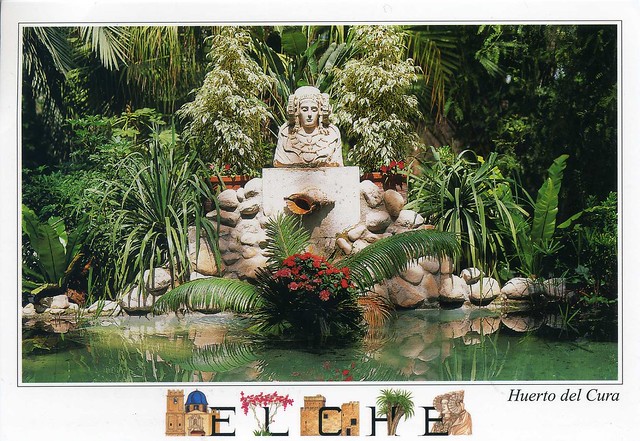
Elche, Spain

One more card from Spain for today. This one's from Elche, in Costa Blanca in Valencia.


Elche is a city located in the comarca of Baix Vinalopó, in the Alicante province which, in turn, is a part of the Valencian Community, Spain. According to the 2008 census, Elche has a population of some 228,300 inhabitants, ranking as the third most populated city in the Valencian Community (after Valencia and Alicante) and the 20th largest Spanish city.

Part of the municipality is coastal but the main city is some 11 km from the Mediterranean Sea. A small creek called Vinalopó flows through the city splitting it in two parts.

El Huerto del Cura ('the Curate's orchard') is part of El Palmeral - an ancient grove of palm trees (Phoenix dactylifera) said to have been planted by the Phoenecians. The orchard grows both fruiting species and ornamental species. The garden has two ponds. [source]

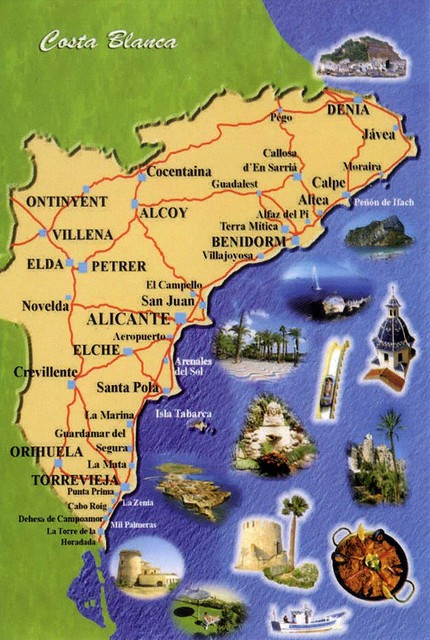
Costa Blanca, Spain

Let's move on, to the west coast of Spain. This is another card I got from Wanda. I'm so excited she got me a map card as well!


Costa Blanca refers to the over 200 kilometres of coastline belonging to the Province of Alicante in Spain. The name "Costa Blanca" was devised as a promotional name used by British European Airways when they launched their air service between London and Valencia in 1957. It has a well developed tourism industry and is a popular destination for British and German tourists. It extends from the towns of Denia in the north, beyond which lies the Costa dels Tarongers, to Pilar de la Horadada in the south, beyond which lies the Costa Calida. It includes the major tourist destinations of Benidorm, Alicante, Denia and Xàbia.

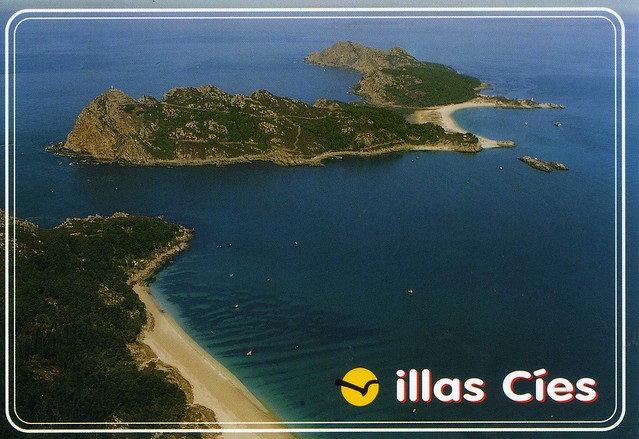
Cíes Islands, Spain

One more Galician card...


The Cíes Islands are an archipelago off the coast of Pontevedra in Galicia, in the mouth of the Ría de Vigo. They belong to the parish of San Francisco de Afora, in the municipality of Vigo. They were declared a Nature Reserve in 1980 and are included in the Atlantic Islands of Galicia National Park (Parque Nacional Marítimo-Terrestre das Illas Atlánticas de Galicia) created in 2002. In the year 2007, the British newspaper The Guardian chose the beach of Rodas, in the island of Monteagudo, as the "most beautiful beach of the world".

The Cíes consist of three islands, Monteagudo ("Sharp Mount" or North Island), do Faro ("Lighthouse Island", or Isla do Medio, "Middle Island") and San Martiño ("Saint Martin" or South Island).

Due to the high natural value of this area and to the deterioration it was suffering by human activity, it was declared a Nature Reserve in 1980. The level of legal protection varied until November 21, 2000, when the Galician Parliament unanimously agreed to apply for the status of National Park to the central Government. The Spanish Congress of Deputies signed a definite agreement in June 2002, creating the National Land-Marine Park of the Atlantic Islands of Galicia, formed by a number of archipelagos, islands and cays, namely the Cíes, Ons, Sálvora, Noro, Vionta, Cortegada and the Malveiras.

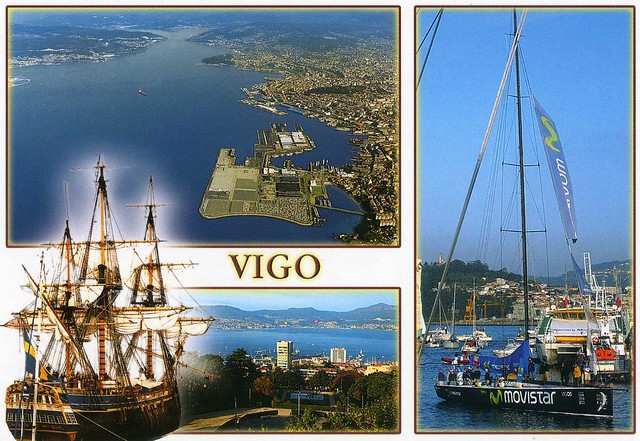
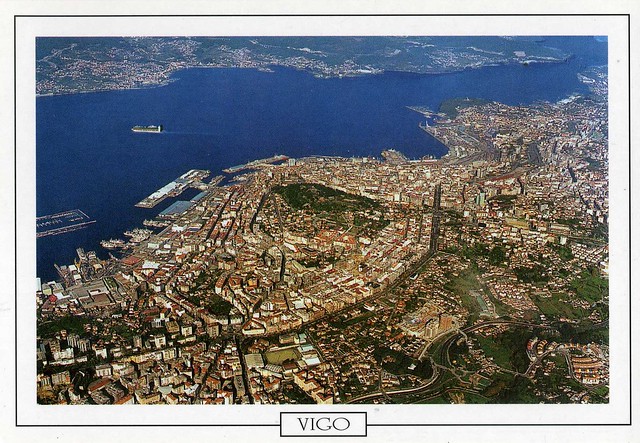
Vigo, Spain

More cards from Wanda...


Vigo is a city and municipality in Galicia, Spain. The city is located on the ria of the same name on the Atlantic Ocean.

It is the largest city in Galicia with a population of 297,332, with an extended metropolitan population of 468,654, making it the 14th-largest metropolitan area of Spain. Vigo is the largest city in Spain which is not a provincial capital.

The urban area of Vigo is built over both a hill-fort (Castro) and a Roman settlement. It is generally accepted that the name Vigo is derived from the Latin word Vicus.

Vigo is one of the leading industrial areas in Galicia, with car factories, shipyards, and auxiliary industry. Vigo has the largest fishing port in Europe as well, and the home port of the world's largest fishing company, Pescanova. The headquarters of the European Fisheries Agency are placed in here.

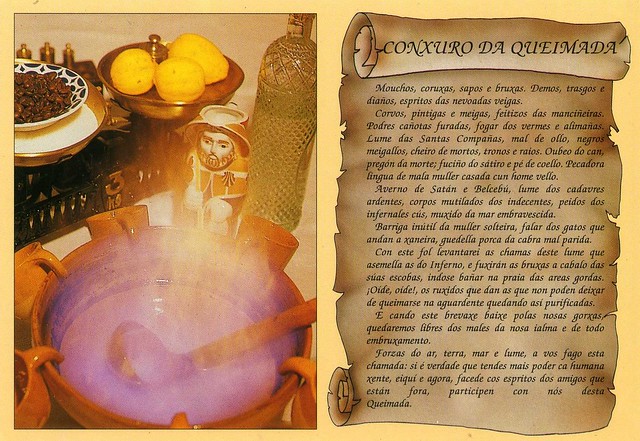
Conxuro da Queimada

Happy New Year 2011! I hope you all will have a lovely year with lots of great postcards. :) 2010 was pretty good for me postcard-wise, I'm hoping 2011 will be the same. I got some Spanish and Portuguese postcards for Christmas from my friend Wanda. Yeah, my friends know I like postcards :D There were some really nice ones amongst those cards so I wanted to post about a few of them here. The first one is a very cool recipe card. :)


'Conxuro da Queimada' translates as 'Queimada's Spell'. It is an alcoholic beverage of Galician tradition. Queimada is a punch made from Galician aguardente (Orujo Gallego) - a spirit distilled from wine and flavoured with special herbs or coffee, plus sugar, lemon peel, coffee beans and cinnamon.

Typically, while preparing the punch a spell or incantation is recited, so that special powers are conferred to the queimada and those drinking it. Then the queimada is set alight, and slowly burns as more brandy is added. Wanda very helpfully included an English translation on the back of the card:

Owls, barn owls, toads and witches. Demons, goblins and devils, spirits of the misty vales.

Crows, salamanders and mages, charms of the folk healer(ess). Rotten pierced canes, home of worms and vermin. Wisps of the Holy Company, evil eye, black witchcraft, scent of the dead, thunder and lightning. Howl of the dog, omen of death, maws of the satyr and foot of the rabbit. Sinful tongue of the bad woman married to an old man.

Satan and Beelzebub's Inferno, fire of the burning corpses, mutilated bodies of the indecent ones, farts of the arses of doom, bellow of the enraged sea.

Useless belly of the unmarried woman, speech of the cats in heat, dirty turf of the wicked born goat.

With this bellows I will pump the flames of this fire which looks like that from Hell, and witches will flee, straddling their brooms, going to bathe in the beach of the thick sands. Hear! Hear the roars of those that cannot stop burning in the firewater, becoming so purified.

And when this beverage goes down our throats, we will get free of the evil of our soul and of any charm. Forces of air, earth, sea and fire, to you I make this call: if it's true that you have more power than people, here and now, make the spirits of the friends who are outside, take part with us in this Queimada.