Saturday, 26 November 2011

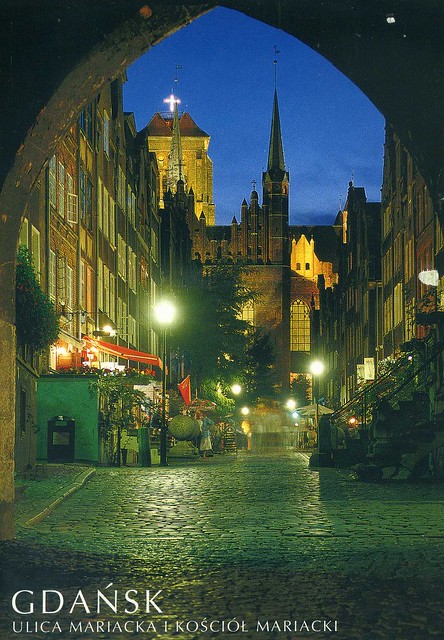
Gdańsk, Poland

Another official, I received this one around the same time as the card from Latvia. This one is from my favourites as well. I really appreciate it when people take the time to select a card they think the receiver is going to like, and go through the galleries. Not that I don't like surprises as well, though!


PL-271187


Gdańsk is a Polish city on the Baltic coast, at the centre of the country's fourth-largest metropolitan area. It's an old city, dating back to 997.

Gdańsk is Poland's principal seaport as well as the capital of the Pomeranian Voivodeship. It is also historically the largest city of the Kashubian region. The city is close to the former late medieval/modern boundary between West Slavic and Germanic lands and it has a complex political history with periods of Polish rule, periods of German rule, and extensive self-rule, with two spells as a free city. It has been part of modern Poland since 1945.

Gdańsk is situated at the mouth of the Motława River, connected to the Leniwka, a branch in the delta of the nearby Vistula River, whose waterway system supplies 60% of the area of Poland and connects Gdańsk to the national capital in Warsaw. This gives the city a unique advantage as the centre of Poland's sea trade. Together with the nearby port of Gdynia, Gdańsk is also an important industrial centre. Historically an important seaport and shipbuilding centre, Gdańsk was a member of the Hanseatic League.

The city was the birthplace of the Solidarity movement which, under the leadership of political activist Lech Wałęsa, played a major role in bringing an end to Communist rule across Central Europe.

Latvian countryside

Ooops. I just realised I haven't updated this blog for over a month. I haven't meant to ignore this thing but to be honest, the past month has been pretty rough and I haven't had the time/energy to update this blog. I do hope I'll start feeling better again soon and be able to catch up with a lot of stuff.

Anyway.. I'm in the mood for updating again and decided to start with this beautiful official I received a couple of months ago.


LV-44811


I have no idea of the exact location of the place on this card, all it says on the card is that it's in Latvia. :P This one had been in my favourites for quite a while so I was really happy to actually receive it. It's such a beautiful view, the atmosphere is so calm and peaceful, and the colours are lovely. Such a treat! ..and it's not like I receive postcards from Latvia all the time anyway.


I've decided not to write about stamps anymore unless I feel there's something very special about them. It just takes way too much time to find info about a lot of stamps and I don't think it's worth it.. so from now on you'll just get pictures of the stamps. :P

Saturday, 22 October 2011

Qatar

One more card for today. ...and it's from a new country (to me): Qatar. And it's such a nice, colourful card, too!


The card shows a Qatari girl in traditional jewellery, which looks pretty impressive indeed. I can't help thinking it must be pretty heavy, though...

Qatar, also known as the State of Qatar, is an Arab emirate, in the Middle East, occupying the small Qatar Peninsula on the northeasterly coast of the much larger Arabian Peninsula. Its sole land border is with Saudi Arabia to the south, with the rest of its territory surrounded by the Persian Gulf. A strait of the Persian Gulf separates Qatar from the nearby island state of Bahrain.

Qatar has been ruled as an absolute monarchy by the Al Thani family since the mid-19th century. Formerly a British protectorate noted mainly for pearling, it became independent in 1971, and has become one of the region's wealthiest states due to its enormous oil and natural gas revenues. In 1995, Sheikh Hamad bin Khalifa Al Thani became Emir when he seized power from his father, Khalifa bin Hamad Al Thani, in a peaceful coup d'état. The most important positions in Qatar are held by the members of the Al Thani family, or close confidants of the al- Thani family. Beginning in 1992, Qatar has built intimate military ties with the United States, and is now the location of U.S. Central Command’s Forward Headquarters and the Combined Air Operations Center.

Qatar has the world's largest per capita production and proven reserves of both oil and natural gas. In 2010, Qatar had the world's highest GDP per capita, while the economy grew by 19.40%, the fastest in the world. The main drivers for this rapid growth are attributed to ongoing increases in production and exports of liquefied natural gas, oil, petrochemicals and related industries. Qatar has the second-highest human development in the Arab World after the United Arab Emirates. In 2009, Qatar was the United States’ fifth-largest export market in the Middle East, trailing behind the U.A.E., Israel, Saudi Arabia and Egypt. With a small citizen population of less than 300,000 people, Qatar workforce comprises expatriates from other Arab nations (20% of population), the Indian subcontinent (India 20%, Nepal 13%, Pakistan 7%, Sri Lanka 5%), Southeast Asia (Philippines 10%), and other countries (5%). Qatar has attracted an estimated $100 billion in investment, with approximately $60–70 billion coming from the U.S in the energy sector. It is estimated that Qatar will invest over $120 billion in the energy sector in the next ten years.


The stamp is from a mini sheet of 18 stamps issued in 2002 to commemorate the Fifa World Cup that year.

Negril Lighthouse, Jamaica

Weird... I thought I'd already posted about this card in this blog but I checked back and nope, I haven't. It must've just been a similar lighthouse postcard, then.. :p I received this one a couple of years ago and it might still be the only postcard I've received directly from Jamaica, written and stamped.


Negril Lighthouse was built in 1894 2.4 km south south east of the westernmost tip of Jamaica by the French company Bubbler & Bernard. It is one of the earliest concrete lighthouses. Its foundation is a tank 4.3 m deep, which is kept filled with water to keep the 20-metre reinforced concrete tower balanced and secured in the event of an earthquake. The tower is topped with a lantern and gallery.

An automatic white light 30 m above sea level flashes every two seconds. The light was operated by gas initially, switching to acetylene in 1956 and solar energy in 1985. Several adjacent one-story frame keeper's houses are staffed.

The site is a well-known attraction of the Negril area, and the lighthouse is maintained by the Port Authority of Jamaica, an agency of the Ministry of Transport and Works.


Such beautiful stamps! The one on the right is from a set of 5 stamps issued in 1995, commemorating the 50th Anniversary of the Birth of Bob Marley, and the stamp next to it is from a set of 4 bird stamps, also issued in 1995, this one showing the Yellow-billed parrot. The stamp on the left is from a set of 4 stamps issued in 2003 with the theme 'BirdLife International', the stamp here showing the Jamaican Tody. The stamp at the bottom is from a set of 4 stamps from 1995, commemorating 50 years of United Nations.

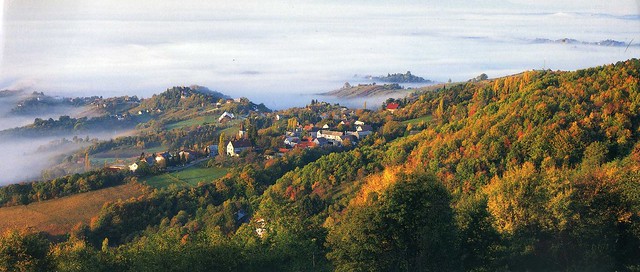
Plešivica, Croatia

Another beautiful postcard from a dear friend, this time from Nives. I actually received this card a few months ago, but I'm really, really behind with this blog.. :/


Plešivica is a mountain about 40 kilometres from Zagreb. I couldn't really find much info about it, and it all seems quite confusing as there seems to be different spellings, and I'm not sure if I'm reading about the right place as they are apparently also located in different parts of Croatia... hhhmmmm... In any case, it looks like a really beautiful place, I like the foggy view. :)


The stamp is from a set of 4 stamps issued in 2010, representing Croatian Ethnographic Heritage. This one shows Medimurje.

Petropavlovsk-Kamchatsky, Russia

I have a little ongoing project - I'm trying to get a postcard from all different regions of Russia. I still have lots missing but I'm trying to work through the list slowly. Kamchatka is one of the newest regions in my collection, and the three cards Kristina sent me are all amazing.


Petropavlovsk-Kamchatsky is the main city and the administrative, industrial, scientific, and cultural center of Kamchatka Krai, Russia. It has a population of 179,500 (2010).

Petropavlovsk was founded by Danish navigator Vitus Bering, in the service of the Russian Navy. Bering reached Avacha Bay on July 10, 1740 and laid the foundation stone for the harbor town, naming the new settlement "Petropavlovsk" (Peter + Paul) after his two ships, the St. Peter and the St. Paul, built in Okhotsk for his second expedition. The town's location on the sheltered Avacha Bay and at the mouth of the Avacha River saw it develop to become the most important settlement in Kamchatka. It was granted town status on April 9, 1812.

The city is situated on high hills and surrounded by volcanoes. In fact, the horizon cannot be seen clearly from any point in town as volcanoes and mountains are everywhere. Across Avacha Bay from the city is Russia's largest submarine base, the Rybachiy Nuclear Submarine Base, established during Soviet times and still used by the Russian Navy. The city is located 6,766 kilometers from Moscow (about nine hours by plane) and about 2,220 kilometers from Vladivostok.


The stamp on the left is from a set of 2 stamps issued in 2009, to commemorate the 125th Anniversary of the Birth of painter Z.E. Sereryakova. The stamp on the right was issued in 2010 to commemorate the Vancouver Winter Olympics.

Kakadu, Australia

An absolutely gorgeous postcard I received from dear Heather last month. I love the colours here!


I've already written about Kakadu here so I won't be repeating that here. On the right you can see some Aboriginal art - isn't it lovely and colourful?!


As usual, the stamps that Heather has used are really beautiful. The ones on the right appear to be from a sheetlet of 20 stamps issued earlier this year, showing coral reefs of the Cocos (Keeling) Islands, while the stamps on the left are from a set of 4 stamps, also issued earlier this year, to commemorate the 50th anniversary of the World Wide Fund for Nature (WWF). ....aaand what makes this card even cooler is the special Quokka stamp cancellation. Thank you SO much, Heather, you're a star!

Seinäjoki, Finland

Every autumn in Finland the Finnish Post celebrates 'Postimerkin päivä' ('Day of the Stamp'). It's been a tradition for as long as I can remember - they had it when I was a child and into stamp collecting, and my grandmother would always try to help me get the special cancellation from her town. Yeah, there's a special cancellation for that day, something I wish they'd do here in the UK as well. Dear Marja (marja2006) was kind enough to send me this card with a matching stamp and the cancellation. :)


This card shows the Town Hall in Seinäjoki. It was designed by Alvar Aalto, a famous Finnish architect. To be honest, though, I'm not too impressed with this building, it simply looks really boring to me. I'm more familiar with Seinäjoki because of Provinssirock, one of the largest and oldest rock festivals in Finland and which I attended a few times when I was younger, about ten or so years ago (is it really that long since I've been there?!).


Marja used a special matching stamp - it looks like the stamp has the Town Hall on it, too, as well as Lakeuden Risti church (also designed by Alvar Aalto). Different towns in Finland have started to have their own stamps in Finland in recent years it seems, which I really like.

Saturday, 15 October 2011

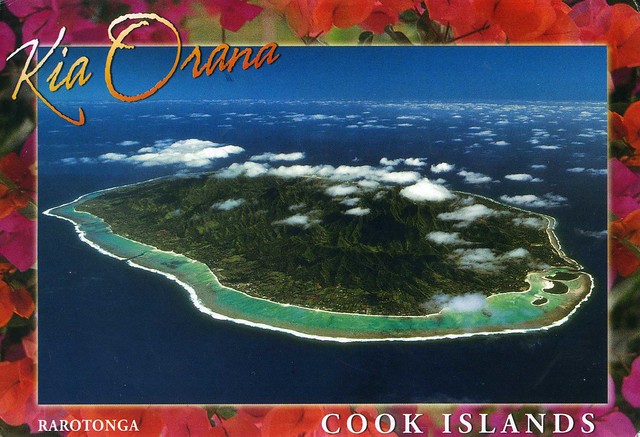
Rarotonga, Cook Islands

Just one more card for today.. but this last card is quite a treat - it's from the Cook Islands, and actually mailed directly from there! I have my postcard pal Sharon from Australia to thank for this treat; she visited Cook Islands this summer and kindly sent me a postcard from there.


The Cook Islands is a self-governing parliamentary democracy in free association with New Zealand. The 15 small islands in this South Pacific Ocean country have a total land area of 240 square kilometres, but the Cook Islands Exclusive Economic Zone (EEZ) covers 1,800,000 square kilometres of ocean.

The Cook Islands are in the South Pacific Ocean, north-east of New Zealand, between French Polynesia and American Samoa. There are 15 major islands, divided into two distinct groups: the Southern Cook Islands, and the Northern Cook Islands of coral atolls.

The islands were formed by volcanic activity; the northern group is older and consists of six atolls (sunken volcanoes topped by coral growth). The climate is moderate to tropical.

The main population centres are on the island of Rarotonga (14,153 (census 2006), out of the country's total population of 19,569), where there is an international airport. The chief town, Avarua, on the north coast of Rarotonga, is also the capital of the Cook Islands.

With about 100,000 visitors travelling to the islands in the 2010-11 financial year, tourism is the country's main industry, and the leading element of the economy, far ahead of offshore banking, pearls, and marine and fruit exports.

Defence and foreign affairs are the responsibility of New Zealand, in consultation with the Cook Islands. In recent times, the Cook Islands have adopted an increasingly independent foreign policy. Although Cook Islanders are citizens of New Zealand, they have the status of Cook Islands nationals, which is not given to all New Zealand citizens.


The stamp is from a set of 18 definitives issued in 2010, all depicting flowers.

Armenian Monastic Ensembles of Iran

Another official from earlier this year, this one is also one of my very few postcards from Iran. ...and it's a Unesco site as well!


IR-4594


The Armenian Monastic Ensembles of Iran, in the north-west of the country, consists of three monastic ensembles of the Armenian Christian faith: St Thaddeus and St Stepanos and the Chapel of Dzordzor. (The one on this card is St Stepanos.) These edifices - the oldest of which, St Thaddeus, dates back to the 7th century – are examples of outstanding universal value of the Armenian architectural and decorative traditions. They bear testimony to very important interchanges with the other regional cultures, in particular the Byzantine, Orthodox and Persian. Situated on the south-eastern fringe of the main zone of the Armenian cultural space, the monasteries constituted a major centre for the dissemination of that culture in the region. They are the last regional remains of this culture that are still in a satisfactory state of integrity and authenticity. Furthermore, as places of pilgrimage, the monastic ensembles are living witnesses of Armenian religious traditions through the centuries. Source.


The stamps on the right are definitives issued in 2009, while the stamp on the left is also a definitive, issued in 2010 and possibly from a set of 4 (?) stamps depicting fish.

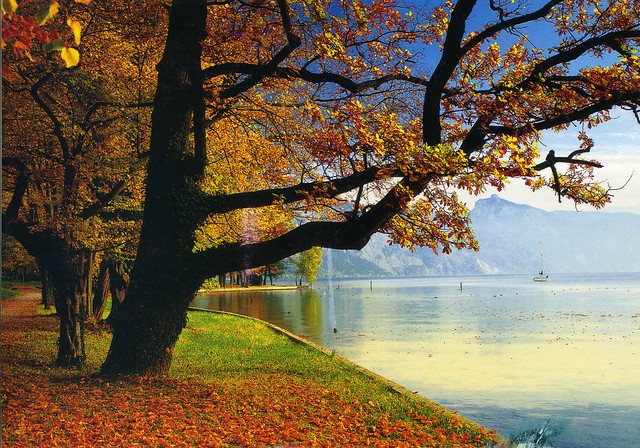
autumn in Austria

Ha! The weather reports were wrong, thank goodness, and it didn't snow here. It has actually been reasonably warm - I haven't had to use my hotwater bottle too many times yet :p I haven't been to West Park to take photos yet, I really need to go at some point.. Meanwhile, here's a pretty autumnal postcard to look at. :)


AT-73531


I have no idea of the exact location of the place on this card, all I know is that it's supposedly a random location somewhere in Austria. ..and such a beautiful place it is, too! I love the colours here, the contrast of the oranges and yellows with the blue of the lake and the mountains (?).


The stamp is a Europa stamp from 2009, that year's theme being 'astronomy'.

Thursday, 6 October 2011

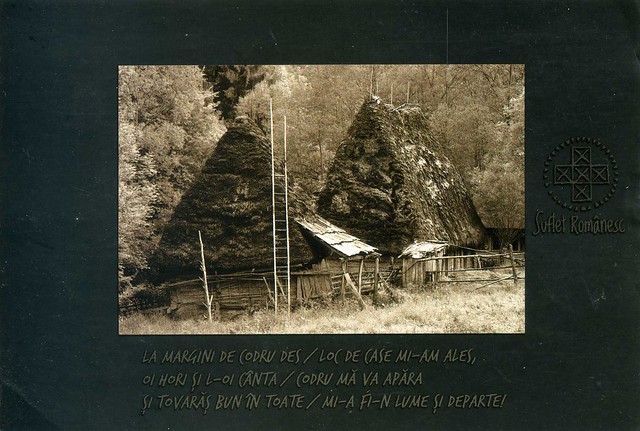
Transylvania, Romania

One more card for today, a very nice official I received from Romania this summer.


RO-28622


Transylvania is a historical region in the central part of Romania. Bounded on the east and south by the Carpathian mountain range, historical Transylvania extended in the west to the Apuseni Mountains; however, the term sometimes encompasses not only Transylvania proper, but also the historical regions of Crişana, Maramureş, and Romanian part of Banat.

Transylvania is often associated with Dracula (Bram Stoker's novel and its film adaptations, and Vlad the Impaler), and the horror genre in general, while the region is also known for the scenic beauty of its Carpathian landscape and its rich history.

The houses on this card are traditional houses that can be found in Carpathian Mountains. The poem, then, is called 'Soapte Din Transilvania' ('Whispers of Transylvania'). There was a helpful English translation on the back of the card:

At the edge of that dark forest
I chose my house to build
I dance and sing to praise the best
of my companions, my truthful shield
here and far away.


The stamp on the left is from a set of 7 stamps issued in 2005, depicting Romanian Pottery. The stamp on the right is from a set of 4 stamps issued in 2007, showing Romanian Ceramics.