Showing posts with label churches. Show all posts

Saturday, 16 January 2016

Monuments of Oviedo and the Kingdom of the Asturias, Spain

A Unesco card I received from a tag last year. I still don't have too many Unesco cards from Spain... :o


In the 9th century the flame of Christianity was kept alive in the Iberian peninsula in the tiny Kingdom of the Asturias. Here an innovative pre-Romanesque architectural style was created that was to play a significant role in the development of the religious architecture of the peninsula. Its highest achievements can be seen in the churches of Santa María del Naranco, San Miguel de Lillo, Santa Cristina de Lena, the Cámara Santa and San Julián de los Prados, in and around the ancient capital city of Oviedo. Associated with them is the remarkable contemporary hydraulic engineering structure known as La Foncalada.

This card shows the church of St Mary at Mount Naranco (Iglesia de Santa María del Naranco), a Roman Catholic Asturian pre-Romanesque Asturian architecture church on the slope of Mount Naranco situated 3 kilometres from Oviedo, northern Spain. Ramiro I of Asturias ordered it to be built as a royal palace as part of a larger complex that also incorporated the nearby church of San Miguel de Lillo, 100 meters away. It was completed in 848. Its structural features, such as the barrel vault — with transverse ribs corresponding one-to-one with contraforts at the exterior, make it a clear precursor of the Romanesque construction. The exterior decorations, as well as the use of stilted arches mark the intended verticality of the composition. It was converted into a church at the end of the 13th century.


Wednesday, 12 August 2015

Pilgrimage Church of Wies, Germany

Getting *really* behind with this blog again so time for an update. ...although I should probably be outside instead as it's such a gorgeous, sunny, warm day. Uh oh...

Today's first card is from the Unesco tag on the Postcrossing forum.


The Pilgrimage Church of Wies is an oval rococo church, designed in the late 1740s by Dominikus Zimmermann, who lived nearby for the last eleven years of his life. It is located in the foothills of the Alps, in the municipality of Steingaden in the Weilheim-Schongau district, Bavaria, Germany.

It is said that, in 1738, tears were seen on a dilapidated wooden figure of the Scourged Saviour. This miracle resulted in a pilgrimage rush to see the sculpture. In 1740, a small chapel was built to house the statue but it was soon realized that the building would be too small for the number of pilgrims it attracted, and so Steingaden Abbey decided to commission a separate shrine. Many who have prayed in front of the statue of Jesus on the altar have claimed that people have been miraculously cured of their diseases, which has made this church even more of a pilgrimage site.

Construction took place between 1745 and 1754, and the interior was decorated with frescoes and with stuccowork in the tradition of the Wessobrunner School. "Everything was done throughout the church to make the supernatural visible. Sculpture and murals combined to unleash the divine in visible form".

There is a popular belief that the Bavarian government planned to sell or demolish the rococo masterpiece during the secularization of Bavaria at the beginning of the 19th century, and that only protests from the local farmers saved it from destruction. Available sources, however, document that the responsible state commission clearly advocated the continuation of Wies as a pilgrimage site, even in spite of economic objections from the abbot of Steingaden.

The Wieskirche was added to the UNESCO World Heritage List in 1983 and underwent extensive restoration between 1985 and 1991.

Wednesday, 22 July 2015

Wooden Churches of Southern Małopolska, Poland

My Unesco collection has been growing slowly. This is one of the cards I've received this year.


The wooden churches of southern Little Poland represent outstanding examples of the different aspects of medieval church-building traditions in Roman Catholic culture. Built using the horizontal log technique, common in eastern and northern Europe since the Middle Ages, these churches were sponsored by noble families and became status symbols. They offered an alternative to the stone structures erected in urban centres. The churches are located in Gorlice, Nowy Targ, Bochnia counties (Lesser Poland Voivodeship or Małopolskie), and Brzozów County (Subcarpathian Voivodeship) and are in Binarowa, Blizne, Dębno, Haczów, Lipnica Dolna, and Sękowa.

The wooden church style of the region originated in the late Medieval, the late sixteenth century, and began with Gothic ornament and polychrome detail, but because they were timber construction, the structure, general form, and feeling is entirely different from the gothic architecture or Polish Gothic (in stone or brick). Later construction show Rococo and Baroque ornamental influence. The form of these Roman Catholic churches is deeply influenced by the Greco-Catholic and Orthodox presence in the region. Some display Greek cross plans and onion domes, but the most interesting of the churches combine these features with the Roman forms with elongated naves and steeples. Other collections of wooden churches of the region are in the open-air museums in Sanok and Nowy Sącz.

Wednesday, 15 April 2015

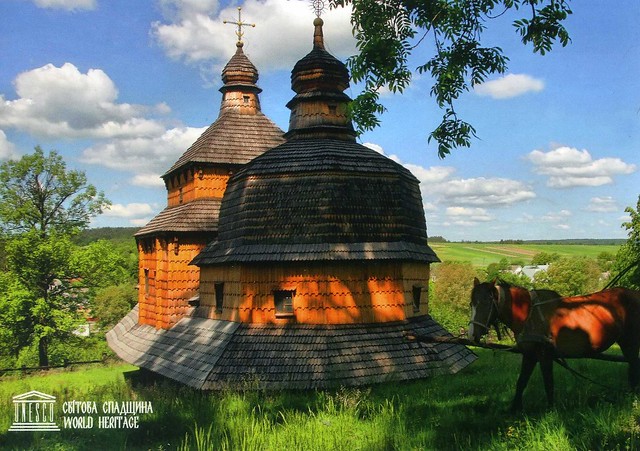
Descent of the Holy Spirit Church, Potelych, Ukraine

I received a few Ukrainian Unesco cards in an envelope a while back, this is one of them, one of the Wooden Tserkvas of the Carpathian Region in Poland and Ukraine.


Located at the eastern fringes of Central Europe within the Polish and Ukrainian Carpathian mountain range, the sixteen wooden tserkvas (churches) are outstanding examples of the once widespread Orthodox ecclesiastical timber-building tradition in the Slavic countries that survives to this day. The architectural forms of the tserkvas with tri-partite plans, pyramidal domes, cupolas and bell towers conform to the requirements of Eastern liturgy while reflecting the cultural traditions of the local communities that developed separately due to the mountainous terrain. They include Hutsul types in the Ukrainian south-eastern Carpathians at Nyzhniy Verbizh and Yasynia; Halych types in the northern Carpathians either side of the Polish/Ukrainian border at Rohatyn, Drohobych, Zhovkva, Potelych, Radruż and Chotyniec; Boyko types either side of the Polish/Ukrainian border near the border with Slovakia at Smolnik, Uzhok and Matkiv, and western Lemko types in the Polish west Carpathians at Powroźnik, Brunary Wyźne, Owczary, Kwiatoń and Turzańsk. Built using the horizontal log technique with complex corner jointing, and exhibiting exceptional carpentry skills and structural solutions, the tserkvas were raised on wooden sills placed on stone foundations, with wooden shingles covering roofs and walls. The tserkvas with their associated graveyards and sometimes free-standing bell towers are bounded by perimeter walls or fences and gates, surrounded by trees.

Wednesday, 8 April 2015

Churches of Chiloé, Chile

I swear this will be the last post for today. :P My Chilean Unesco collection is now *almost* complete, thanks to Daniela.


 In the Chiloé archipelago off the coast of Chile are about 70 churches built within the framework of a “Circular Mission” introduced by the Jesuits in the 17th century and continued by the Franciscans in the 18th and 19th centuries. The most exceptional illustrations of this unique form of wooden ecclesiastical architecture (the so-called Chilota School of architecture) are the churches of Achao, Quinchao, Castro, Rilán, Nercón, Aldachildo, Ichuac, Detif, Vilupulli, Chonchi, Tenaún, Colo, San Juan, Dalcahue, Chellín and Caguach. These sixteen churches are outstanding examples of the successful fusion of European and indigenous cultural traditions. The abilities of the people of Chiloé as builders achieved its highest expression in these wooden churches, where farmers, fishermen and sailors exhibited great expertise in the handling of the most abundant material in this environment, wood. Along with the churches, the mestizo culture resulting from Jesuit missionary activities has survived to the present day.

This isolated archipelago was colonized by the Spanish in the mid 16th century. The Jesuits, who arrived in 1608, used a circulating missionsystem in their evangelization of the area: religious groups made annual tours around the archipelago, staying for a few days at locations where churches were erected jointly with the communities of believers. The rest of the year a specially trained layperson attended the spiritual needs of the inhabitants. The construction techniques and architecture of the churches of Chiloé are specific to this locale: European experience was adapted and reformulated, giving rise to a vernacular tradition, supported by a great quantity and variety of testimonies which are still in use. Along with the culture of the archipelago, these churches are the result of a rich and extensive cross-cultural dialogue and interaction.

Saturday, 4 October 2014

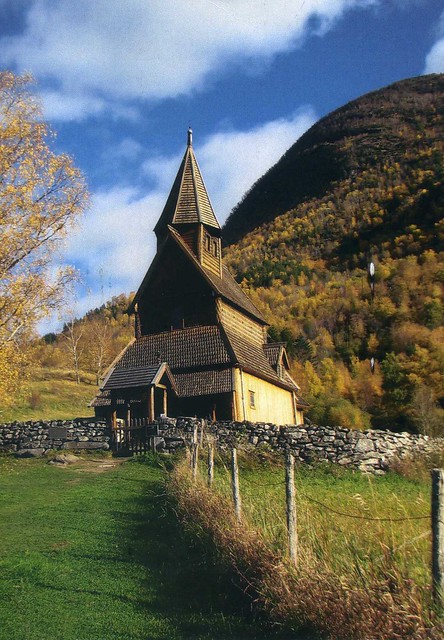
Urnes Stave Church, Norway

I was the Finnish 'winner of the month' on the Postcrossing forum two years ago. This is one of the cards I received and also one of my favourites. I have a soft spot for Norwegian postcards and this one is a Unesco site as well. ...and an ad card from Finland, which I never would've guessed by just looking at the card. It does make me a little sad now as well, because the card was sent by dear Marja who's sadly not with us anymore. I do miss her on the forum :( I hope her family and everyone close to her are ok.


Urnes Stave Church is a 12th-century stave church at Ornes, along the Lustrafjorden in the municipality of Luster in Sogn og Fjordane county, Norway. It sits on the eastern side of the fjord, directly across the fjord from the village of Solvorn and about 5 kilometres east of the village of Hafslo. It has been owned by Fortidsminneforeningen (Society for the Preservation of Norwegian Ancient Monuments) since 1881. In 1979, the Urnes Stave Church was listed as a World Heritage Site by UNESCO.

Sunday, 7 July 2013

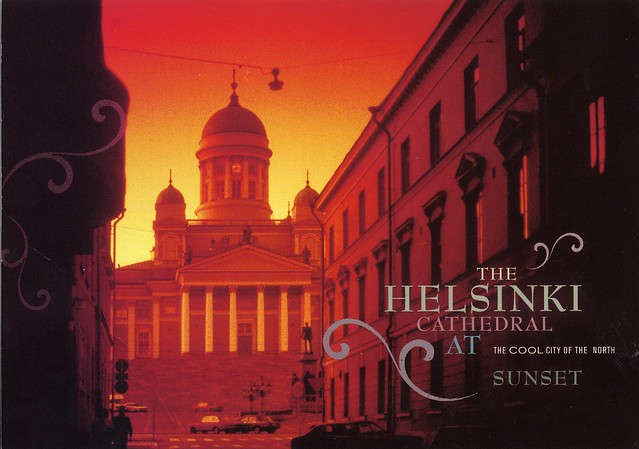
Helsinki Cathedral, Helsinki, Finland

This is a slightly older card, received about four years ago from dear Marja in Finland. I really like all the postcards I've seen from this particular series, and I just love the design of this card for some reason. Haha, and I wanted to post something Finland-related as I'll be going there in a month. I'll be staying for a week there, visiting family. I'm really looking forward to it, seeing my family again and all the familiar places as well. Hopefully it'll still be nice and warm as well, it seems like this summer has been pretty good over there so far. ...better than here in England at least, although the past few days have been really hot here and I'm boiling at the moment. Still, I much prefer this to the usual cold, miserable weather. :P


Helsinki Cathedral (Finnish: Helsingin tuomiokirkko, Suurkirkko) is the Finnish Evangelical Lutheran cathedral of the Diocese of Helsinki, located in the neighbourhood of Kruununhaka in the centre of Helsinki, Finland. The church was originally built from 1830-1852 as a tribute to the Grand Duke of Finland, Tsar Nicholas I of Russia. It was also known as St Nicholas' Church until the independence of Finland in 1917.

 A distinctive landmark in the Helsinki cityscape, with its tall, green dome surrounded by four smaller domes, the building is in the neoclassical style. It was designed by Carl Ludvig Engel as the climax of his Senate Square layout: it is surrounded by other, smaller buildings designed by him. The church's plan is a Greek cross (a square centre and four equilateral arms), symmetrical in each of the four cardinal directions, with each arm's façade featuring a colonnade and pediment. Engel originally intended to place a further row of columns on the western end to mark the main entrance opposite the eastern altar, but this was never built.

Today, the cathedral is one of Helsinki's most popular tourist attractions. More than 350,000 people visit the church each year, some to attend religious events, but mostly as tourists. The church is in regular use for services of worship and special events such as weddings.

Saturday, 30 March 2013

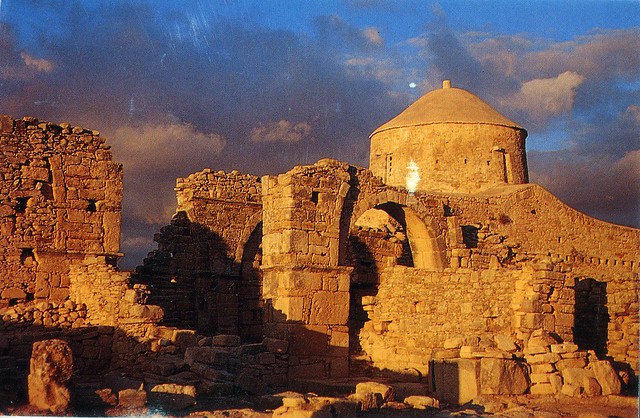
Timiou Stavrou (Holy Cross), Cyprus

Uh-oh... It's been ages since I last posted here, it seems. I don't want to go into detail here, I'll just say that I haven't really been in the mood for updating this blog (and as a result the pile of cards I WOULD eventually like to post about here is getting bigger and bigger). This first card isn't even all that recent.. I received it back in 2009, from the same woman who sent me this card, and one more that might end up in this blog one day..


Anyway, this card shows the Timiou Stavrou (Holy Cross) church. This small 14th century church was restored in 1995 and has a unique icon of Christ flanked by the Virgin Mary and John the Baptist. Fine wall paintings blend Byzantine Orthodox and Venetian Catholic influences. It is one of the Painted Churches in the Troodos Region, Cyprus, a Unesco site. This region is characterized by one of the largest groups of churches and monasteries of the former Byzantine Empire. The complex of 10 monuments included on the World Heritage List, all richly decorated with murals, provides an overview of Byzantine and post-Byzantine painting in Cyprus. They range from small churches whose rural architectural style is in stark contrast to their highly refined decoration, to monasteries such as that of St John Lampadistis.

Sunday, 16 September 2012

Iceland

I had such a lovely surprise in my mailbox this summer! My French friend Tiphaine and her boyfriend took their mothers to Iceland as a surprise gift for them, and Tiphaine was sweet enough to send me a postcard from there. I had no idea she was going to Iceland! Another friend of mine went there earlier this summer, too - I want to go as well!! :P


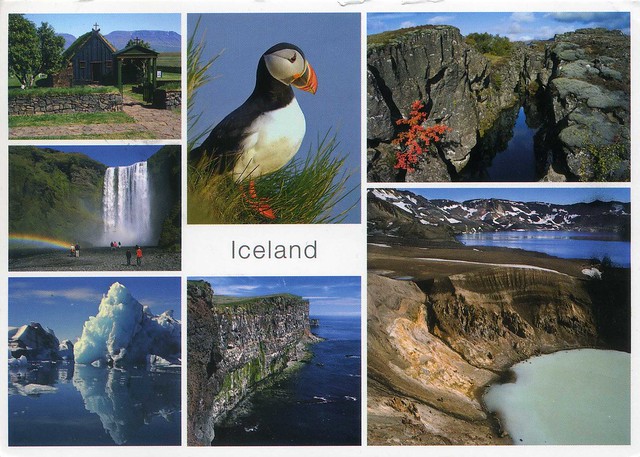
Doesn't Iceland look amazing?! The picture in the top left corner shows a church in Skagafjörður in northern Iceland, while the picture in the top right corner is a view from the Þingvellir National Park, which is also a Unesco site. The picture underneath it shows Víti crater by lake Askja, and the one next to it shows the Látrabjarg cliffs. The picture in the bottom left corner shows the Jökulsárlón lagoon, and the one on top of it is the Skógafoss waterfall.

Wednesday, 27 June 2012

Berlin, Germany

I only just realised that I don't have any postcards of Berlin in this blog. How did that happen?! I've never actually been to Berlin but would really, really love to go. My sister's been there a couple of times and loves the place, and whenever I read about Berlin in blogs, magazines etc, it always receives SO much praise and everyone and their dogs seem to be madly in love with the city. I'm curious!


Berlin is the capital city of Germany and one of the 16 states of Germany. With a population of 3.5 million people, Berlin is Germany's largest city and is the second most populous city proper and the eighth most populous urban area in the European Union. Located in northeastern Germany, it is the center of the Berlin-Brandenburg Metropolitan Region, which has 5.9 million residents from over 190 nations. Located in the European Plains, Berlin is influenced by a temperate seasonal climate. Around one third of the city's area is composed of forests, parks, gardens, rivers and lakes.

First documented in the 13th century, Berlin was the capital of the Kingdom of Prussia (1701–1918), the German Empire (1871–1918), the Weimar Republic (1919–1933) and the Third Reich (1933–1945). Berlin in the 1920s was the third largest municipality in the world. After World War II, the city became divided into East Berlin—the capital of East Germany—and West Berlin, a West German exclave surrounded by the Berlin Wall (1961–1989). Following German reunification in 1990, the city regained its status as the capital of Germany, hosting 147 foreign embassies.

Berlin is a world city of culture, politics, media, and science. Its economy is primarily based on the service sector, encompassing a diverse range of creative industries, media corporations, and convention venues. Berlin also serves as a continental hub for air and rail transport, and is a popular tourist destination. Significant industries include IT, pharmaceuticals, biomedical engineering, biotechnology, electronics, traffic engineering, and renewable energy.

Berlin is home to renowned universities, research institutes, orchestras, museums, and celebrities, as well as host of many sporting events. Its urban settings and historical legacy have made it a popular location for international film productions. The city is well known for its festivals, diverse architecture, nightlife, contemporary arts, public transportation networks and a high quality of living.

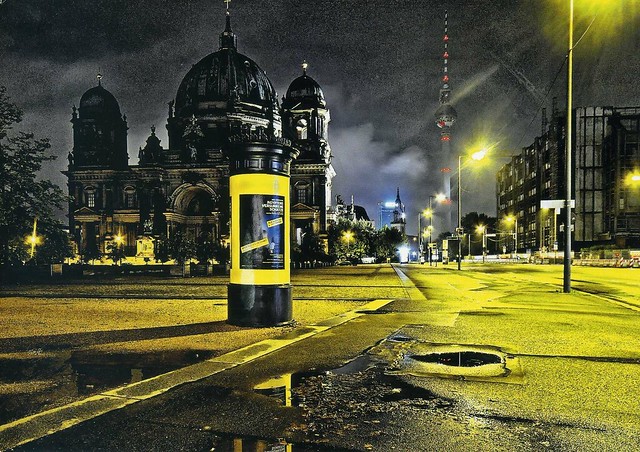
On this postcard you can see the Berlin Cathedral (Berliner Dom in German), an Evangelical church in Berlin. It is the parish church of the Evangelical congregation Gemeinde der Oberpfarr- und Domkirche zu Berlin, a member of the umbrella organisation Evangelical Church of Berlin-Brandenburg-Silesian Upper Lusatia. Its present building is located on Museum Island in the Mitte borough. The Berlin Cathedral has never been a cathedral in the actual sense of that term since it has never been the seat of a bishop.

Saturday, 21 January 2012

Manila, Phillippines

I received this beautiful card from my postcard pal Maerose in the Philippines last year. Thank you so much, dear!


Manila is the capital of the Philippines. It is one of the sixteen cities forming Metro Manila. Manila is located on the eastern shores of Manila Bay and is bordered by Navotas and Caloocan to the north, Quezon City to the northeast, San Juan and Mandaluyong to the east, Makati on the southeast, and Pasay to the south.

Manila has a total population of more than 1,660,714 according to the 2007 census. Manila is the second most populous city in the Philippines, behind its neighbor, Quezon City. The populace inhabit an area of only 38.55 square kilometers, making Manila the most densely populated city in the world. Metro Manila is the most populous metropolitan area in the Philippines and the 11th in the world with an estimated population of 16,300,000. The greater urban area is the fifth-largest in the world and has an estimated metropolitan population of 20,654,307 people.

The city is divided into six legislative districts and consists of sixteen geographical districts. Within their precincts can be found areas of bustling commerce and some of the most historically and culturally significant iconic landmarks in the country as well as the seat of the executive and judicial branches of the government. It is home to many scientific and educational institutions, as well as numerous sport facilities. These make the city a major political, commercial, cosmopolitan, cultural, educational, religious, and transportation center of the Philippines.

The earliest written account of the city is the 10th-century Laguna Copperplate Inscription which describe an Indianized kingdom maintaining diplomatic relations with the Kingdom of Medang and commercial exchanges with Ancient Japan and Song Dynasty China. The city was invaded by Brunei's Sultan Bolkiah and was already Islamized by the 15th century when the Spanish first arrived. Manila eventually became the center of Spanish activity in the Far East and one end of the Manila–Acapulco galleon trade route linking Latin America and Asia. This caused it to be called the "Pearl of the Orient". Several Chinese insurrections, local revolts, a British Occupation and a Sepoy mutiny also occurred thereafter. Later, it saw the rise of the Philippine Revolution which was followed by the arrival of the Americans who made contributions to the city's urban planning and development only to have most of those improvements lost in the devastation of World War II. Since then the city has been rebuilt.

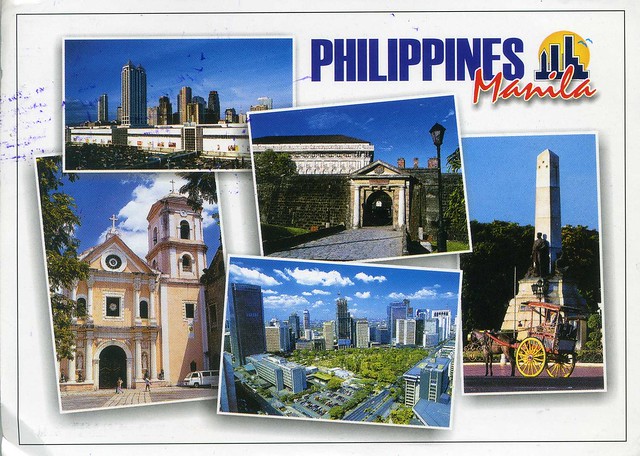
On this postcard you can see a number of places in Manila:

Ortigas Center and Megamall. Entrance to Intramuros, former Spanish residence. Spanish-inspired horse-driving calesa in front of Rizal Monument. Makati, business district of the Philippines. San Augustin Church, one of the oldest churches in the Philippines (and a Unesco site).

Wednesday, 11 May 2011

Borgund Stave Church, Norway

Another official, but this one is much older, back from 2008. It's from Joey who used to be the most active postcrosser in Norway, but he's since left Postcrossing, which is a shame as he was such a nice guy. I've received a few cards from him and they are all great.


NO-17520


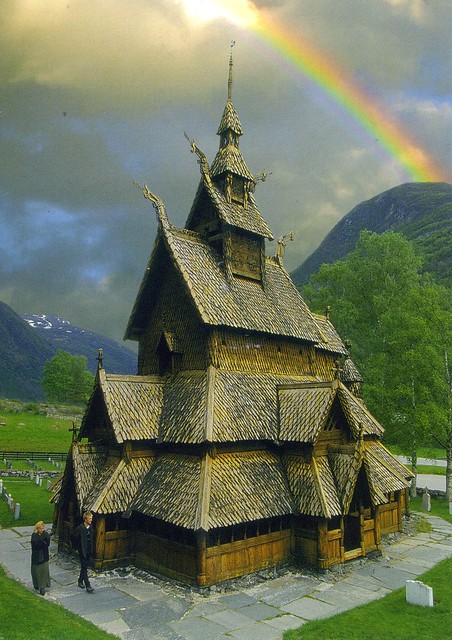
Borgund Stave Church is a stave church located in Borgund, Lærdal, Norway. It is classified as a triple nave stave church of the so-called Sogn-type. This is also the best preserved of Norway's 28 extant stave churches.

Borgund was built sometime between AD 1180 and 1250 with later additions and restorations. Its walls are formed by vertical wooden boards, or staves, hence the name stave church. The 4 corner posts were connected to one another by ground sills, resting atop a stone foundation. The rest of the staves then rise from the ground sills, each stave notched and grooved along the sides so that they lock into one another, forming a sturdy wall.

Borgund has tiered, overhanging roofs, topped with a tower. On the gables of the roof, there are four carved dragon heads, swooping from the carved roof ridge crests, recalling the carved dragon heads found on the prows of Norse ships. Similar gable heads also appear on small bronze house shaped reliquaries common in Norway in this period. Borgund’s current dragon heads possibly date from the 18th century, however original dragon heads remaining on earlier structures, such as the stave church at Lom stave church and nearby Urnes stave church, the oldest still extant stave church, also in the Sogn district, suggest that there probably would have been similar dragon heads there at one time. Borgund is one of the only churches to still have preserved its ridge crests, carved with openwork vine and vegetal repeating designs.


The stamp on the right is from a set of 4 stamps issued in 2008, with the theme 'Transport'. The other one I couldn't find any info of.

Wednesday, 6 April 2011

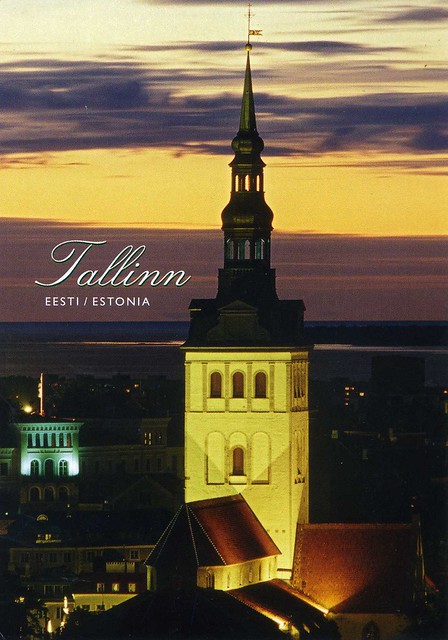
St. Nicholas' Church, Tallinn, Estonia

One more card for today, from the not so far away Estonia. My parents visited Tallinn last week and sent me a postcard from there. I was debating whether to post that card or this one from my friend Rita, but eventually decided on this one. Maybe I'll post the card from mum and dad at some point later...


St. Nicholas' Church (Niguliste kirik in Estonian) is a medieval church in Tallinn, Estonia. It is dedicated to Saint Nicholas, the patron of the fishermen and sailors. Originally built in the 13th century, it was partially destroyed in Soviet Bombing of Tallinn in World War II. After restoration it is in use as an art museum and concert hall. I suppose I should ask Rita more about it - she's a guide and recently passed an important exam so she's now allowed to work as a guide in this church. :)


The stamp was issued last year with the theme 'Treasures from the Estonian Art Museum'

Thursday, 20 January 2011

Skopje, Macedonia

I have a thing for panoramic postcards, there's something quite special about them I think. More room for the picture for one thing, but it's not just that, I can't quite explain it though. One thing is for sure - they are nice to send to friends because there's a bit more room for the writing! :D Anyway, this lovely panoramic card is from the lovely Ana in Macedonia. Thank you so much!


The Orthodox Cathedral Church on this card is situated in the centre of Skopje and is where the main religious events take place, particularly during Christmas and Easter. Oh, and incidentally, Eastern Orthodox national churches celebrate Christmas on 7th January, something I only learned since joining Postcrossing... This really is an educational hobby! :)

It looks like it is The Church of Saint Clement of Ohrid. Built in 1972, the Orthodox church in one of few in the world to be designed in modern contemporary architecture. The main Macedonian orthodox cathedral church was consecrated in 1990, on the 1150th anniversary of the birth of the church patron, St. Clement of Ohrid. The iconostasis icons were painted by Gjorgi Danevski and Spase Spirovski and the frescoes were painted by the academic painter Jovan Petrov and his collaborators.


The stamp is from a set of 4 commemorative stamps issued in 1999 with the theme Flowers.

Wednesday, 4 August 2010

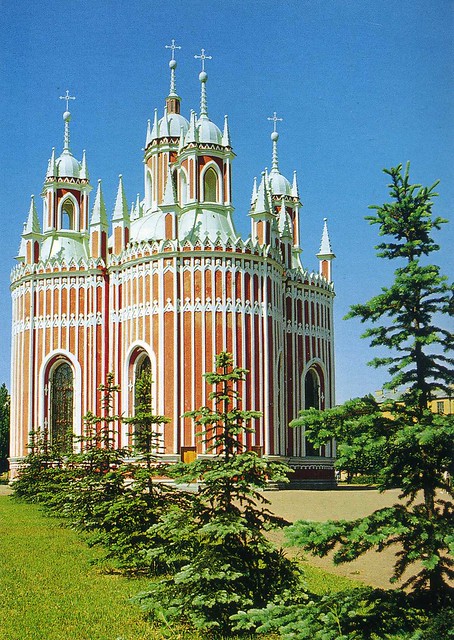
The Chesme Church, St Petersburg, Russia

There seems to be lots of absolutely stunning architecture in Russia, and many churches and cathedrals particularly are wonderfully colourful. This one is no exception, in fact this might just be my favourite of the ones I've seen so far - it looks like a candy! :)


This fairytale gothic church is one of St. Petersburg's most unusual and most delightful, although it is a little off the beaten track for most tourists. Located in the far south of the city, it was built under Catherine the Great as the house church for the Chesme Palace, a resting post between St. Petersburg and the Summer Palace in Tsarskoe Selo. It has since been subsumed in a mostly Stalinist residential region, and is now well within the city limits.

One of two fascinating gothic churches designed by the German-Russian court architect Yury Felton, the Chesme Church was consecrated in 1780, on the tenth anniversary of Russia's naval victory over the Turkish fleet at Chesme Bay, which occurred on the birthday of John the Baptist, hence the church's name. A wedding-cake structure with striped crenellated walls and five gothic turrets in place of traditional onion domes, this truly unique church has survived almost fully intact to this day, despite the fact that it was turned, along with the Chesme Palace, into part of a forced labour camp by the Soviet government - the cross on the central turret was replaced with a hammer, tongs and anvil to symbolize the toil of the proletariat. Just before the Second World War, the complex was given over to the Institute of Aviation Technology, which still occupies the palace to this day.

Used as a burial site for war heroes almost since its consecration, the area around the church became a graveyard for soldiers who died during the Siege of Leningrad. In the 1970s, the church became a Museum of the Battle of Chesme, and was eventually returned to the Orthodox Church in 1990. It is now an extremely popular church, with regular services and numerous visitors who come to pay their respects to the war dead.


The stamp on the right is from the Europa series, this year's theme being Children's Books and this is the Russian contribution to the series. The stamp next to that is from the Russian "Regions" serie, unfortunately I have no idea which region this represents as I can't read Russian. :( The stamp under it is from 2009, a definitive from a set of 12 showing Russian Kremlins. This one here is the Kazan Kremlin. The small stamp on the left is a definitive from 1998 from a set of 11, this one related to agriculture.

Monday, 5 July 2010

Kyiv, Ukraine

This very beautiful postcard of St Andrew's Church in Kyiv, Ukraine, arrived a while ago. The church itself looks very pretty and I really like the flowers on the foreground. Blossoming trees are one of my favourite things about spring. :)


St Andrew's Church is a major Baroque church located in Kiev, the capital of Ukraine. The church was constructed in 1747–1754, to a design by the Imperial Russian architect Bartolomeo Rastrelli. It is sometimes incorrectly referred to as a cathedral.

The Saint Andrew's Church overlooks the historic Podil neighborhood, situated on a steep hill to which the church gave its current name Andriyivska Hill. It is currently one of four architectural landmarks of Ukraine, which were put down on the List of Mankind Treasures of Five Continents by the world society.


This stamp is what I see the most on mail from Ukraine. It's a definitive stamp issued in 2004 with the theme 'Agricultur'e. It shows Wheat and a trident.