Showing posts with label luxembourg. Show all posts

Sunday, 19 April 2015

Greetings from Luxembourg

I was so happy when Anne was offering these cards on Facebook - I thought it would be impossible to get this card sent from Luxembourg! Thank you ever so much, Anne!


I might have to look up a recipe for bouneschluppp, it sounds yummy! I don't really know too much about Luxembourg and must confess I hadn't heard of any of the people mentioned on this card before.

Monday, 16 February 2015

aubergine caviar

I was talking about food postcards yesterday so here's one. ...and with one of my favourite ingredients, aubergine, too!


Mmmmm, I couldn't possibly get enough of aubergines! I love it in pretty much any form, although the baba ganoush I had in London a couple of years ago had too much tahini for my liking. (I'm not a huge fan of tahini and when making hummus, I always have to reduce the amount of tahini as most recipes call for way too much of it for my liking.) I haven't tried this dip yet but it does sound gorgeous. Here's a recipe from the back of the postcard:  

2 aubergines 
1 garlic clove 
1 glass olive oil 
salt 
pepper

Halve the aubergines lengthways, lay them on a baking sheet. Season with salt and pepper, add a drizzle of olive oil and bake in the oven (180 C) for 30 to 40 minutes. Scoop out the aubergine flesh with a spoon, add the pressed garlic and crush the mixture to obtain a fine puree. Stir with a wooden spoon, slowly adding the olive oil, as when making mayonnaise. Check the seasoning and store in a cool place.
 

Saturday, 20 October 2012

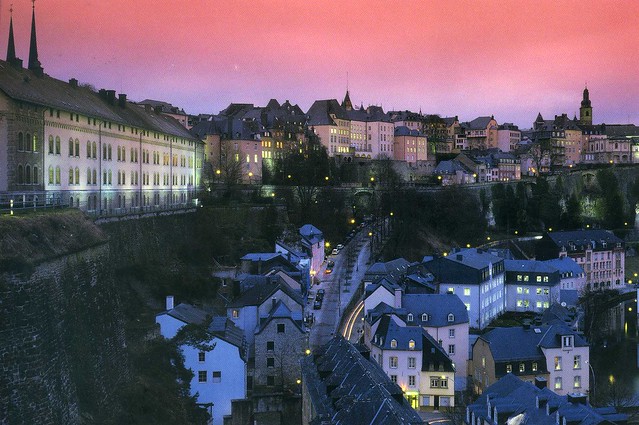
City of Luxembourg, Luxembourg

One more card for today.. this one is from a tag in Heather's great postcard group on Facebook. Such a treat, too!


The city of Luxembourg, also known as Luxembourg City, is a commune with city status, and the capital of the Grand Duchy of Luxembourg. It is located at the confluence of the Alzette and Pétrusse Rivers in southern Luxembourg. The city contains the historic Luxembourg Castle, established by the Franks in the Early Middle Ages, around which a settlement developed. As of 2011, the commune of Luxembourg City had a population of 94,034, which was almost three times the population of the country's second most populous commune. The Old Quarters of the city is a Unesco site.

Because of its strategic position, Luxembourg was, from the 16th century until 1867, when its walls were dismantled, one of Europe's greatest fortified sites. It was repeatedly reinforced as it passed from one great European power to another: the Holy Roman Emperors, the House of Burgundy, the Habsburgs, the French and Spanish kings, and finally the Prussians. Until their partial demolition, the fortifications were a fine example of military architecture spanning several centuries.

The City of Luxembourg is located at the crossing point of two major Roman roads. In 963 Sigefroid, a count from the Moselle valley, built a castle on the Rocher du Bock, which he obtained by means of an exchange with the Abbey of St Maximin of Trier. His servants and soldiers settled around the castle and the modern town sprang from the market-place of this settlement, the Vieux Marché.

Thursday, 6 October 2011

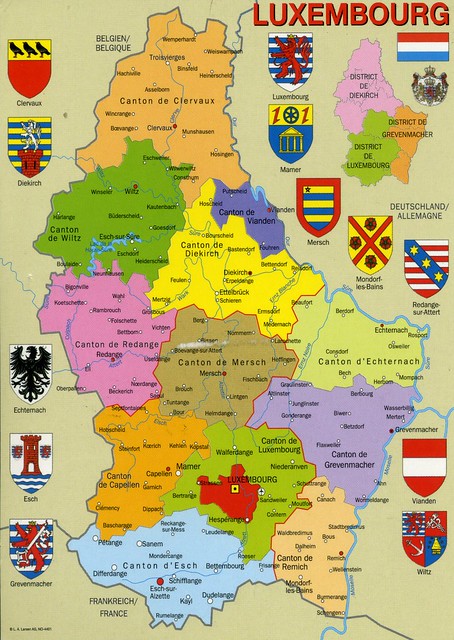
map of Luxembourg

Another older card, this one is an official postcrossing card I received back in 2008. I don't have too many postcards from Luxembourg...


LU-2467


Luxembourg is a landlocked country in western Europe, bordered by Belgium, France, and Germany. It has two principal regions: the Oesling in the North as part of the Ardennes massif, and the Gutland ("good country") in the south. Luxembourg has a population of over half a million people in an area of approximately 2,586 square kilometres. A representative democracy with a constitutional monarch, it is ruled by a grand duke. It is now the world's only remaining sovereign grand duchy. The country has a highly developed economy, with the world's highest GDP (nominal) per capita according to the IMF. Its historic and strategic importance dates back to its founding as a Roman era fortress site and Frankish count's castle site in the Early Middle Ages. It was an important bastion along the Spanish Road when Spain was the principal European power influencing the whole western hemisphere and beyond in the 16th–17th centuries.

Luxembourg is a member of the European Union, NATO, OECD, the United Nations, Benelux, and the Western European Union, reflecting the political consensus in favour of economic, political, and military integration. The city of Luxembourg, the capital and largest city, is the seat of several institutions and agencies of the European Union.

Luxembourg culture is a mix of Romance Europe and Germanic Europe, borrowing customs from each of the distinct traditions. Luxembourg is a trilingual country; German, French and Luxembourgish are official languages. Although a secular state, Luxembourg is predominantly Roman Catholic.


The stamp on the left is from a set of 6 stamps issued in 2001, depicting different Euro coins. The stamp on the right was issued in 2008 in a set of 2 stamps showing children's paintings, with the theme 'Greetings from Luxembourg'.