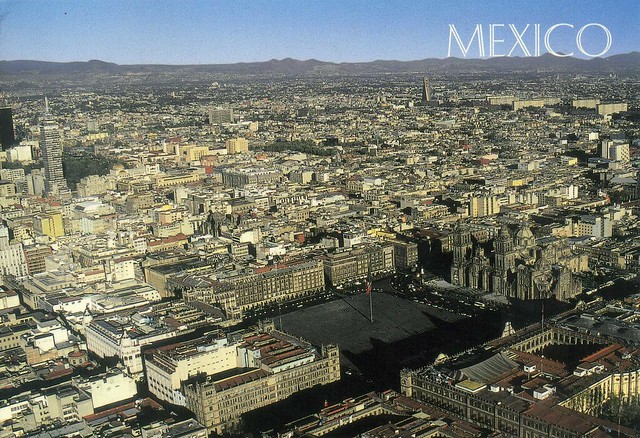
Mexico City, officially known as México, D. F., or simply D.F.) is the Federal District (Distrito Federal), capital of Mexico and seat of the federal powers of the Mexican Union. It is a federal entity within Mexico which is not part of any one of the 31 Mexican states but belongs to the federation as a whole. Mexico City is the country's largest city as well as its most important political, cultural, educational and financial center.
As an "alpha" global city Mexico City is one of the most important financial centers in North America. It is located in the Valley of Mexico (Valle de México), a large valley in the high plateaus at the center of Mexico, at an altitude of 2,240 metres. The city consists of sixteen boroughs.
The 2009 estimated population for the city proper was around 8.84 million people, and has a land area of 1,485 square kilometres. According to the most recent definition agreed upon by the federal and state governments, the Mexico City metropolitan area population is 21.2 million people, making it the largest metropolitan area in the western hemisphere, the fifth largest agglomeration and the largest Spanish-speaking city in the world.
The Greater Mexico City has a gross domestic product (GDP) of US$390 billion in 2008, making Mexico City urban agglomeration the eighth richest metropolitan area in the world. The city was responsible for generating 21% of Mexico's Gross Domestic Product and the metropolitan area accounted for 34% of total national GDP.
The city was originally built on an island of Lake Texcoco by the Aztecs in 1325 as Tenochtitlan, which was almost completely destroyed in the 1521 siege of Tenochtitlan, and subsequently redesigned and rebuilt in accordance with the Spanish urban standards. In 1524, the municipality of Mexico City was established, known as México Tenochtitlán, and as of 1585 it was officially known as Ciudad de México (Mexico City). Mexico City served as the political, administrative and financial center of a major part of the Spanish colonial empire. After independence from Spain was achieved, the Federal District was created in 1824.
The Historic Centre of Mexico City is also a Unesco World Heritage site. It has five Aztec temples, the ruins of which have been identified, a cathedral (the largest on the continent) and some fine 19th- and 20th-century public buildings such as the Palacio de las Bellas Artes.





 Maroon


