This is an interesting one. Chiayu of Taiwan messaged me last year, asking whether I'd be interested in swapping postcards as she was going to Nepal for a while. Of course I was interested! :) I was really surprised about her message, though - normally people want something a lot harder to get than what I can usually offer if they are offering postcards from somewhere like Nepal. Well, it certainly was a nice surprise!
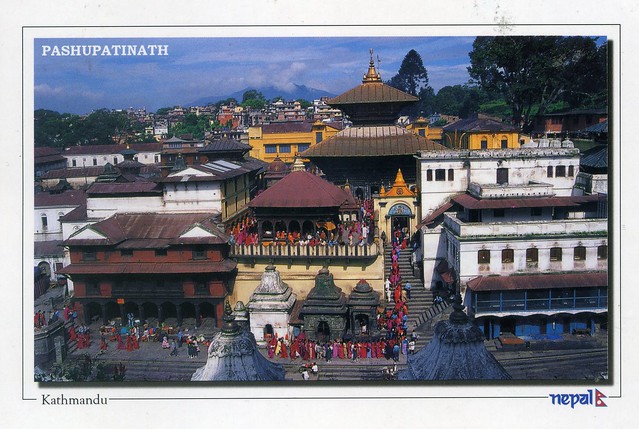
The gold roofed Pashupatinath Temple is from the 5th century AD, dedicated to Lord Shiva and a Unesco world heritage site as well as one of the holiest shrines for Hindus. It is part of the cultural heritage of the Kathmandu Valley. The cultural heritage of the Kathmandu Valley is illustrated by seven groups of monuments and buildings which display the full range of historic and artistic achievements for which the Kathmandu Valley is world famous. The seven include the Durbar Squares of Hanuman Dhoka (Kathmandu), Patan and Bhaktapur, the Buddhist stupas of Swayambhu and Bauddhanath and the Hindu temples of Pashupati and Changu Narayan.
Chiayu used a matching stamp :)
Showing posts with label nepal. Show all posts
Saturday, 21 February 2015
Saturday, 13 December 2014
Faces of Nepal
... and yet another swap card from 2012.
Not much to say about this one, except that it was nice to receive a postcard showing local people, even it tourist views are great as well.
Wednesday, 4 July 2012
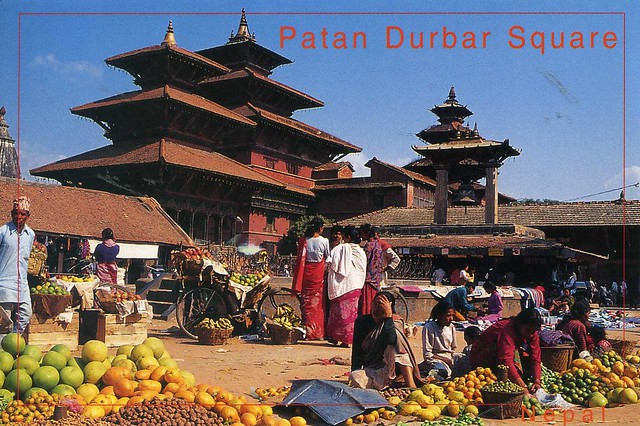
Patan Durbar Square, Lalitpur, Nepal
One more card for today.. This one was SUCH a surprise, too - I never expected to receive an official Postcrossing card from Nepal as it's such a small country with just a few users and not that many cards sent (the postcard ID on this one is so small!). Looks like I can be lucky sometimes as well, then?! :) Not only is this my first received written and stamped postcard from Nepal, it's also a really lovely view - I love market scenes like this, it's nice to see pictures of ordinary life in different parts of the world.
Patan Durbar Square is situated at the centre of Lalitpur city. It is one of the three Durbar Squares in the Kathmandu Valley, all of which are UNESCO World Heritage Sites. One of its attraction is The Ancient Royal Palace where Malla Kings of Lalitpur resided.
Lalitpur (officially Lalitpur Sub-Metropolitan City, also called Patan) is one of the major cities of Nepal located in the south-central part of Kathmandu Valley. Patan is also known as Manigal. It is best known for its rich cultural heritage, particularly its tradition of arts and crafts. It is also called as city of festival and feast, fine ancient art, making of metallic and stone carving statue. At the time of the 2001 Nepal census it had a population of 162,991 in 68,922 individual households.
Nepal is a landlocked sovereign state located in South Asia. It has an area of 147,181 square kilometres and a population of approximately 27 million (and 2 million absentee workers living abroad). It is located in the Himalayas and bordered to the north by the People's Republic of China, and to the south, east, and west by the Republic of India, while across the Himalayas lies the Tibetan Autonomous Region. Kathmandu is the nation's capital and the country's largest metropolis. Kathmandu Valley itself has estimated population of 5 million.
Nepal has a rich geography. The mountainous north has eight of the world's ten tallest mountains, including the highest point on Earth, Mount Everest, called Sagarmatha in Nepali. It contains more than 240 peaks over 6,096 m above sea level. The fertile and humid south is heavily urbanized.
Hinduism is practised by about 81% of Nepalese - making it the country with the highest percentage of Hindu followers. Buddhism, though a minority faith in the country, is linked historically with Nepal.
A monarchy throughout most of its history, Nepal was ruled by the Shah dynasty of kings from 1768, when Prithvi Narayan Shah unified its many small kingdoms. However, a decade-long Civil War by the Communist Party of Nepal (Maoist) and several weeks of mass protests by all major political parties led to the 12 point agreement of November 22, 2005. The ensuing elections for the constituent assembly on May 28, 2008 overwhelmingly favored the abdication of the Nepali monarch Gyanendra Shah and the establishment of a federal multiparty representative democratic republic.
NP-346
Patan Durbar Square is situated at the centre of Lalitpur city. It is one of the three Durbar Squares in the Kathmandu Valley, all of which are UNESCO World Heritage Sites. One of its attraction is The Ancient Royal Palace where Malla Kings of Lalitpur resided.
Lalitpur (officially Lalitpur Sub-Metropolitan City, also called Patan) is one of the major cities of Nepal located in the south-central part of Kathmandu Valley. Patan is also known as Manigal. It is best known for its rich cultural heritage, particularly its tradition of arts and crafts. It is also called as city of festival and feast, fine ancient art, making of metallic and stone carving statue. At the time of the 2001 Nepal census it had a population of 162,991 in 68,922 individual households.
Nepal is a landlocked sovereign state located in South Asia. It has an area of 147,181 square kilometres and a population of approximately 27 million (and 2 million absentee workers living abroad). It is located in the Himalayas and bordered to the north by the People's Republic of China, and to the south, east, and west by the Republic of India, while across the Himalayas lies the Tibetan Autonomous Region. Kathmandu is the nation's capital and the country's largest metropolis. Kathmandu Valley itself has estimated population of 5 million.
Nepal has a rich geography. The mountainous north has eight of the world's ten tallest mountains, including the highest point on Earth, Mount Everest, called Sagarmatha in Nepali. It contains more than 240 peaks over 6,096 m above sea level. The fertile and humid south is heavily urbanized.
Hinduism is practised by about 81% of Nepalese - making it the country with the highest percentage of Hindu followers. Buddhism, though a minority faith in the country, is linked historically with Nepal.
A monarchy throughout most of its history, Nepal was ruled by the Shah dynasty of kings from 1768, when Prithvi Narayan Shah unified its many small kingdoms. However, a decade-long Civil War by the Communist Party of Nepal (Maoist) and several weeks of mass protests by all major political parties led to the 12 point agreement of November 22, 2005. The ensuing elections for the constituent assembly on May 28, 2008 overwhelmingly favored the abdication of the Nepali monarch Gyanendra Shah and the establishment of a federal multiparty representative democratic republic.
Thursday, 10 May 2012
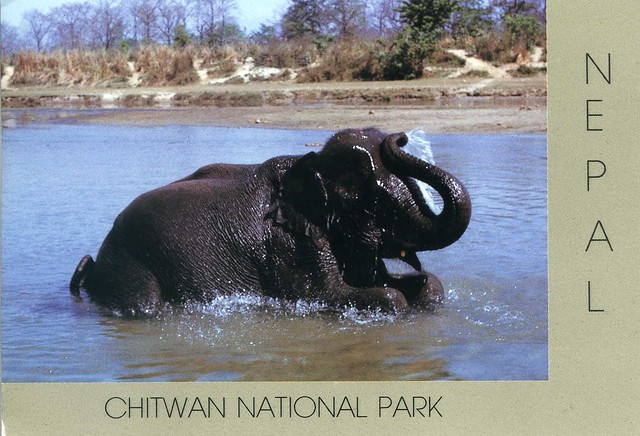
Chitwan National Park, Nepal
Something a little different now.. This is one of the only postcards of Nepal I have. Sadly it wasn't mailed directly from Nepal, but you can't have everything I suppose.. and the Slovenian stamps on this card are lovely!
Chitwan National Park is the first national park in Nepal. Formerly called Royal Chitwan National Park it was established in 1973 and granted the status of a World Heritage Site in 1984. It covers an area of 932 km2 and is located in the subtropical Inner Terai lowlands of south-central Nepal in the Chitwan District. In altitude it ranges from about 100 metres in the river valleys to 815 metres in the Churia Hills.
In the north and west of the protected area the Narayani-Rapti river system forms a natural boundary to human settlements. Adjacent to the east of Chitwan National Park is Parsa Wildlife Reserve, contiguous in the south is the Indian Tiger Reserve Valmiki National Park. The coherent protected area of 2,075 km2 represents the Tiger Conservation Unit (TCU) Chitwan-Parsa-Valmiki, which covers a 3,549 km2 huge block of alluvial grasslands and subtropical moist deciduous forests.
Chitwan National Park is the first national park in Nepal. Formerly called Royal Chitwan National Park it was established in 1973 and granted the status of a World Heritage Site in 1984. It covers an area of 932 km2 and is located in the subtropical Inner Terai lowlands of south-central Nepal in the Chitwan District. In altitude it ranges from about 100 metres in the river valleys to 815 metres in the Churia Hills.
In the north and west of the protected area the Narayani-Rapti river system forms a natural boundary to human settlements. Adjacent to the east of Chitwan National Park is Parsa Wildlife Reserve, contiguous in the south is the Indian Tiger Reserve Valmiki National Park. The coherent protected area of 2,075 km2 represents the Tiger Conservation Unit (TCU) Chitwan-Parsa-Valmiki, which covers a 3,549 km2 huge block of alluvial grasslands and subtropical moist deciduous forests.
Subscribe to:
Posts (Atom)


Maroon