Monday, 13 April 2015

Midori waterfall, Japan

A lovely waterfall postcard I received from Japan earlier this year. I really like the stamp and the special cancellation, too.


The text on the back of the postcard says this is Midori waterfall. The rest of the text is in Japanese and unfortunately I only know some very, very basic Japanese so I can't read the text and thus have no idea what it says. Trying to find info online was a bit tricky, too, but I did find this website, which had the following information:  

In order to restore Renchi-tei Garden, which was destroyed by the great fire of the Horeki period, the 11th lord Harunaga created this waterfall in 1774, at the same time as he built Yugao-tei Teahouse. 

From the "Harunaga Diary", we know that he was very demanding of the gardeners, asking them to redo their work several times. The result was a grand waterfall measuring 6.6 m. in height and 1.6 m. in width, which had a lot of water and produced a loud sound. The water crashes down onto the rocks below, and flows into Hisago-ike Pond. 

It was designed for visitors to enjoy not only its appearance, but also its sound. The trees around the waterfall that produce beautiful red autumn leaves are various types of Japanese maple that were especially selected for their subtly different shades of red. 
 

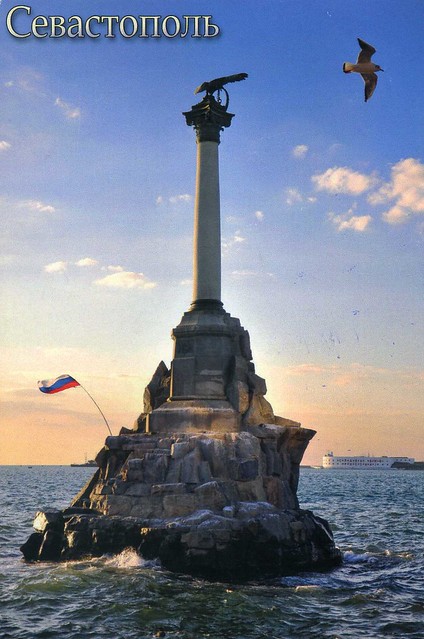
Sevastopol, Crimea

This is my first postcard received from Crimea since Russia occupied the area, so the stamps are Russian. I always thought Russian Post was really slow, but this arrived in 13 days, which is pretty standard in my experience for mail from Ukraine. I like the dreamy feel of this picture. ...and again wish I lived a bit closer to the sea. :P

 
UA-1265549
 
Sevastopol is a city located in the southwestern region of the Crimean Peninsula on the Black Sea. The city is currently a subject of territorial dispute, as a result of annexation of Crimea, between Ukraine, which considers Sevastopol as a city with special status, and Russia, which itself considers it a federal city within the Crimean Federal District.

Sevastopol has a population of 342,451, concentrated mostly near the Bay of Sevastopol and surrounding areas. The location and navigability of the city's harbours have made Sevastopol a strategically important port and naval base throughout history. The city has been a home to the Russian Black Sea Fleet, which is why it was considered as a separate city in Crimea of significant military importance.

Although relatively small at 864 square kilometres, Sevastopol's unique naval and maritime features provide the basis for a robust economy. The city enjoys mild winters and moderate warm summers; characteristics that help make it a popular seaside resort and tourist destination, mainly for visitors from the former Soviet republics. The city is also an important centre for marine biology; in particular, dolphins have been studied and trained in the city since the end of World War II.

This postcard shows the Monument to the ships scuttled during the siege of Sevastopol during the Crimean War by Amandus Adamson.

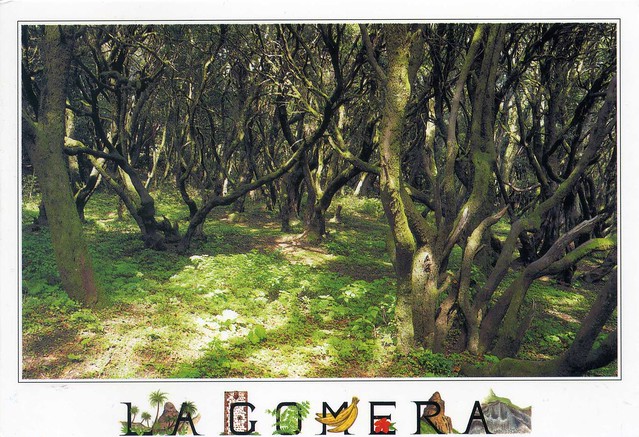
Garajonay National Park, Spain

I'd been looking for a postcard of Garajonay National Park for quite a while, and even swapped for one a while ago but never received that postcard. I was therefore really happy when this swap with Patricia worked out well.


Garajonay National Park is located in the center and north of the island of La Gomera, one of the Canary Islands, Spain. It was declared a national park in 1981 and a World Heritage Site by UNESCO in 1986. It occupies 40 km2 and it extends into each of the six municipalities on the island.

The park is named after the rock formation of Garajonay, the highest point on the island at 1,487 m. It also includes a small plateau whose altitude is 790-1,400 m above sea level.

The park provides the best example of Canarian laurisilva, a humid subtropical forest that in the Tertiary covered almost all of Southern Europe. It is also found on the Azores and the Madeira Islands. Laurus azorica, known as Azores laurel, or by the Portuguese names louro, loureiro, louro-da-terra, and louro-de-cheiro, can be found in the park, as well as Laurus novocanariensis, known as Canary laurel. Although named as a single type of forest, the national park englobes several varieties of forests. Most humid and protected valleys oriented to the North have the richest and most complex forests. It is known as valley laurisilva, a true subtropical rainforest where the largest laurel trees can be found. At higher altitudes, with less protection from wind and sun, the forest loses some of its more delicate species. Here it is called slope laurisilva (laurisilva de ladera). At the south the forest is mainly a mix of beech and heather, species adapted to the less humid atmosphere.

Other attractions of the national park are the massive rocks that are found along the island. These are former volcanoes whose shapes have been carved by erosion. Some, like the "Fortaleza" (fortress in Spanish) were considered sacred by the native islanders, as well as ideal refuges when attacked. The park is crossed by a large network of 18 footpaths, trekking being one of the main tourist activities in the island.

Many of the species of flora and fauna are endemic to the Macaronesian islands, the Canary Islands or La Gomera, and the Garajonay forest harbors a rich biota of understory plants, invertebrates, and birds and bats, including a large number of endemic species.

Greetings from Germany

Today's 'Greetings from' postcard comes from Germany. ...with a super cute stamp! :) Thank you, Claudia!


Claudia asked me what I thought about the hype about these postcards... Um. I do think it's got a bit ridiculous, but I feel like a right hypocrite saying that as I try to collect the whole series, too. :P I can also sort of understand why a lot of people (me including) are a bit picky when swapping these, because if you swapped with everyone who asked it would get VERY expensive. There's no way I could afford that.

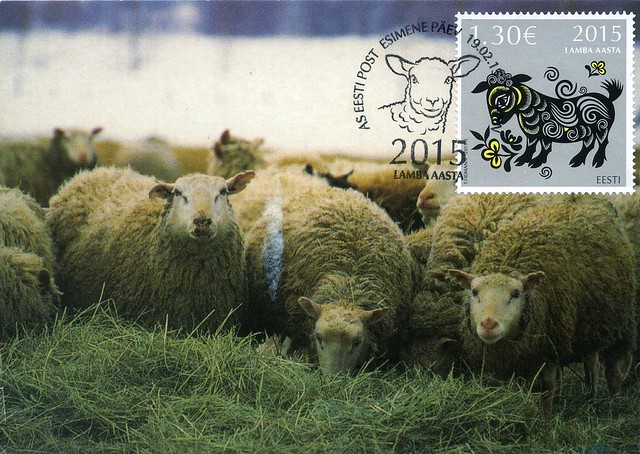
Year of the Sheep, Estonia

An unofficial Year of the Sheep maxicard from Estonia :) I wish you could make your own maxicards here in England, too, but I have no idea how you could get the special cancellations.


The cancellation is so cute, and I really like Estonian lunar year stamps. It's a little scary how expensive stamps are over there, though - it's more expensive than in Finland, and I bet wages aren't as high in Estonia. Stamp prices seem to be going up everywhere, though. Over here it now costs £1 to send a postcard, something I'm definitely NOT happy about. I'm pretty sure that when I moved here in 2008, international stamps were just over 50p. It's ridiculous how much the price has increased in seven years!

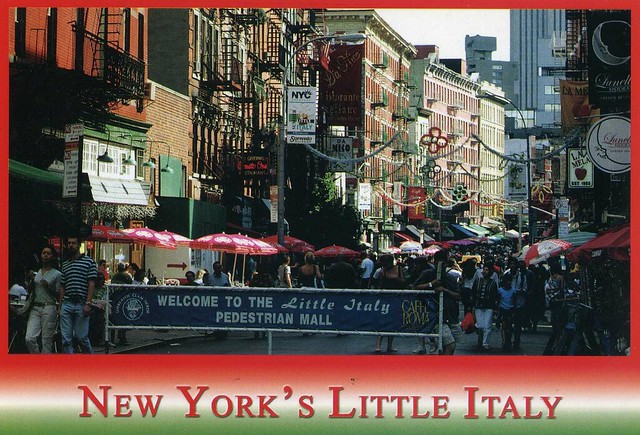
New York's Little Italy, USA

I got some New York postcards from Wanda a few years ago. This is one of them. I really like street views like this!


Little Italy is a neighborhood in lower Manhattan, New York City, once known for its large population of Italians. Today the neighborhood consists of only a few Italian stores and restaurants. It is bounded on the west by Tribeca and Soho, on the south by Chinatown, on the east by the Bowery and Lower East Side, and on the north by Nolita.

 Little Italy on Mulberry Street used to extend as far south as Worth Street, as far north as Kenmare Street, as far west as Lafayette Street, and as far east as Bowery. It is now only three blocks on Mulberry Street.

As of the 2000 U.S. Census, 1,211 residents claiming Italian ancestry lived in three census tracts that make up Little Italy. Those residents comprise 8.25% of the population in the community, which is similar to the proportion of those of Italian ancestry throughout New York City.

Wednesday, 8 April 2015

Churches of Chiloé, Chile

I swear this will be the last post for today. :P My Chilean Unesco collection is now *almost* complete, thanks to Daniela.


 In the Chiloé archipelago off the coast of Chile are about 70 churches built within the framework of a “Circular Mission” introduced by the Jesuits in the 17th century and continued by the Franciscans in the 18th and 19th centuries. The most exceptional illustrations of this unique form of wooden ecclesiastical architecture (the so-called Chilota School of architecture) are the churches of Achao, Quinchao, Castro, Rilán, Nercón, Aldachildo, Ichuac, Detif, Vilupulli, Chonchi, Tenaún, Colo, San Juan, Dalcahue, Chellín and Caguach. These sixteen churches are outstanding examples of the successful fusion of European and indigenous cultural traditions. The abilities of the people of Chiloé as builders achieved its highest expression in these wooden churches, where farmers, fishermen and sailors exhibited great expertise in the handling of the most abundant material in this environment, wood. Along with the churches, the mestizo culture resulting from Jesuit missionary activities has survived to the present day.

This isolated archipelago was colonized by the Spanish in the mid 16th century. The Jesuits, who arrived in 1608, used a circulating missionsystem in their evangelization of the area: religious groups made annual tours around the archipelago, staying for a few days at locations where churches were erected jointly with the communities of believers. The rest of the year a specially trained layperson attended the spiritual needs of the inhabitants. The construction techniques and architecture of the churches of Chiloé are specific to this locale: European experience was adapted and reformulated, giving rise to a vernacular tradition, supported by a great quantity and variety of testimonies which are still in use. Along with the culture of the archipelago, these churches are the result of a rich and extensive cross-cultural dialogue and interaction.

Taxco, Mexico

A nice view from Mexico, received from a swap last year. I would really like to visit Mexico one day, not the least because of the food. :P


Taxco de Alarcón (usually referred to as simply “Taxco”) is a small city and administrative center of a municipality of the same name (Taxco de Alarcón) located in the Mexican state of Guerrero. The name Taxco is most likely derived from the Nahuatl word tlacheco, which means “place of the ballgame.” However, one interpretation has the name coming from the word tatzco which means “where the father of the water is,” due to the high waterfall near the town center on Atatzin Mountain. “De Alarcón” is in honor of writer Juan Ruiz de Alarcón who was a native of the town. Like many municipalities in central Mexico, the municipality’s coat-of-arms is an Aztec glyph. This glyph is in the shape of a Mesoamerican ballcourt with rings, players and skulls, derived from the most likely source of Taxco’s name.

The city is heavily associated with silver, both with the mining of it and other metals and for the crafting of it into jewelry, silverware and other items. This reputation, along with the city’s picturesque homes and surrounding landscapes have made tourism the main economic activity as the only large-scale mining operation here is coming to a close.

Taxco is located in the north-central part of the state, 36 kilometres from the city of Iguala, 135 km from the state capital of Chilpancingo and 170 km southwest of Mexico City. The city was named one of Mexico’s “Pueblos Mágicos” (Magical Towns) due to the quality of the silverwork, the colonial constructions and the surrounding scenery.

Padaung Family, Inle Lake, Myanmar

This is the second postcard I received from a swap a few years ago


The Kayan are a subgroup of the Red Karen (Karenni) people, a Tibeto-Burman ethnic minority of Burma (Myanmar). The Kayan consists of the following groups: Kayan Lahwi (also called Padaung), Kayan Ka Khaung (Gekho), Kayan Lahta, Kayan Ka Ngan. Kayan Gebar, Kayan Kakhi and, sometimes, Bwe people (Kayaw).

Padaung (Yan Pa Doung) is a Shan term for the Kayan Lahwi (the group whose women wear the brass neck coils). The Kayan residents in Mae Hong Son Province in Northern Thailand refer to themselves as Kayan and object to being called Padaung. In The Hardy Padaungs (1967) Khin Maung Nyunt, one of the first authors to use the term "Kayan", says that the Padaung prefer to be called Kayan. On the other hand, Pascal Khoo Thwe calls his people Padaung in his 2002 memoir, From the Land of Green Ghosts: A Burmese Odyssey.

In the late 1980s and early 1990s due to conflict with the military regime in Burma, many Kayan tribes fled to the Thai border area. Among the refugee camps set up there was a Long Neck section, which became a tourist site, self-sufficient on tourist revenue and not needing financial assistance.

According to U Aung Roe (1993:21ss) Kayan number about 40,000 in Shan State (around the Pekon Township area) and 20,000 in Kayah State (around Demawso and Loikaw). A 2004 estimate puts the population at approximately 130,000. About 600 Kayan reside in the three villages open to tourists in Mae Hong Son, or in the Ban Mai Nai Soi refugee camp.

Andorra

A lovely postcard from Andorra I received a couple of years ago. ...and still one of my only postcards from Andorra as well.


I have no idea what the text here says... and I've been too lazy to put it into Google translate to possibly get a rough idea. :P I tried googling Lucile Imbert as well but didn't really have any luck; all the links I got seemed to be for regular people's Facebook pages. I thought this was supposed to be a quote from someone well-known..?!

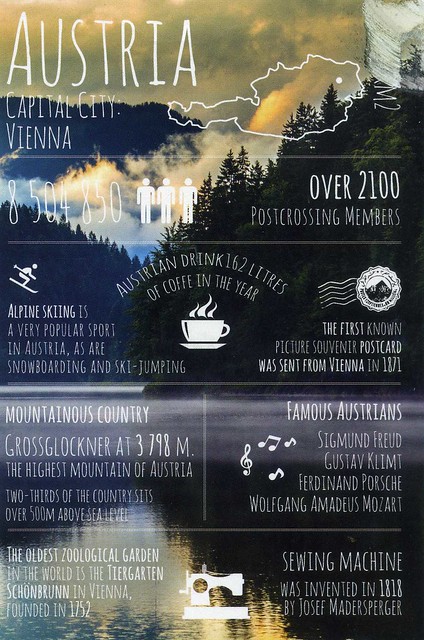
Greetings from Austria

Another 'Greetings from' postcard I ended up receiving two copies of. :P One is from a Facebook swap and the other from the Vacation RR on the Postcrossing forum.


I hadn't realised Austrians drank that much coffee! I do know Finns drink a lot of it as well, and I'm a weird exception who doesn't like the stuff at all. Well, I like coffee-flavour ice cream, cakes etc, I just can't stand the taste of the actual drink.

 ...and the bit about the first ever picture postcard here is pretty neat as well. :)


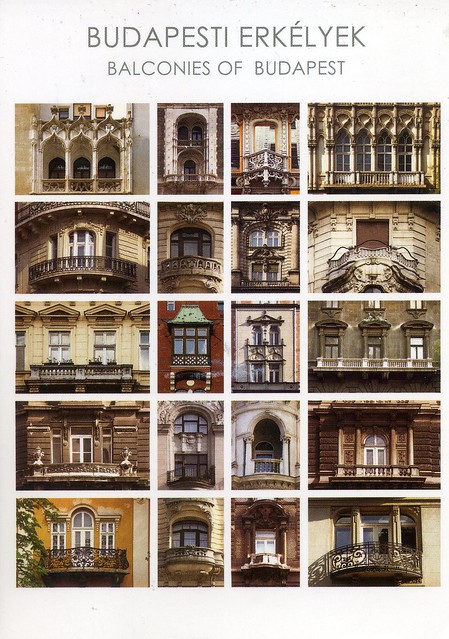
Balconies of Budapest, Hungary

A few more cards for today. :D This is an official I received last year.

 
HU-72316

Such pretty balconies! I love postcards showing little details like this, and this is one of the cases where I don't mind a multiview card.