Thursday, 6 October 2011

Transylvania, Romania

One more card for today, a very nice official I received from Romania this summer.


RO-28622


Transylvania is a historical region in the central part of Romania. Bounded on the east and south by the Carpathian mountain range, historical Transylvania extended in the west to the Apuseni Mountains; however, the term sometimes encompasses not only Transylvania proper, but also the historical regions of Crişana, Maramureş, and Romanian part of Banat.

Transylvania is often associated with Dracula (Bram Stoker's novel and its film adaptations, and Vlad the Impaler), and the horror genre in general, while the region is also known for the scenic beauty of its Carpathian landscape and its rich history.

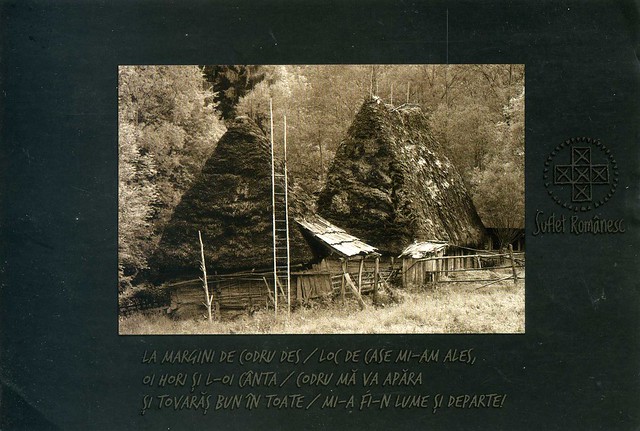
The houses on this card are traditional houses that can be found in Carpathian Mountains. The poem, then, is called 'Soapte Din Transilvania' ('Whispers of Transylvania'). There was a helpful English translation on the back of the card:

At the edge of that dark forest
I chose my house to build
I dance and sing to praise the best
of my companions, my truthful shield
here and far away.


The stamp on the left is from a set of 7 stamps issued in 2005, depicting Romanian Pottery. The stamp on the right is from a set of 4 stamps issued in 2007, showing Romanian Ceramics.

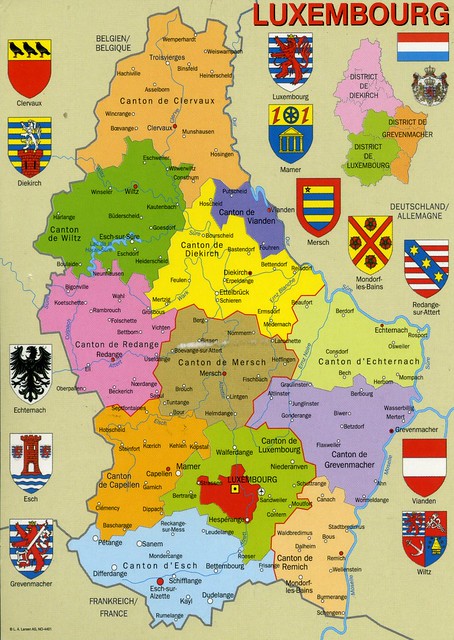
map of Luxembourg

Another older card, this one is an official postcrossing card I received back in 2008. I don't have too many postcards from Luxembourg...


LU-2467


Luxembourg is a landlocked country in western Europe, bordered by Belgium, France, and Germany. It has two principal regions: the Oesling in the North as part of the Ardennes massif, and the Gutland ("good country") in the south. Luxembourg has a population of over half a million people in an area of approximately 2,586 square kilometres. A representative democracy with a constitutional monarch, it is ruled by a grand duke. It is now the world's only remaining sovereign grand duchy. The country has a highly developed economy, with the world's highest GDP (nominal) per capita according to the IMF. Its historic and strategic importance dates back to its founding as a Roman era fortress site and Frankish count's castle site in the Early Middle Ages. It was an important bastion along the Spanish Road when Spain was the principal European power influencing the whole western hemisphere and beyond in the 16th–17th centuries.

Luxembourg is a member of the European Union, NATO, OECD, the United Nations, Benelux, and the Western European Union, reflecting the political consensus in favour of economic, political, and military integration. The city of Luxembourg, the capital and largest city, is the seat of several institutions and agencies of the European Union.

Luxembourg culture is a mix of Romance Europe and Germanic Europe, borrowing customs from each of the distinct traditions. Luxembourg is a trilingual country; German, French and Luxembourgish are official languages. Although a secular state, Luxembourg is predominantly Roman Catholic.


The stamp on the left is from a set of 6 stamps issued in 2001, depicting different Euro coins. The stamp on the right was issued in 2008 in a set of 2 stamps showing children's paintings, with the theme 'Greetings from Luxembourg'.

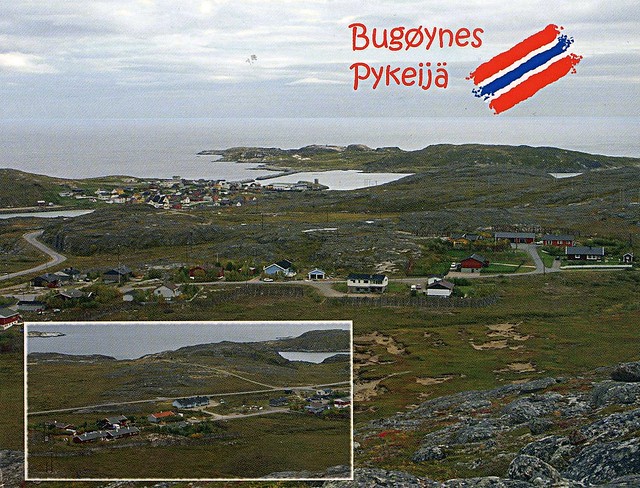
Bugøynes, Norway

I thought I'd throw in an older card again. This one is from my parents from their trip to northern Norway about two years ago.


Bugøynes (Pykeijä in Finnish) is a fishing community in the very most northeastern tip of Norway, in the municipality of Sør-Varanger in the province of Finnmark, situated by the Varanger Fjord which is a vast bay off the Barents Sea (a part of the Arctic Ocean), near the border with Russia. The village is situated some 500 km north of the Arctic Circle, with nearly 230 inhabitants.

Before the road was built to Bugøynes in 1962, the main link between Bugøynes and the rest of the world was by sea. The most-visited town in those days was Vadsø, on the opposite side of the Varanger Fjord. Although Kirkenes, on the south side of the fjord, was the local administrative centre for Bugøynes, it did not become the centre for shopping until people could reach it by car.

Now most trade in this part of Finnmark takes place in Kirkenes. Workplaces in Bugøynes include fishing, salmon and other fish processing, the processing of reindeer meat and game, as well as slipway and machine workshops.

I seem to remember my parents mentioning visiting a fishing boat or similar where the catch included HUGE crabs - one of them weighed more than 9 kg!


The stamp on the right is from a set of 2 stamps issued in 2009, under the theme 'Norwegian Year of Cultural Heritage'. The stamp here shows a radio. The smaller stamp on the left is from a set of 3 definitives issued in 2001.

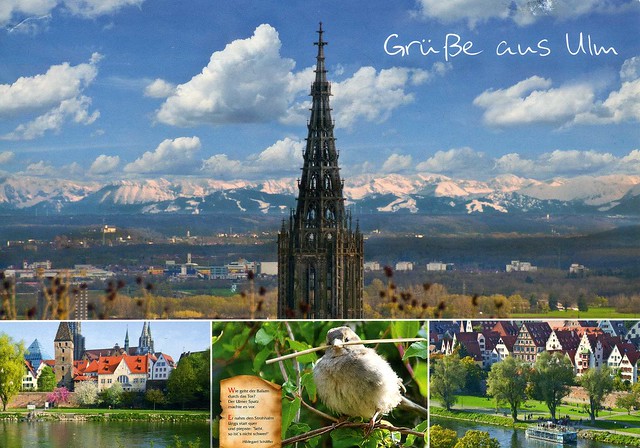
Ulm, Germany

I'm not usually too fond of multiviews but this one is a really nice exception and I really, really like this card! I won it in a lottery on the Postcrossing forum a while back. (Speaking of lotteries, I've been lucky enough to win a couple recently so I've been thinking of having my own as well. I've got an idea in mind and if everything goes as planned, I should be able to put it up next weekend. Keep an eye on the lottery section of the forum if you're interested!)


Ulm is a city in the federal German state of Baden-Württemberg, situated on the River Danube. The city, whose population is estimated at 120,000 (2006), forms an urban district of its own and is the administrative seat of the Alb-Donau district. Ulm, founded around 850, is rich in history and traditions as a former Free Imperial City. Today, it is an economic centre due to its varied industries, and it is the seat of a university (University of Ulm, founded in 1967). Internationally, Ulm is primarily known for having the church with the tallest steeple in the world, the Gothic minster (Ulm Minster, German: Ulmer Münster) and as the birthplace of Albert Einstein.


The stamp was issued earlier this year and shows the old town of Regensburg, which is a Unesco site.

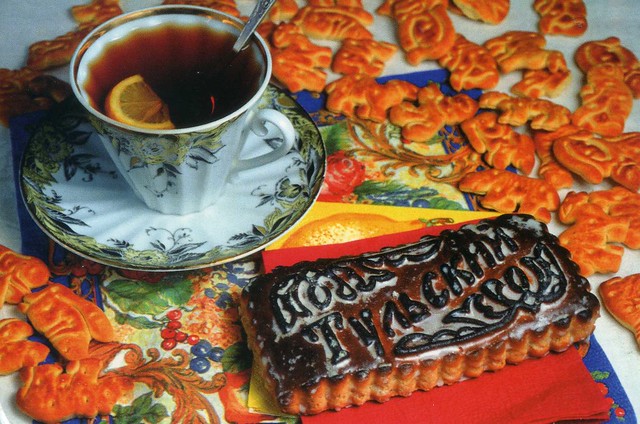
Russian cuisine: Tula pryanik and tea

One good thing about autumn and cold days is that they're a perfect excuse for staying at home and drinking lots of tea (not that you need an excuse to drink tea - I drink it all the time :P). This postcard reminds me of such cosy days in. :)


I wonder if drinking black tea with a slice of lemon is a particularly Russian thing to do? I remember when I had just started university in Finland and for about a month I lived in a flat where I shared the kitchen with one more person. She was a lovely Russian-Estonian girl who introduced me to this way of drinking tea. I should try this again, I seem to remember it was really tasty. Mmm...!

Pryanik, then, are traditional gingerbread. Tula pryanik is a type of printed gingerbread from the city of Tula, the most famous kind of Russian gingerbreads. Usually the Tula gingerbread look like a rectangular tile or a flat figure. Modern Tula gingerbreads usually contain jam or condensed milk, while in the old times they were made with honey. Gingerbreads are known in Tula since 17th century. The first mention of the Tula gingerbread is in Tula сensus book of 1685.

I don't think I've ever tried pryaniki.. I'd love to, though, it looks and sounds really delicious! I wonder if it's anything like the Polish gingerbread, Toruń (which are sooo yummy!)..??


Russia is definitely one of my favourite countries when it comes to stamps. Just look at these beauties! The stamp on the right is a Europa stamp from 2005, that year's theme being gastronomy. The small stamp underneath is a definite from 2008 in a set of 15 stamps, this one representing a Fox. The flower stamp in the middle is from a set of 5 stamps issued in 2001, depicting tulips (I hadn't realised the flower on it is a tulip! ooops...), and the small stamp next to it is from a set of 12 definitives issued in 2009, depicting Russian Kremlins, this one here showing the Novgorod Kremlin. The round stamp below, then, is from a set of 5 stamps issued in 2003, depicting Fruits.

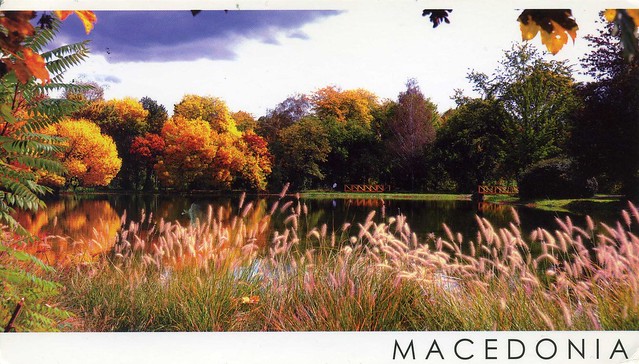
City Park, Skopje, Macedonia

Autumn's here again. *sigh* I'm not too excited, even if I do like the colourful leaves in trees. It's just that it's also a lot colder again and I don't like having to freeze all the time. We've had a pretty weird autumn here so far, though - last week it was super warm, some days were actually warmer than in the Caribbean I think, but then this weekend it might snow! :( Anyway, with autumn here again at least it's more appropriate to post about this lovely card here - it didn't seem right earlier this year. :p Dear Ana sent me this beautiful card earlier this year.


This is the City Park in Skopje. Ana tells me it is one of the most frequented destinations in Skopje during nice sunny weekends in the summer, I wonder how popular it is in autumn? It certainly looks lovely! ..and reminds me a bit of West Park, my favourite park in Wolverhampton. It's such a lovely oasis amongst all the houses and urban areas, a bit of nature in this area which otherwise isn't exactly the prettiest place in England. I should visit there again soon, to relax a bit and to take photos again. ;)


The adorable cat stamp was issued in 2007 and the Darwin stamp in 2009. I'm too lazy to check but wasn't 2009 a special year when it comes to Darwin, I mean I remember a set of Darwin stamps being issued in the UK then as well?!

Sunday, 25 September 2011

Pitcairn Island

..and now something quite different: Pitcairn Island! Unfortunately the card was not sent directly from Pitcairn Island, but that would just be too much luck as receiving a written and stamped postcard directly from there is extremely difficult. I'm not surprised when there are so few people living there, and travelling there is really difficult and it's not easy to get a permission to travel there (you need an approval of perfect health, amongst other requirements). Thanks a million for the swap, Kim!


The Pitcairn Islands form a group of four volcanic islands in the southern Pacific Ocean. The islands are a British Overseas Territory and overseas territory of the European Union in the Pacific. The four islands – named Pitcairn, Henderson, Ducie, and Oeno – are spread over several hundred miles of ocean and have a total land area of about 47 km2. Only Pitcairn, the second largest and measuring about 3.2 km across, is inhabited.

The islands are best known as home of the descendants of the Bounty mutineers and the Tahitians (or Polynesians) who accompanied them, an event retold in numerous books and films. This history is still apparent in the surnames of many of the islanders. With only about 50 inhabitants (from four families as of 2010: Christian, Warren, Young, and Brown), Pitcairn is the least populous jurisdiction in the world (although it is not a sovereign nation). The United Nations Committee on Decolonisation includes the Pitcairn Islands on the United Nations list of Non-Self-Governing Territories.


The card was mailed from Taiwan, and the stamp is from a miniature sheet issued in 2008 to commemorate the Year of the Ox.

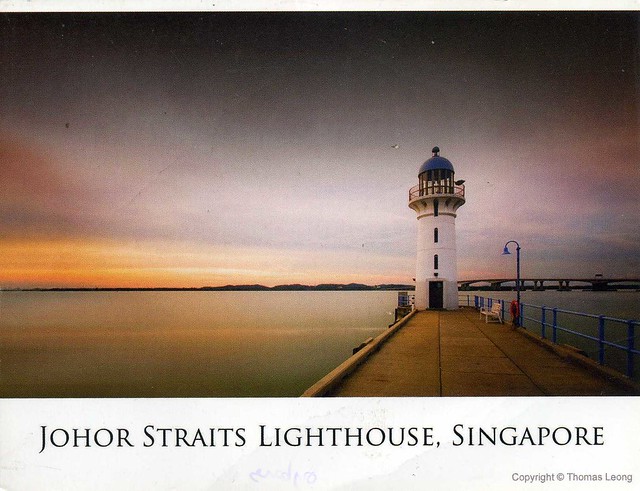
Johor Straits Lighthouse, Singapore

I think this is my first lighthouse postcard from Singapore. It's so pretty, too, I really like the colours here.


Johor Strait Lighthouse is situated in the west of Singapore, facing the straits of Johor and opposite the Johor state of Malaysia. There's a wee bit of info here towards the end of the page, if I got it right it seems like this lighthouse is still active and in use.


I wish I received more postcards from Singapore, their stamps are so pretty! The ones on this card are no exception. The one on the left is from a set of 2 flower definitives issued in 2009, and the stamp on the right is from a set of 4 butterfly stamps issued in 2010, the one here showing the Common Birdwing.

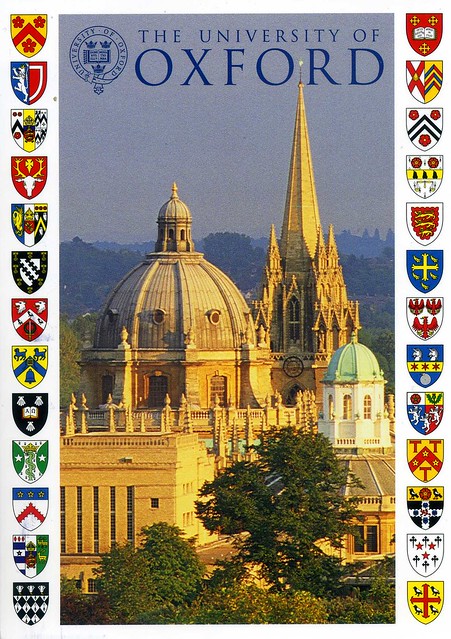
The University of Oxford, England

Another historical town, this time in England... My Russian postcard pal Katya sent this to me on her holiday in England this summer.


The University of Oxford is the second oldest surviving university in the world and the oldest in the English-speaking world. Although the exact date of its foundation remains unclear, there is evidence of teaching there as far back as the 11th century. The University grew rapidly from 1167 when Henry II banned English students from attending the University of Paris.

After disputes between students and Oxford townsfolk in 1209, some academics fled north-east to Cambridge, where they established what became the University of Cambridge. The two ancient English universities have many common features and are often jointly referred to as Oxbridge. In addition to their cultural and practical associations, as a historic part of British society, they have a long history of rivalry with each other.

There are thirty-eight colleges of the University of Oxford and six Permanent Private Halls, each controlling its membership and with its own internal structure and activities.[27] All resident students, and most academic staff, must be members both of a college or hall, and of the university.

League tables consistently list Oxford as one of the UK's best universities; the university regularly contends with Cambridge for first place in the tables. Oxford consistently ranks in the world's top 10. For more than a century, it has served as the home of the Rhodes Scholarship, which brings students from a number of countries to study at Oxford as postgraduates or for a second bachelor's degree.

I've been to Oxford a couple of times, and found the city really beautiful, like a huge open air museum. The university and its student seem like something out of the real world, though. I think it might be a great deal due to so many students being from public (which actually means 'private' in this country :p) schools. It doesn't seem like there's much social mix in the University of Oxford.. I was just reading some statistics about recent admissions, and it seems like over 40% of those gaining a place studied in an independent school (while independent schools only educate about 7% of the total UK school population...), and most pupils who are accepted from state schools come from 'elite' grammar and selective schools, rather than comprehensives. I think that says something about the level of education in some state schools in this country... :/


I find these postage labels a little confusing.. In some places you just get these boring grey ones, while in some others you get ones with pictures of birds that are much nicer. ...although only a limited number of post offices actually have these machines, and none of the ones in Wolverhampton do. I wish at least the main post office there did because it would be more convenient to use that to post a letter rather than having to queue for ages, especially when you won't get nice stamps on the letter anyway even if you do queue to the counter. :(
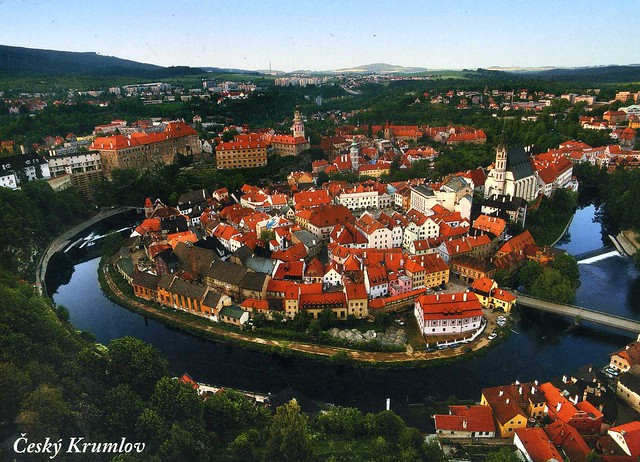
Český Krumlov, Czech Republic

I set my official Postcrossing account inactive for a couple of months this summer. I wasn't sure if I'd have much time to commit for it, and I also figured that would stop cards arriving during the honeymoon in Barcelona and people wouldn't have to wait extra days for their cards to be registered. Anyway, I set it back to active soon after getting back home from Barcelona, and have received LOTS of cards since then. There have been some pretty weird incidents, like receiving some consecutive IDs from same countries - in one occasion I received THREE of these from Bosnia & Herzegovina, and the cards were all the same because the senders (brother & sister) didn't have any other cards available. :D The card below is also one of these consecutive IDs; I received two cards from the same person, from his two accounts. I don't mind, though, as the cards are both beautiful.


CZ-133026


Český Krumlov is a small city in the South Bohemian Region of the Czech Republic, best known for the fine architecture and art of the historic old town and Český Krumlov Castle. Old Český Krumlov is a UNESCO World Heritage Site and was given this status along with the historic Prague castle district.

The city is named Český Krumlov ("Bohemian Krumlov") to differentiate it from Moravský Krumlov ("Moravian Krumlov") in the southeast of the country.

Construction of the town and castle began in the late 13th century at a ford in the Vltava River, which was important in trade routes in Bohemia. In 1302 the town and castle were owned by the House of Rosenberg. Emperor Rudolf II bought Krumlov in 1602 and gave it to his natural son Julius d’Austria. Emperor Ferdinand II gave Krumlov to the House of Eggenberg. From 1719 until 1945 the castle belonged to the House of Schwarzenberg. Most of the architecture of the old town and castle dates from the 14th through 17th centuries; the town's structures are mostly in Gothic, Renaissance, and Baroque styles. The core of the old town is within a horseshoe bend of the river, with the old Latrán neighborhood and castle on the other side of the Vltava.


The stamp was issued earlier this year and shows W.A. Mozart.

Thursday, 15 September 2011

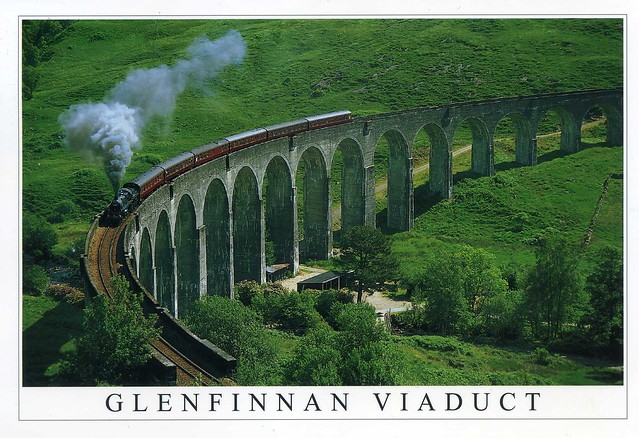
Glenfinnan Viaduct, Scotland

The last month and a half have been really hectic and so much has happened (not all very good, either.. :/) so I'm behind with a lot of things and not just this blog. I thought I'd post one more card today just to try and get back to the habit of updating this blog and maybe do that a bit more often again.. This one is holiday-themed as well - it's from Matt's older sister Rachel, sent during her holiday to Scotland last month. She spent a few days in Edinburgh and a while in the Highlands as well, which I'm perhaps even more jealous of. I'd love to visit the Scottish Highlands one day, too, and I certainly wouldn't mind travelling on 'Hogwarts Express'!


Glenfinnan Viaduct is a railway viaduct on the West Highland Line in Glenfinnan, Lochaber, Highland, Scotland. It was built between 1897 and 1901. Located at the top of Loch Shiel in the West Highlands of Scotland, the viaduct overlooks the Glenfinnan Monument and the waters of Loch Shiel.

The West Highland Line connects Fort William and Mallaig, and was a crucial vein for the local fishing industry and the highlands economy in general, which suffered enormously after the Highland Clearances of the 1800s.

The line is used by passenger trains operated by ScotRail between Glasgow Queen Street and Mallaig, usually diesel multiple units. Additionally in the summer the heritage Jacobite steam train operates along the line. It is a popular tourist event in the area, and the viaduct is one of the major attractions of the line. It is also the 'Harry Potter Express' - as Rachel put it :) She actually saw it pass by one of the B&B's she was staying in!


One of the most common stamps I see on my mail... It looks like this one's not very new, though, as it doesn't have any of the more recent security features on it.

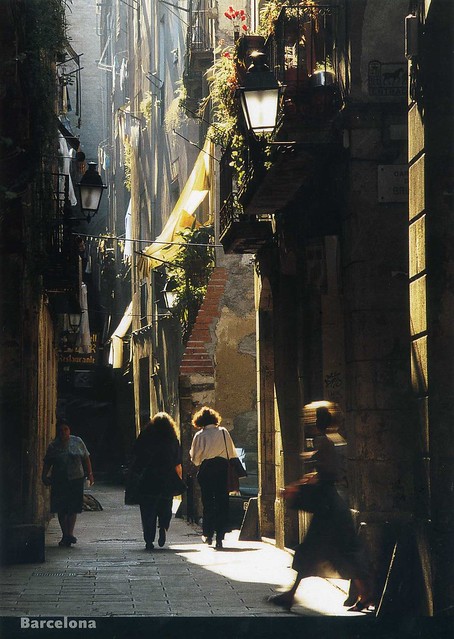
Barcelona, Spain

I've been back from Barcelona for a little over a week now. It was such an amazing week, I had so much fun and wish I could've stayed longer (although I couldn't really have afforded it, it was so expensive over there!). Barcelona is such a beautiful city, there's tons to see, lots of whimsical architecture, palm trees everywhere (I was getting rather obsessed about these for some reason :p), seaside, lots of sunshine and warm/hot weather.. It was pretty depressing to come back to the rain and cold of England. ..and to think that me and Matt probably won't be able to afford another holiday again in a few years... *sigh*


This is one of the many postcards I bought for myself. It says 'Ciutat Vella' on the back of the card - Ciutat Vella is the old part of the city, comprising of Barri Gòtic, El Raval, La Ribera, Sant Pere, Santa Caterina and Barceloneta. The picture on this card looks like it could be from Barri Gòtic, which was also probably my favourite area of the city we visited. I loved all the narrow streets and alleys, old historical buildings, all the little details, laundry hanging outside and other signs of "ordinary life", tiny shops and the atmosphere in general, even if it was packed with tourists so it's probably not all that "authentic" in the end. There were lots of amazing little ice cream and frozen yoghurt shops in Barri Gòtic, too, I know I'm going to miss them. My favourite was Gelaaati!, I liked it enough to go there twice and wouldn't have minded visiting it more.. :p I know the place isn't exactly Spanish but on this occasion I didn't mind too much. Otherwise it was really depressing to find all the Spanish restaurants to be so expensive and half the time me and Matt actually ended up eating in places like Burger King or KFC because we couldn't afford Spanish food all the time (we were lucky in that the breakfast in our hotel was so good and we didn't need to eat out so much thanks to that. They even had churros with hot chocolate! ..and manchego cheese which I loved). That was one of the only things I didn't like about the place and found really upsetting.

The hotel we stayed in wasn't very centrally located, but it was within walking distance from Plaça d'Espanya, and one evening we walked over to see the Magic Fountain of Montjuïc. It really was amazing, such a cool thing to see! Some of the music choices were a bit weird - music from 'Lord of the Rings' and 'Gladiator', for instance. They did play 'Barcelona' by Freddie Mercury and Montserrat Caballé, though, which made me happy.

Did I say I want to go back?!?