Thursday, 8 March 2012

schoolgirls, Vietnam

Another postcard with Year of the Dragon stamps! ...although in this case they came as a total surprise - I only knew I'd be receiving this particular postcard, I had no idea what stamps Gloria would be using on it. Vietnamese stamps all seem to be so pretty, to be honest, but I was still super happy to receive this.


I mustn't have been looking properly when I first saw this postcard as I had no idea the women on it were schoolgirls. They seemed a bit older to me somehow..! :O This is such a beautiful postcard anyway, the girls look so happy and the shaded street looks so peaceful and lush.

Belgrade, Serbia

I've been trying to collect Year of the Dragon stamps from different countries this year - it's been a bit easier to arrange swaps as there were actually some Lunar Year stamps issued in the UK this year (the Royal Mail don't normally issue them :(). Serbia is one of the latest additions to my collection, thanks to Ana who kindly offerent to swap with me. ...and she put the stamps on such a beautiful postcard, too!


I love autumn views on postcards which is probably why I like this one so much. :) There's some info on the back of the postcard about this place:

BELGRADE. The residence of Prince Miloš Obrenović in the suburbs of Topčider. It was built from 1831 to 1834 by master architects Janja Mihailović and Nikola Djordjević. The works were supervised by masterbuilder Hadži-Nikola Živković.

Ana also told me that this residence is now a part of the History Museum with an exhibition about the Serbian uprising against the Ottoman rule. Topčider, then, is a forest park and an urban neighborhood of Belgrade. Being close to downtown, it is one of the major locations for relaxation, picnics and fresh air for the citizens of Belgrade.

Minsk, Belarus

This is one of the nicest officials I've received from Belarus - I didn't realise that a part of Minsk was this colourful! This is a view of Troitsky Suburb and Upper town.


BY-253624


Minsk is the capital and largest city in Belarus, situated on the Svislach and Niamiha rivers. Minsk is also a headquarters of the Commonwealth of Independent States (CIS). As the national capital, Minsk has a special administrative status in Belarus and is also the administrative centre of Minsk Region (voblast) and Minsk raion (district). It has a population of 1,836,808 inhabitants (2009).

The earliest references to Minsk date to the 11th century (1067), when it was a provincial city within the principality of Polotsk. In 1242, Minsk became a part of the Grand Duchy of Lithuania, and it received its town privileges in 1499. From 1569, it was a capital of the Minsk Voivodship in the Polish–Lithuanian Commonwealth. It was annexed by Russia in 1793, as a consequence of the Second Partition of Poland. From 1919–1991, Minsk was the capital of the Belorussian Soviet Socialist Republic.

Saturday, 18 February 2012

Mate, Argentina

One more card for today... and such a nice one, too! Dear Jane (who used to live in Peru until recently but is now back in England) saw this in my favourites and very kindly offerent to send me a copy. So sweet of her! Mmmm, I would really like something warming like this right now - I'm freezing in my room :S I'll have to go make myself a nice hot cup of tea after I've finished this post.. ;)


Mate, also known as chimarrão or cimarrón, is a traditional South American infused drink, particularly in Argentina, Uruguay, Paraguay, southern states of Brazil, south of Chile, the Bolivian Chaco, and to some extent, Syria and Lebanon. It is prepared from steeping dried leaves of yerba maté in hot water.

Mate is served with a metal straw from a shared hollow calabash gourd. The straw is called a bombilla in some Latin American countries, a bomba in Portuguese, and a bombija or, more generally, a masassa (type of straw) in Arabic. The straw is traditionally made of silver. Modern, commercially available straws are typically made of nickel silver, called Alpaca; stainless steel, or hollow-stemmed cane. The gourd is known as a mate or a guampa; while in Brazil, it has the specific name of cuia. Even if the water is supplied from a modern thermos, the infusion is traditionally drunk from mates or cuias.

As with other brewed herbs, yerba mate leaves are dried, chopped, and ground into a powdery mixture called yerba. The bombilla acts as both a straw and a sieve. The submerged end is flared, with small holes or slots that allow the brewed liquid in, but block the chunky matter that makes up much of the mixture. A modern bombilla design uses a straight tube with holes, or spring sleeve to act as a sieve.

Mate is traditionally drunk in a particular social setting, such as family gatherings or with friends. The same gourd and straw are used by everyone drinking. Passing this drink around to the people you're with is a symbol of friendship.


Jane sent this postcard from Peru, hence the Peruvian stamp.

Faneuil Hall Marketplace, Boston, USA

I'd had this postcard in my favourites for a while so I was really excited to finally receive a copy in a swap from Precilla. Thank you so much! I really like the colours here.


Faneuil Hall, located near the waterfront and today's Government Center, in Boston, Massachusetts, has been a marketplace and a meeting hall since 1742. It was the site of several speeches by Samuel Adams, James Otis, and others encouraging independence from Great Britain, and is now part of Boston National Historical Park and a well-known stop on the Freedom Trail. It is sometimes referred to as "the Cradle of Liberty".

Faneuil Hall is now part of a larger festival marketplace, Faneuil Hall Marketplace, which includes three long granite buildings called North Market, Quincy Market, and South Market, and which now operates as an indoor/outdoor mall and food eatery. It was designed by Benjamin Thompson and Associates and managed by The Rouse Company; its success in the late 1970s led to the emergence of similar marketplaces in other U.S. cities.

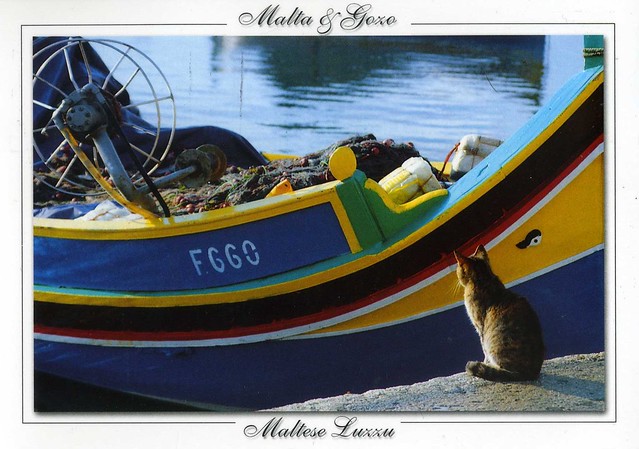
Maltese Luzzu, Malta

Another postcard from somewhere warm... I received this one as an "RAS" from Leena in Malta last summer. She always sends the most beautiful, colourful postcards!


A luzzu is a traditional fishing boat from the Maltese islands. They are brightly painted in shades of yellow, red, green and blue, and the bow is normally pointed with a pair of eyes. These eyes may be the modern survival of an ancient Phoenician custom (also practiced by the ancient Greeks); they are sometimes (and probably inaccurately) referred to as the Eye of Horus or of Osiris.

The luzzu has a double-ended hull. A variant, the kajjik, is similar in appearance, but has a square transom.

The design of the Luzzu, like that of another Maltese boat, the dghajsa, is believed to date back at least to the Phoenician times. The luzzu has survived because it tends to be a sturdy and stable boat even in bad weather. Originally, the luzzu was equipped with sails although nowadays almost all are motorised, with onboard diesel engines being the most common. Some luzzi have been converted to passenger carriers for tourists although the vast majority continue to be used as fishing vessels.

The town of Marsaxlokk is especially famous for the large numbers of luzzu and similar craft operating in its harbor.

The luzzu is one of the symbols of Malta and is featured on the reverse of the older series (1979-89) of Maltese lira coins.

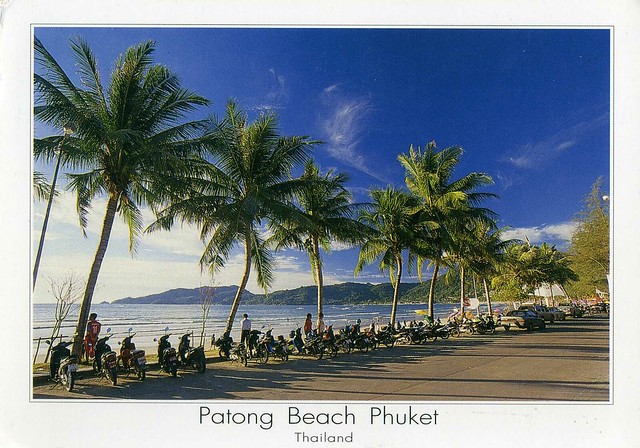
Patong Beach, Phuket, Thailand

My grandma has been visiting Thailand for a few weeks in January/February for a few years now, and this year was no exception. She always sends me postcards from her holidays, too, which is really sweet of her. I have to say I wouldn't mind being somewhere that warm at the moment myself!


Patong Beach refers to the beach and town on Phuket's west coast. It is the main tourist resort in Phuket, and contains an important center of Phuket's nightlife and inexpensive shopping. The beach became popular with Western tourists, especially Europeans, in the late 1980s. Numerous hotels are located there and the area has expanded into a large tourist mecca.

Patong Beach is famous for its nightlife and 3.5-kilometer beach that runs the entire length of Patong’s western side. Nightlife is centered on two main areas Bangla Road and 'Paradise Complex', with Bangla Road being predominantly straight and Paradise Complex gay. Both roads are lined with many bars, discotheques and go go bars.

On December 26, 2004, Patong Beach along with many other areas along the western coast of Phuket and Thailand were struck by a tsunami caused by the 2004 Indian Ocean earthquake. The wave caused a great deal of destruction to the waterfront of the beach and immediately inland and many people were killed. Patong was one of the worst affected areas of Phuket, although the destruction was not as bad as nearby Khao Lak. Patong has largely recovered since the tsunami.

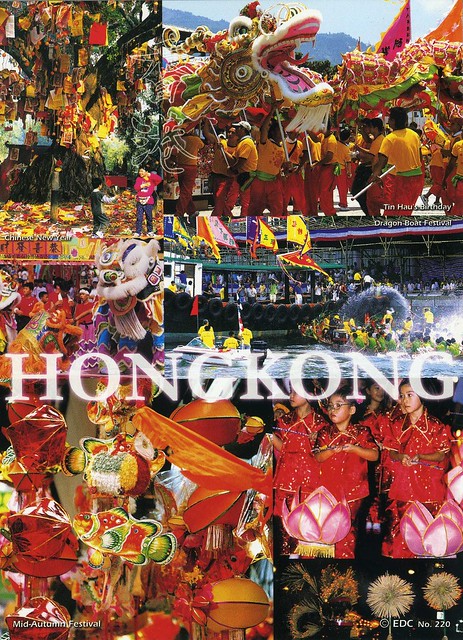
Hong Kong

A few posts back I wrote about how my friend Miranda went for holiday in Hong Kong and Taiwan for around New Year's. This is one of the postcards she brought me from Hong Kong, showing the celebrations of different festivals and other special occasions in Hong Kong.


In case you can't read the descriptions on the scan, the one on top left is for Chinese New Year, the one next to it Tin Hau's Birthday, the one under that Dragon Boat Festival, and the picture on bottom left is from Mid-Autumn Festival.

Aside from Chinese New Year, Mid-Autumn Festival is one that really fascinates me. It is also known as the Moon Festival or Mooncake Festival and is a popular lunar harvest festival celebrated by Chinese and Vietnamese people. A description of the festival first appeared in Rites of Zhou, a written collection of rituals of the Western Zhou Dynasty from 3,000 years ago. The celebration became popular during the early Tang Dynasty. The festival is held on the 15th day of the eighth month in the Chinese calendar, which is in September or early October in the Gregorian calendar, close to the autumnal equinox. The Government of the People's Republic of China listed the festival as an "intangible cultural heritage" in 2006, and it was made a Chinese public holiday in 2008. It is also a Taiwanese public holiday.

Accompanying the celebration, there are additional cultural or regional customs, such as eating mooncakes (round or rectangular pastries, measuring about 10 cm in diameter and 4–5 cm thick. A rich thick filling usually made from red bean or lotus seed paste is surrounded by a relatively thin (2–3 mm) crust and may contain yolks from salted duck eggs), matchmaking, carrying brightly lit lanterns, lighting lanterns on towers, floating sky lanterns...

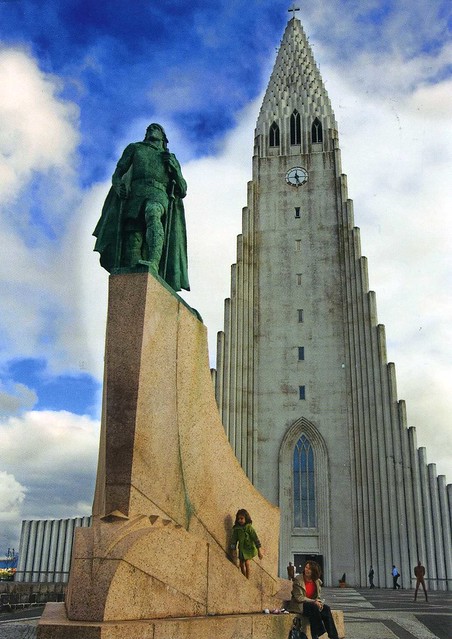
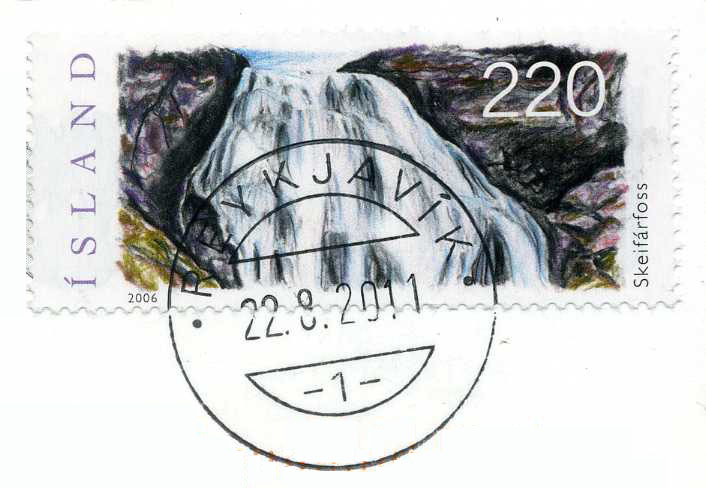
Reykjavik, Iceland

It's been a pretty good day today so far. I woke up to a text from my friend Amy, asking me if I'd like to meet up with her as she was around. ..so we went to Wolverhampton and had yummy hot chocolate and tea in Starbucks. She's such a lovely person, it's always great to meet her. It doesn't happen often enough, though, because she lives in Walsall and then there's daily life in the way. I definitely need to go see her in Walsall at some point, though, and we were talking about possibly having picnics this summer. Mmmmm, that would be nice! She also told me she's going to go to Iceland this May for a few days. I'm so jealous! Iceland is one of those places I've always wanted to visit, it seems so fascinating and distant (but also ridiculously expensive :(). I'm looking forward to seeing Amy's photos! ..and I think I'll have to be cheeky and ask her if she could send me a postcard... hhhmmmm... I don't have too many postcards from Iceland, the most recent one I had is this one from last year that I received through the postcrossing forum.


Here you can see Hallgrímskirkja, a Lutheran (Church of Iceland) parish church in Reykjavík, Iceland. At 74.5 metres, it is the largest church in Iceland and the sixth tallest architectural structure in Iceland. The church is named after the Icelandic poet and clergyman Hallgrímur Pétursson (1614 to 1674), author of the Passion Hymns.

State Architect Guðjón Samúelsson's design of the church was commissioned in 1937. He is said to have designed it to resemble the basalt lava flows of Iceland's landscape. It took 38 years to build the church. Construction work began in 1945 and ended in 1986, the landmark tower being completed long before the church's actual completion. The crypt beneath the choir was consecrated in 1948, the steeple and wings were completed in 1974. The nave was consecrated in 1986. Situated in the centre of Reykjavík, it is one of the city's best-known landmarks and is visible throughout the city. It is similar in style to the expressionist architecture of Grundtvig's Church of Copenhagen, Denmark, completed in 1926.

Saturday, 28 January 2012

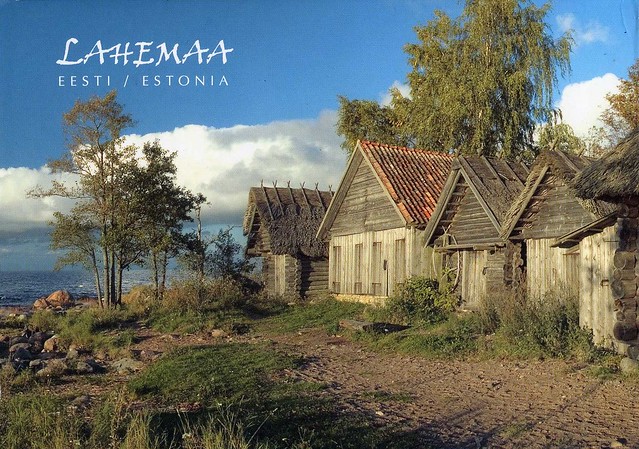
Altja fishing village, Lahemaa, Estonia

I've had this card in my favourites for ages, I'm really excited to finally have it! ...and the silly thing is, the postcard wasn't even the main point of this swap - Heidi was offering the Estonian Year of the Dragon stamp and I was interested in getting one. So yeah, this is a pretty awesome postcard, it even has a first day cancellation!


The card shows some sheds for fishing nets at Altja fishing village in Lääne-Viru County, in northeastern Estonia. Altja is also located in Lahemaa National Park (established in 1971). The park area covers 725 km² (including 250.9 km² of sea). It was the first national park of the former Soviet Union. Given its size it is one of Europe's biggest national parks. Its charter calls for the preservation, research and promotion of North-Estonian landscapes, ecosystems, biodiversity and national heritage.

The name Lahemaa originates from the most thoroughly studied and visited part of the North-Estonian coast, where four large peninsulas (Juminda, Pärispea, Käsmu and Vergi) are separated from each other by four bays (Kolga, Hara, Eru and Käsmu.) Lahemaa translates roughly as "Land of Bays".

Taiwan

My friend Miranda visited her home in Hong Kong again recently, and she also went to Taiwan for a few days. She was kind enough to bring me some postcards from her trip ^_^ I'll probably post one of the postcards from Hong Kong here at some point, meanwhile here's one from Taiwan. I love the colours and the sky in this one.


The National Chiang Kai-shek Memorial Hall is a famous monument, landmark and tourist attractions erected in memory of Generalissimo Chiang Kai-shek, former President of the Republic of China. It is located in Taipei, Republic of China (Taiwan).

The monument, surrounded by a park, stands at the east end of Memorial Hall Square. The structure is framed on the north and south by the National Theater and National Concert Hall. The entire plaza is located within sight of the Presidential Office Building.

Kraków, Poland

Just a small update for today. I'm getting behind with everything again :( I received this postcard from dear Ana earlier this month. Thank you so much for the lovely surprise! Ahhh, I wish I could travel a bit more, too. I certainly wouldn't mind visiting Kraków, it looks really pretty ^_^


Kraków is the second largest and one of the oldest cities in Poland. Situated on the Vistula River in the Lesser Poland region, the city dates back to the 7th century. Kraków has traditionally been one of the leading centres of Polish academic, cultural, and artistic life and is one of Poland's most important economic hubs. It was the capital of Poland from 1038 to 1596; the capital of the Grand Duchy of Kraków from 1846 to 1918; and the capital of Kraków Voivodeship from the 14th century to 1999. It is now the capital of the Lesser Poland Voivodeship.

The city has grown from a Stone Age settlement to Poland's second most important city. It began as a hamlet on Wawel Hill and was already being reported as a busy trading centre of Slavonic Europe in 965. With the establishment of new universities and cultural venues at the emergence of the Second Polish Republic and throughout the 20th century, Kraków reaffirmed its role as a major national academic and artistic centre. The city has a population of approximately 760,000 whereas about 8 million people live within a 100 km radius of its main square.

After the invasion of Poland by Nazi Germany at the start of World War II, Kraków was turned into the capital of Germany's General Government. The Jewish population of the city was moved into a walled zone known as the Kraków Ghetto, from which they were sent to extermination camps such as Auschwitz and the concentration camp at Płaszów.

In 1978, Karol Wojtyła, archbishop of Kraków, was elevated to the papacy as Pope John Paul II – the first Slavic pope ever, and the first non-Italian pope in 455 years. Also that year, UNESCO approved the first ever sites for its new World Heritage List, including the entire Old Town in inscribing Cracow's Historic Centre.